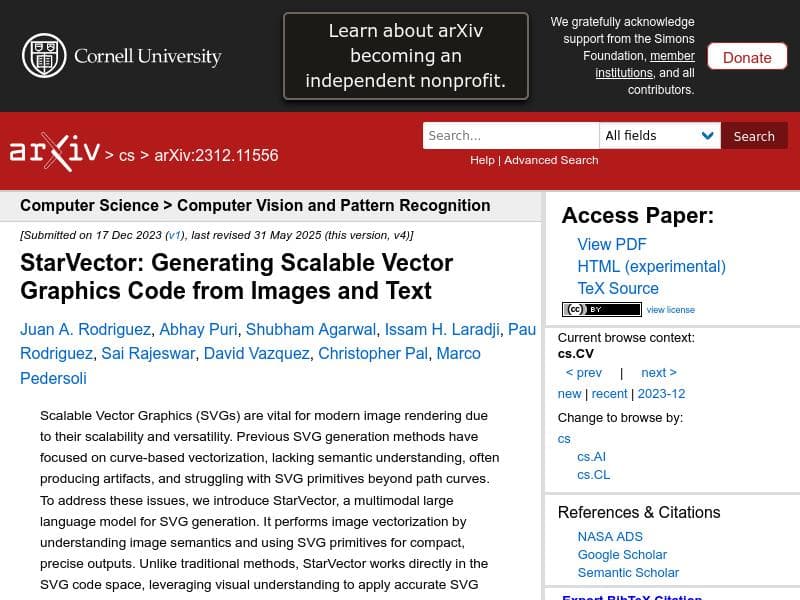
Description
StarVector uniquely combines visual and linguistic AI processing to generate high-quality, editable SVG code from images or text instructions. Ideal for designers and developers, it redefines vectorization as a code generation task, delivering state-of-the-art performance across diverse vector graphic creation needs.
StarVector is an advanced AI tool designed to transform images and textual instructions into high-quality Scalable Vector Graphics (SVG) code through a sophisticated multimodal architecture. At its core, StarVector redefines the traditional vectorization process by framing it as a code generation problem, enabling it to leverage the full expressive power of SVG syntax. This approach allows the tool to produce precise, editable vector graphics that are ideal for a wide range of applications, from graphic design and digital art to technical diagram generation. By combining both visual and linguistic inputs, StarVector offers a versatile solution that bridges the gap between image recognition and language understanding, making vector graphic creation more accessible and efficient than ever before. One of the standout features of StarVector is its multimodal large language model specifically trained for SVG generation. Unlike conventional vectorization tools that rely solely on image processing, StarVector comprehends image semantics deeply, allowing it to interpret complex visual elements and translate them into SVG primitives such as ellipses, polygons, and text elements. This capability ensures that the output is not just a rough approximation but a semantically meaningful and structurally sound SVG code. The model operates directly in the SVG code space, which means it generates clean, human-readable, and editable SVG files rather than just pixel-based outputs or raster-to-vector conversions. This direct code generation is powered by training on the extensive SVG-Stack dataset, which contains over 2 million samples, enabling StarVector to generalize effectively across diverse vectorization tasks. StarVector also introduces the SVG-Bench benchmark, a novel evaluation framework designed to rigorously assess the quality and accuracy of vectorization models. This benchmark helps validate StarVector’s state-of-the-art performance in multiple tasks, including image-to-SVG conversion, text-to-SVG generation, and diagram creation. The ability to handle both image and text inputs makes StarVector uniquely versatile, catering to users who want to generate vector graphics from sketches, photographs, or even descriptive textual prompts. This tool is particularly well-suited for graphic designers, UI/UX professionals, illustrators, and technical writers who require precise vector graphics for their projects. It is also valuable for developers and researchers working on AI-driven design automation or those needing to convert complex diagrams and images into editable vector formats quickly. Given its multimodal capabilities, StarVector can streamline workflows that traditionally involved manual tracing or multiple software tools by automating the vectorization process with high fidelity. StarVector is offered for free, making it accessible to a broad audience including students, hobbyists, and professionals. Its open availability encourages experimentation and integration into various creative and technical pipelines without the barrier of subscription fees or licensing costs. When compared to alternative vectorization tools, StarVector stands out due to its multimodal approach and direct SVG code generation. Many existing tools focus primarily on raster-to-vector conversion without semantic understanding or rely on post-processing to clean up outputs. StarVector’s training on a massive dataset and its benchmark-driven validation ensure superior accuracy and versatility. However, as with any AI-based system, some limitations exist. Complex or highly detailed images may still challenge the model, and the quality of text-to-SVG generation depends on the clarity and specificity of the input instructions. Additionally, while the tool excels in generating SVG code, users unfamiliar with SVG syntax might require some learning to fully leverage the editable outputs. In summary, StarVector is a cutting-edge AI tool that revolutionizes vector graphic creation by combining visual and linguistic processing into a single, powerful multimodal model. Its ability to produce clean, semantically rich SVG code from both images and text makes it an invaluable asset for designers, developers, and researchers seeking efficient and high-quality vectorization solutions.

Description
StarVector uniquely combines visual and linguistic AI processing to generate high-quality, editable SVG code from images or text instructions. Ideal for designers and developers, it redefines vectorization as a code generation task, delivering state-of-the-art performance across diverse vector graphic creation needs.
StarVector is an advanced AI tool designed to transform images and textual instructions into high-quality Scalable Vector Graphics (SVG) code through a sophisticated multimodal architecture. At its core, StarVector redefines the traditional vectorization process by framing it as a code generation problem, enabling it to leverage the full expressive power of SVG syntax. This approach allows the tool to produce precise, editable vector graphics that are ideal for a wide range of applications, from graphic design and digital art to technical diagram generation. By combining both visual and linguistic inputs, StarVector offers a versatile solution that bridges the gap between image recognition and language understanding, making vector graphic creation more accessible and efficient than ever before. One of the standout features of StarVector is its multimodal large language model specifically trained for SVG generation. Unlike conventional vectorization tools that rely solely on image processing, StarVector comprehends image semantics deeply, allowing it to interpret complex visual elements and translate them into SVG primitives such as ellipses, polygons, and text elements. This capability ensures that the output is not just a rough approximation but a semantically meaningful and structurally sound SVG code. The model operates directly in the SVG code space, which means it generates clean, human-readable, and editable SVG files rather than just pixel-based outputs or raster-to-vector conversions. This direct code generation is powered by training on the extensive SVG-Stack dataset, which contains over 2 million samples, enabling StarVector to generalize effectively across diverse vectorization tasks. StarVector also introduces the SVG-Bench benchmark, a novel evaluation framework designed to rigorously assess the quality and accuracy of vectorization models. This benchmark helps validate StarVector’s state-of-the-art performance in multiple tasks, including image-to-SVG conversion, text-to-SVG generation, and diagram creation. The ability to handle both image and text inputs makes StarVector uniquely versatile, catering to users who want to generate vector graphics from sketches, photographs, or even descriptive textual prompts. This tool is particularly well-suited for graphic designers, UI/UX professionals, illustrators, and technical writers who require precise vector graphics for their projects. It is also valuable for developers and researchers working on AI-driven design automation or those needing to convert complex diagrams and images into editable vector formats quickly. Given its multimodal capabilities, StarVector can streamline workflows that traditionally involved manual tracing or multiple software tools by automating the vectorization process with high fidelity. StarVector is offered for free, making it accessible to a broad audience including students, hobbyists, and professionals. Its open availability encourages experimentation and integration into various creative and technical pipelines without the barrier of subscription fees or licensing costs. When compared to alternative vectorization tools, StarVector stands out due to its multimodal approach and direct SVG code generation. Many existing tools focus primarily on raster-to-vector conversion without semantic understanding or rely on post-processing to clean up outputs. StarVector’s training on a massive dataset and its benchmark-driven validation ensure superior accuracy and versatility. However, as with any AI-based system, some limitations exist. Complex or highly detailed images may still challenge the model, and the quality of text-to-SVG generation depends on the clarity and specificity of the input instructions. Additionally, while the tool excels in generating SVG code, users unfamiliar with SVG syntax might require some learning to fully leverage the editable outputs. In summary, StarVector is a cutting-edge AI tool that revolutionizes vector graphic creation by combining visual and linguistic processing into a single, powerful multimodal model. Its ability to produce clean, semantically rich SVG code from both images and text makes it an invaluable asset for designers, developers, and researchers seeking efficient and high-quality vectorization solutions.
Tool Features
- Multimodal large language model for SVG generation
- Understands image semantics for vectorization
- Uses SVG primitives like ellipses, polygons, and text
- Works directly in SVG code space
- Trained on SVG-Stack dataset with 2 million samples
- Generalizes across vectorization tasks
- Introduces SVG-Bench benchmark for evaluation
- Achieves state-of-the-art performance in image-to-SVG, text-to-SVG, and diagram generation
Frequently Asked Questions
What is StarVector?
StarVector is an AI-powered tool that generates high-quality SVG code from images or text instructions using a multimodal architecture that integrates visual and linguistic processing.
How much does StarVector cost?
StarVector is available for free, allowing users to access its full capabilities without any subscription or licensing fees.
Who is StarVector best for?
StarVector is ideal for graphic designers, illustrators, UI/UX professionals, technical writers, developers, and researchers who need precise and editable vector graphics generated from images or textual descriptions.
What are the main features of StarVector?
Key features include a multimodal large language model for SVG generation, semantic understanding of images, use of SVG primitives like ellipses and polygons, direct SVG code generation, training on a 2 million sample SVG-Stack dataset, generalization across vectorization tasks, introduction of the SVG-Bench benchmark, and state-of-the-art performance in image-to-SVG, text-to-SVG, and diagram generation.
Does StarVector offer a free trial?
StarVector is completely free to use, so there is no need for a separate free trial.
What integrations does StarVector support?
Currently, StarVector operates as a standalone tool accessible via its website. Specific integrations with other software or platforms have not been detailed.
How does StarVector work?
StarVector uses a multimodal large language model trained on millions of SVG samples to interpret images and text instructions, then generates clean, editable SVG code by leveraging the full syntax of SVG primitives, effectively treating vectorization as a code generation task.
Socials
Use ToolSponsored Tools








































Reviews
No reviews yet. Be the first to share your experience.