Description
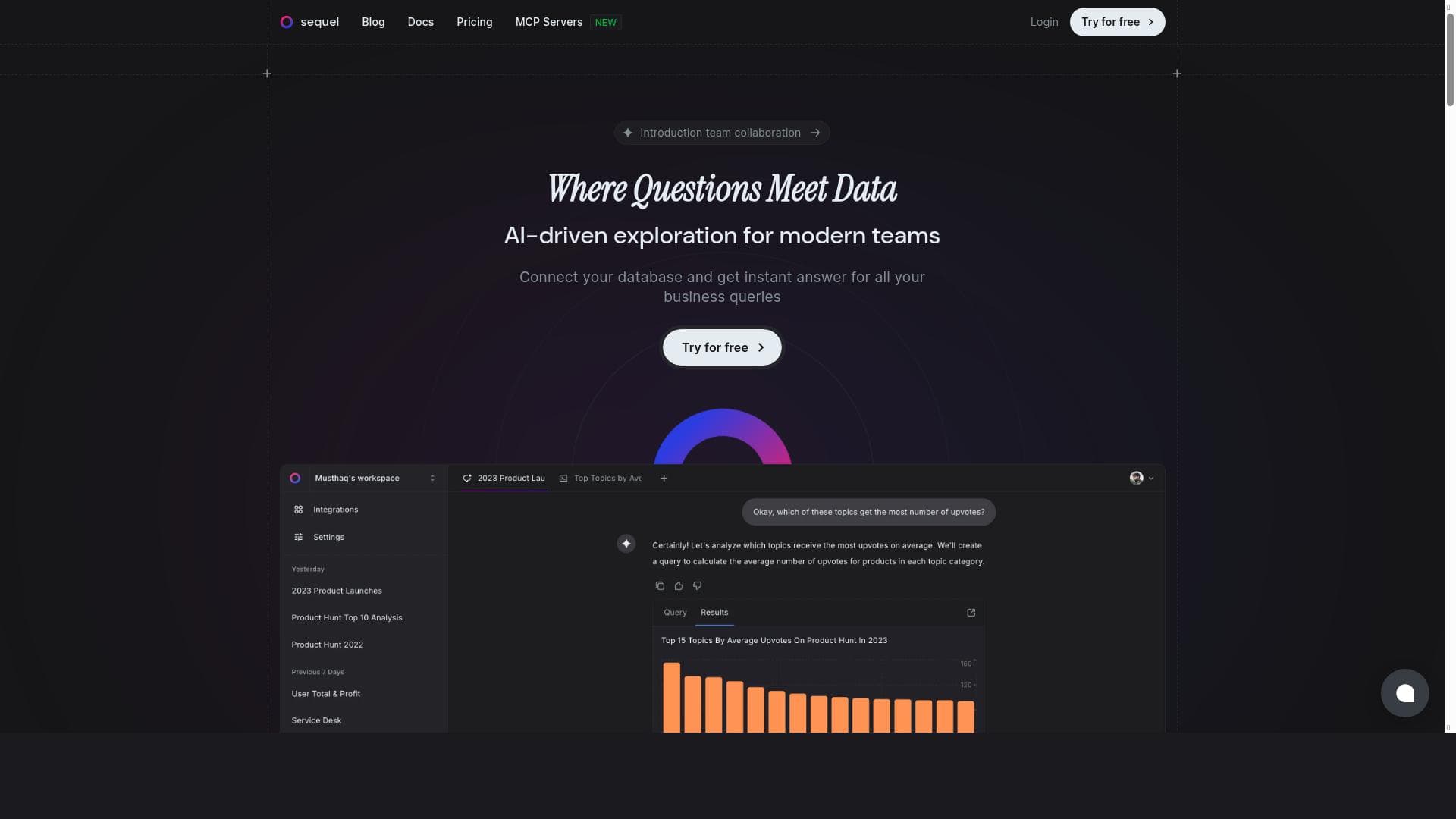
Sequel revolutionizes data interaction by allowing users to converse with their databases in natural language, instantly generating reports and insights powered by AI. Ideal for business teams seeking quick, collaborative, and intuitive data analysis without technical barriers, Sequel streamlines decision-making and fosters a data-driven culture.
Sequel is an innovative AI-powered tool designed to transform the way businesses interact with their data. Its core purpose is to enable users to converse directly with their databases using natural language, eliminating the need for complex query languages or technical expertise. By simply typing or speaking business questions, users can instantly generate reports, visualize data through graphs, and perform in-depth analysis powered by artificial intelligence. This approach democratizes data access, making it easier for teams across an organization to derive actionable insights without relying heavily on data specialists. At the heart of Sequel are several key features that enhance data interaction and decision-making. First, it allows seamless connection to a wide range of databases, ensuring that users can work with their existing data infrastructure without disruption. Once connected, Sequel leverages AI-driven data exploration to interpret natural language queries and translate them into accurate database commands. This capability provides instant answers to complex business questions, accelerating the decision-making process. Additionally, Sequel supports team collaboration by enabling multiple users to share queries, reports, and insights within a unified platform, fostering a data-driven culture. The tool also boasts native AI integration, which means it continuously learns from user interactions to improve response accuracy and suggest relevant data insights proactively. Sequel is particularly well-suited for business analysts, data teams, product managers, and executives who need quick, reliable access to data insights without deep technical skills. For example, a marketing manager can ask Sequel to generate a report on campaign performance, visualize trends over time, and identify key drivers of customer engagement—all through simple natural language commands. Similarly, finance teams can use Sequel to analyze revenue streams, forecast trends, and detect anomalies without writing SQL queries. Its collaborative features make it ideal for organizations that prioritize cross-functional data sharing and collective decision-making. Regarding pricing, Sequel offers a freemium model, allowing users to start exploring its capabilities at no cost. This approach lowers the barrier to entry and enables businesses to evaluate the tool’s benefits before committing to paid plans. While specific pricing tiers and feature limitations for paid plans are not detailed here, the freemium option typically includes essential functionalities with options to upgrade for advanced features, increased usage limits, or enhanced support. Compared to traditional BI tools and SQL query interfaces, Sequel stands out by focusing on natural language interaction and AI-driven insights. Unlike conventional platforms that require technical expertise or manual report building, Sequel simplifies data querying and accelerates insight generation. Its native AI integration and collaborative environment also provide a more dynamic and user-friendly experience than many legacy systems. However, users should consider that natural language processing may occasionally misinterpret ambiguous queries, and complex data transformations might still require specialized tools. In terms of limitations, while Sequel excels at conversational data analysis, it may not fully replace advanced data engineering or custom analytics workflows that require deep customization. Additionally, the effectiveness of its AI-driven responses depends on the quality and structure of the connected databases. Organizations with highly fragmented or poorly maintained data sources might experience reduced accuracy. Lastly, as with any cloud-connected AI tool, data security and compliance considerations should be evaluated based on organizational policies. Overall, Sequel offers a powerful, user-friendly solution for businesses seeking to unlock the value of their data through natural language interaction and AI-enhanced analysis. Its combination of instant answers, collaborative features, and seamless database connectivity makes it a compelling choice for teams aiming to become more data-driven without the complexity of traditional BI tools.

Description
Sequel revolutionizes data interaction by allowing users to converse with their databases in natural language, instantly generating reports and insights powered by AI. Ideal for business teams seeking quick, collaborative, and intuitive data analysis without technical barriers, Sequel streamlines decision-making and fosters a data-driven culture.
Sequel is an innovative AI-powered tool designed to transform the way businesses interact with their data. Its core purpose is to enable users to converse directly with their databases using natural language, eliminating the need for complex query languages or technical expertise. By simply typing or speaking business questions, users can instantly generate reports, visualize data through graphs, and perform in-depth analysis powered by artificial intelligence. This approach democratizes data access, making it easier for teams across an organization to derive actionable insights without relying heavily on data specialists. At the heart of Sequel are several key features that enhance data interaction and decision-making. First, it allows seamless connection to a wide range of databases, ensuring that users can work with their existing data infrastructure without disruption. Once connected, Sequel leverages AI-driven data exploration to interpret natural language queries and translate them into accurate database commands. This capability provides instant answers to complex business questions, accelerating the decision-making process. Additionally, Sequel supports team collaboration by enabling multiple users to share queries, reports, and insights within a unified platform, fostering a data-driven culture. The tool also boasts native AI integration, which means it continuously learns from user interactions to improve response accuracy and suggest relevant data insights proactively. Sequel is particularly well-suited for business analysts, data teams, product managers, and executives who need quick, reliable access to data insights without deep technical skills. For example, a marketing manager can ask Sequel to generate a report on campaign performance, visualize trends over time, and identify key drivers of customer engagement—all through simple natural language commands. Similarly, finance teams can use Sequel to analyze revenue streams, forecast trends, and detect anomalies without writing SQL queries. Its collaborative features make it ideal for organizations that prioritize cross-functional data sharing and collective decision-making. Regarding pricing, Sequel offers a freemium model, allowing users to start exploring its capabilities at no cost. This approach lowers the barrier to entry and enables businesses to evaluate the tool’s benefits before committing to paid plans. While specific pricing tiers and feature limitations for paid plans are not detailed here, the freemium option typically includes essential functionalities with options to upgrade for advanced features, increased usage limits, or enhanced support. Compared to traditional BI tools and SQL query interfaces, Sequel stands out by focusing on natural language interaction and AI-driven insights. Unlike conventional platforms that require technical expertise or manual report building, Sequel simplifies data querying and accelerates insight generation. Its native AI integration and collaborative environment also provide a more dynamic and user-friendly experience than many legacy systems. However, users should consider that natural language processing may occasionally misinterpret ambiguous queries, and complex data transformations might still require specialized tools. In terms of limitations, while Sequel excels at conversational data analysis, it may not fully replace advanced data engineering or custom analytics workflows that require deep customization. Additionally, the effectiveness of its AI-driven responses depends on the quality and structure of the connected databases. Organizations with highly fragmented or poorly maintained data sources might experience reduced accuracy. Lastly, as with any cloud-connected AI tool, data security and compliance considerations should be evaluated based on organizational policies. Overall, Sequel offers a powerful, user-friendly solution for businesses seeking to unlock the value of their data through natural language interaction and AI-enhanced analysis. Its combination of instant answers, collaborative features, and seamless database connectivity makes it a compelling choice for teams aiming to become more data-driven without the complexity of traditional BI tools.
Tool Features
- Connect your database
- Instant answers for business queries
- AI-driven data exploration
- Supports team collaboration
- Native AI integration
Frequently Asked Questions
What is Sequel?
Sequel is an AI-powered tool that enables users to interact with their databases using natural language, allowing them to generate reports, graphs, and analyze data without needing technical query skills.
How much does Sequel cost?
Sequel offers a freemium pricing model, allowing users to access core features for free with options to upgrade to paid plans for additional capabilities and usage.
Who is Sequel best for?
Sequel is best suited for business analysts, product managers, finance teams, and executives who want quick, easy access to data insights without deep technical expertise.
What are the main features of Sequel?
Key features include seamless database connectivity, instant answers to business queries via natural language, AI-driven data exploration, team collaboration support, and native AI integration.
Does Sequel offer a free trial?
Yes, Sequel provides a freemium plan that allows users to try the tool’s essential features at no cost.
What integrations does Sequel support?
Sequel supports connecting to various databases, enabling users to work with their existing data infrastructure, though specific database types supported are not detailed here.
How does Sequel work?
Sequel works by interpreting natural language queries from users, translating them into database commands, and then generating reports, visualizations, and insights powered by AI.
Socials
Use ToolSponsored Tools





























Reviews
No reviews yet. Be the first to share your experience.