Description
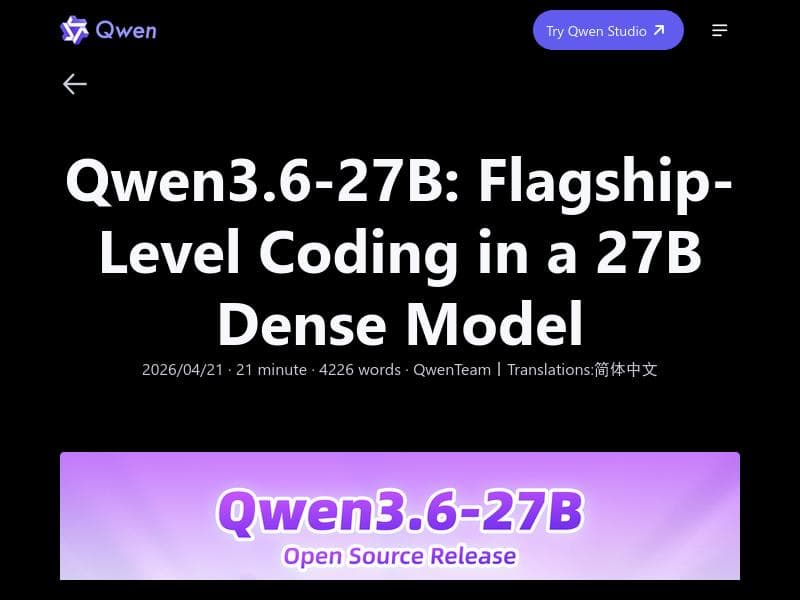
Qwen3.6-27B is a powerful open-source dense AI model that excels in multimodal reasoning and agentic coding, all while being optimized for local self-hosting. Ideal for developers and enterprises seeking advanced chatbot, image, and document processing capabilities without cloud dependency, it offers a unique blend of performance, flexibility, and privacy.
Qwen3.6-27B is an advanced, fully open-source dense AI model designed to deliver exceptional performance across a wide range of applications while maintaining a size that allows for efficient local self-hosting. Unlike many large-scale models that require massive computational resources, Qwen3.6-27B strikes a balance between power and accessibility, making it a versatile tool for developers, researchers, and enterprises seeking robust AI capabilities without the overhead of cloud dependency. Its architecture surpasses even the previous 397 billion parameter Mixture of Experts (MoE) flagship model in agentic coding tasks, demonstrating superior reasoning and problem-solving skills. The model supports multimodal reasoning, enabling it to process and understand inputs from various data types such as text, images, and videos, which broadens its utility beyond traditional language models. Key features of Qwen3.6-27B include chatbot functionality that facilitates natural, context-aware conversations, making it suitable for customer support, virtual assistants, and interactive applications. Its image and video understanding capabilities allow it to analyze visual content, providing insights or generating descriptive text based on multimedia inputs. Additionally, Qwen3.6-27B supports image generation, enabling creative applications such as digital art creation, design prototyping, and content augmentation. The model also excels in document processing, automating tasks like summarization, information extraction, and content classification, which can significantly enhance productivity in business and research environments. Integration with web search allows the model to access up-to-date information, improving the relevance and accuracy of its responses. Moreover, Qwen3.6-27B supports tool utilization and artifact management, which means it can interact with external tools and manage generated outputs or intermediate data efficiently, facilitating complex workflows and automation. This AI tool is best suited for organizations and individuals who require a powerful yet manageable AI model that can be deployed locally. Developers building AI-driven applications that need multimodal input processing, researchers conducting experiments with open-source models, and enterprises aiming to maintain data privacy by avoiding cloud-based AI services will find Qwen3.6-27B particularly valuable. Use cases include intelligent chatbots for customer engagement, automated content creation and moderation, multimedia analysis for marketing or security, and advanced coding assistants that leverage agentic reasoning to improve software development workflows. Qwen3.6-27B is offered under a freemium pricing model, allowing users to access core functionalities at no cost while providing options for premium features or enhanced support. This pricing approach makes it accessible to a broad audience, from hobbyists and startups to large organizations. The ability to self-host the model locally also reduces ongoing costs associated with cloud usage, making it a cost-effective solution for long-term deployment. Compared to alternative large language models, Qwen3.6-27B stands out due to its open-source nature, multimodal capabilities, and efficient size that enables local hosting. While many competitors require cloud infrastructure and have limited multimodal support, Qwen3.6-27B offers a unique combination of flexibility, performance, and privacy. Its surpassing of the 397B MoE model in agentic coding highlights its advanced reasoning abilities, positioning it as a leader in AI-assisted programming and problem-solving. However, users should consider that despite its efficiency, deploying a 27 billion parameter model locally still demands substantial hardware resources and technical expertise. Notable limitations include the potential complexity of setup and maintenance for local hosting, which may be a barrier for non-technical users. Additionally, while the model supports a broad range of features, the quality of outputs can vary depending on the specific task and input data quality. Continuous updates and community support are essential to maximize the model’s capabilities and address any emerging issues. Overall, Qwen3.6-27B represents a cutting-edge, versatile AI tool that empowers users with advanced multimodal intelligence in an accessible, open-source package.

Description
Qwen3.6-27B is a powerful open-source dense AI model that excels in multimodal reasoning and agentic coding, all while being optimized for local self-hosting. Ideal for developers and enterprises seeking advanced chatbot, image, and document processing capabilities without cloud dependency, it offers a unique blend of performance, flexibility, and privacy.
Qwen3.6-27B is an advanced, fully open-source dense AI model designed to deliver exceptional performance across a wide range of applications while maintaining a size that allows for efficient local self-hosting. Unlike many large-scale models that require massive computational resources, Qwen3.6-27B strikes a balance between power and accessibility, making it a versatile tool for developers, researchers, and enterprises seeking robust AI capabilities without the overhead of cloud dependency. Its architecture surpasses even the previous 397 billion parameter Mixture of Experts (MoE) flagship model in agentic coding tasks, demonstrating superior reasoning and problem-solving skills. The model supports multimodal reasoning, enabling it to process and understand inputs from various data types such as text, images, and videos, which broadens its utility beyond traditional language models. Key features of Qwen3.6-27B include chatbot functionality that facilitates natural, context-aware conversations, making it suitable for customer support, virtual assistants, and interactive applications. Its image and video understanding capabilities allow it to analyze visual content, providing insights or generating descriptive text based on multimedia inputs. Additionally, Qwen3.6-27B supports image generation, enabling creative applications such as digital art creation, design prototyping, and content augmentation. The model also excels in document processing, automating tasks like summarization, information extraction, and content classification, which can significantly enhance productivity in business and research environments. Integration with web search allows the model to access up-to-date information, improving the relevance and accuracy of its responses. Moreover, Qwen3.6-27B supports tool utilization and artifact management, which means it can interact with external tools and manage generated outputs or intermediate data efficiently, facilitating complex workflows and automation. This AI tool is best suited for organizations and individuals who require a powerful yet manageable AI model that can be deployed locally. Developers building AI-driven applications that need multimodal input processing, researchers conducting experiments with open-source models, and enterprises aiming to maintain data privacy by avoiding cloud-based AI services will find Qwen3.6-27B particularly valuable. Use cases include intelligent chatbots for customer engagement, automated content creation and moderation, multimedia analysis for marketing or security, and advanced coding assistants that leverage agentic reasoning to improve software development workflows. Qwen3.6-27B is offered under a freemium pricing model, allowing users to access core functionalities at no cost while providing options for premium features or enhanced support. This pricing approach makes it accessible to a broad audience, from hobbyists and startups to large organizations. The ability to self-host the model locally also reduces ongoing costs associated with cloud usage, making it a cost-effective solution for long-term deployment. Compared to alternative large language models, Qwen3.6-27B stands out due to its open-source nature, multimodal capabilities, and efficient size that enables local hosting. While many competitors require cloud infrastructure and have limited multimodal support, Qwen3.6-27B offers a unique combination of flexibility, performance, and privacy. Its surpassing of the 397B MoE model in agentic coding highlights its advanced reasoning abilities, positioning it as a leader in AI-assisted programming and problem-solving. However, users should consider that despite its efficiency, deploying a 27 billion parameter model locally still demands substantial hardware resources and technical expertise. Notable limitations include the potential complexity of setup and maintenance for local hosting, which may be a barrier for non-technical users. Additionally, while the model supports a broad range of features, the quality of outputs can vary depending on the specific task and input data quality. Continuous updates and community support are essential to maximize the model’s capabilities and address any emerging issues. Overall, Qwen3.6-27B represents a cutting-edge, versatile AI tool that empowers users with advanced multimodal intelligence in an accessible, open-source package.
Tool Features
- Chatbot functionality
- Image and video understanding
- Image generation
- Document processing
- Web search integration
- Tool utilization
- Artifact management
Frequently Asked Questions
What is Qwen3.6-27B?
Qwen3.6-27B is a fully open-source dense AI model designed for multimodal reasoning and agentic coding. It supports text, image, and video understanding, as well as generation tasks, and is optimized for local self-hosting to provide powerful AI capabilities without relying on cloud infrastructure.
How much does Qwen3.6-27B cost?
Qwen3.6-27B is available under a freemium pricing model, offering free access to core features with options for premium plans or additional support. This makes it accessible to a wide range of users, from individual developers to large organizations.
Who is Qwen3.6-27B best for?
It is best suited for developers, researchers, and enterprises that need a powerful, multimodal AI model capable of local deployment. Use cases include AI chatbots, multimedia content analysis, document processing, and advanced coding assistance.
What are the main features of Qwen3.6-27B?
The main features include chatbot functionality, image and video understanding, image generation, document processing, web search integration, tool utilization, and artifact management, enabling a wide range of AI-powered applications.
Does Qwen3.6-27B offer a free trial?
Yes, the freemium pricing model provides free access to core functionalities, effectively serving as a free trial for users to evaluate the model before opting for premium features or support.
What integrations does Qwen3.6-27B support?
Qwen3.6-27B supports web search integration and tool utilization, allowing it to interact with external tools and access up-to-date information to enhance its responses and automate complex workflows.
How does Qwen3.6-27B work?
Qwen3.6-27B processes and generates responses by leveraging its dense neural network architecture optimized for multimodal inputs. It combines advanced reasoning capabilities with agentic coding skills, enabling it to understand and generate text, images, and video content effectively.
Socials
Use ToolSponsored Tools





























Reviews
No reviews yet. Be the first to share your experience.