Description
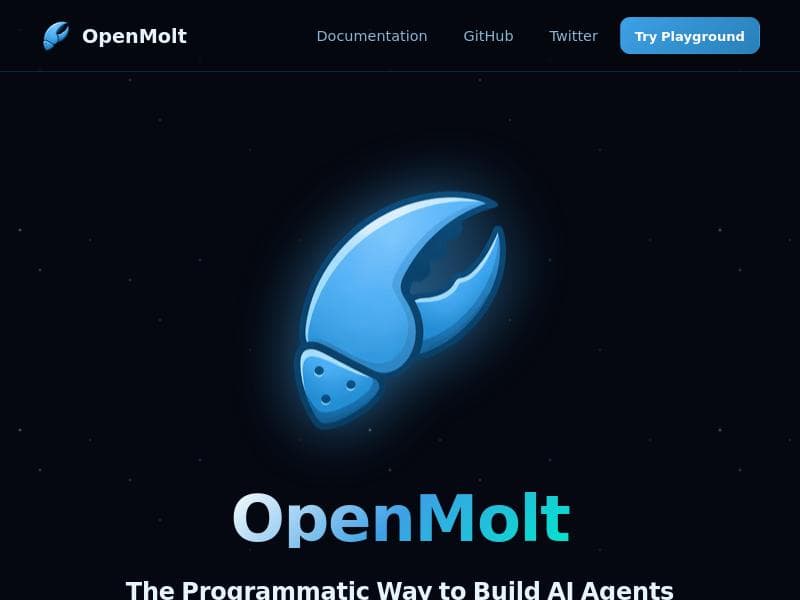
OpenMolt is a Node.js framework that empowers developers to build secure, programmatic AI agents capable of thinking, planning, and acting using multi-provider LLMs and over 30 zero-config integrations. Ideal for automating workflows and building intelligent bots, it offers structured outputs, scheduling, and memory features—all with a security-first design and free pricing.
OpenMolt is a powerful Node.js framework designed to enable developers to build sophisticated programmatic AI agents that can think, plan, and act autonomously by leveraging a wide array of tools, integrations, and memory capabilities directly from their codebase. Its core purpose is to simplify the creation of intelligent agents that interact with various APIs and services securely and efficiently, making it an ideal solution for automating complex workflows, monitoring tasks, and generating actionable insights without the need for extensive boilerplate or manual intervention. By abstracting the complexities of AI agent orchestration, OpenMolt empowers developers to focus on business logic and innovation rather than infrastructure and integration details. One of OpenMolt's standout features is its security-first design. Agents only access the specific scopes granted by the developer, ensuring that API credentials remain securely on the server and are never exposed to the language model. This means the LLM only ever sees tool names and never raw credentials, significantly reducing the risk of credential leakage. OpenMolt supports multiple leading large language models (LLMs) including OpenAI's GPT-4o, Anthropic Claude, and Google Gemini, all accessible through a unified model string format. This multi-provider support allows developers to seamlessly switch between LLM providers without modifying their code, providing flexibility and cost optimization. The platform boasts over 30 ready-to-use integrations with popular services such as Gmail, Slack, GitHub, Notion, Stripe, Discord, and Amazon S3, among others. These integrations require zero configuration, enabling developers to quickly connect their agents to essential tools and data sources. OpenMolt also supports structured output via Zod schemas, allowing developers to define expected response formats and receive validated, typed objects from the LLM. This eliminates the need for manual parsing or validation of AI responses, enhancing reliability and developer productivity. Scheduling capabilities are built-in, with support for interval-based or cron-style daily schedules. This makes OpenMolt ideal for automating recurring reports, workflow orchestration, and continuous monitoring tasks. Additionally, OpenMolt provides an event-driven architecture that allows developers to hook into every step of the AI agent's reasoning loop, including tool calls, plan updates, LLM outputs, and results. This real-time observability facilitates debugging, auditing, and fine-tuning of agent behavior. Memory management is another critical feature, offering both long-term and short-term memory stores with onUpdate callbacks. This enables agents to learn from past interactions and remember important context across runs, significantly enhancing their effectiveness in complex, stateful scenarios. Furthermore, OpenMolt employs declarative tools, allowing integrations to be defined as simple data structures specifying endpoints, authentication templates, and schemas. This approach removes the need for repetitive HTTP boilerplate code, streamlining the development process. OpenMolt is best suited for developers, AI engineers, and organizations looking to build custom AI agents that require secure, scalable, and maintainable integration with multiple APIs and services. Use cases include automated customer support agents, intelligent monitoring systems, workflow automation, data aggregation bots, and personalized notification systems. Its Node.js foundation makes it particularly attractive to teams already invested in JavaScript ecosystems. Regarding pricing, OpenMolt is currently offered for free, making it accessible for individual developers and startups to experiment and build production-grade AI agents without upfront costs. This free access encourages adoption and community growth. Compared to alternatives, OpenMolt stands out by combining multi-provider LLM support, extensive zero-config integrations, and a security-first architecture in a single Node.js framework. While other platforms may offer some of these features separately, OpenMolt’s unified approach reduces complexity and accelerates development. However, as a relatively new tool, it may have fewer community plugins or enterprise support options compared to more established AI orchestration platforms. Additionally, its focus on Node.js may limit adoption among teams using other programming languages. In summary, OpenMolt is a comprehensive, secure, and developer-friendly framework for building intelligent AI agents that integrate deeply with popular services and leverage advanced LLM capabilities. Its rich feature set, combined with free access, makes it a compelling choice for developers aiming to automate complex tasks and workflows with AI.

Description
OpenMolt is a Node.js framework that empowers developers to build secure, programmatic AI agents capable of thinking, planning, and acting using multi-provider LLMs and over 30 zero-config integrations. Ideal for automating workflows and building intelligent bots, it offers structured outputs, scheduling, and memory features—all with a security-first design and free pricing.
OpenMolt is a powerful Node.js framework designed to enable developers to build sophisticated programmatic AI agents that can think, plan, and act autonomously by leveraging a wide array of tools, integrations, and memory capabilities directly from their codebase. Its core purpose is to simplify the creation of intelligent agents that interact with various APIs and services securely and efficiently, making it an ideal solution for automating complex workflows, monitoring tasks, and generating actionable insights without the need for extensive boilerplate or manual intervention. By abstracting the complexities of AI agent orchestration, OpenMolt empowers developers to focus on business logic and innovation rather than infrastructure and integration details. One of OpenMolt's standout features is its security-first design. Agents only access the specific scopes granted by the developer, ensuring that API credentials remain securely on the server and are never exposed to the language model. This means the LLM only ever sees tool names and never raw credentials, significantly reducing the risk of credential leakage. OpenMolt supports multiple leading large language models (LLMs) including OpenAI's GPT-4o, Anthropic Claude, and Google Gemini, all accessible through a unified model string format. This multi-provider support allows developers to seamlessly switch between LLM providers without modifying their code, providing flexibility and cost optimization. The platform boasts over 30 ready-to-use integrations with popular services such as Gmail, Slack, GitHub, Notion, Stripe, Discord, and Amazon S3, among others. These integrations require zero configuration, enabling developers to quickly connect their agents to essential tools and data sources. OpenMolt also supports structured output via Zod schemas, allowing developers to define expected response formats and receive validated, typed objects from the LLM. This eliminates the need for manual parsing or validation of AI responses, enhancing reliability and developer productivity. Scheduling capabilities are built-in, with support for interval-based or cron-style daily schedules. This makes OpenMolt ideal for automating recurring reports, workflow orchestration, and continuous monitoring tasks. Additionally, OpenMolt provides an event-driven architecture that allows developers to hook into every step of the AI agent's reasoning loop, including tool calls, plan updates, LLM outputs, and results. This real-time observability facilitates debugging, auditing, and fine-tuning of agent behavior. Memory management is another critical feature, offering both long-term and short-term memory stores with onUpdate callbacks. This enables agents to learn from past interactions and remember important context across runs, significantly enhancing their effectiveness in complex, stateful scenarios. Furthermore, OpenMolt employs declarative tools, allowing integrations to be defined as simple data structures specifying endpoints, authentication templates, and schemas. This approach removes the need for repetitive HTTP boilerplate code, streamlining the development process. OpenMolt is best suited for developers, AI engineers, and organizations looking to build custom AI agents that require secure, scalable, and maintainable integration with multiple APIs and services. Use cases include automated customer support agents, intelligent monitoring systems, workflow automation, data aggregation bots, and personalized notification systems. Its Node.js foundation makes it particularly attractive to teams already invested in JavaScript ecosystems. Regarding pricing, OpenMolt is currently offered for free, making it accessible for individual developers and startups to experiment and build production-grade AI agents without upfront costs. This free access encourages adoption and community growth. Compared to alternatives, OpenMolt stands out by combining multi-provider LLM support, extensive zero-config integrations, and a security-first architecture in a single Node.js framework. While other platforms may offer some of these features separately, OpenMolt’s unified approach reduces complexity and accelerates development. However, as a relatively new tool, it may have fewer community plugins or enterprise support options compared to more established AI orchestration platforms. Additionally, its focus on Node.js may limit adoption among teams using other programming languages. In summary, OpenMolt is a comprehensive, secure, and developer-friendly framework for building intelligent AI agents that integrate deeply with popular services and leverage advanced LLM capabilities. Its rich feature set, combined with free access, makes it a compelling choice for developers aiming to automate complex tasks and workflows with AI.
Tool Features
- Secure by Design: Agents access only the scopes you grant. API credentials never leave your server. The LLM only sees tool names, never raw credentials.
- Multi-Provider LLM: Use OpenAI GPT-4o, Anthropic Claude, or Google Gemini with a unified model string format. Switch providers without changing your code.
- 30+ Integrations: Gmail, Slack, GitHub, Notion, Stripe, Discord, S3 and more — all ready to use out of the box with zero configuration.
- Structured Output: Pass a Zod schema and get back a validated, typed object. No more parsing or validating LLM responses manually.
- Scheduling: Schedule agents with interval or cron-style daily schedules. Perfect for recurring reports, automated workflows, and monitoring tasks.
- Event-Driven: Hook into every step of the reasoning loop. Observe tool calls, plan updates, LLM outputs, and results in real-time.
- Memory: Long-term and short-term memory stores with onUpdate callbacks. Agents can learn and remember across runs.
- Declarative Tools: Define integrations as data — endpoint, auth template, and schema. No boilerplate HTTP code required.
Frequently Asked Questions
What is OpenMolt?
OpenMolt is a Node.js framework that enables developers to build programmatic AI agents that can think, plan, and act autonomously by integrating with multiple tools, services, and memory stores directly from their codebase.
How much does OpenMolt cost?
OpenMolt is currently available for free, allowing developers and organizations to use its full capabilities without any upfront cost.
Who is OpenMolt best for?
OpenMolt is best suited for developers, AI engineers, and organizations looking to build secure, scalable AI agents that integrate with multiple APIs and services, especially those working within the Node.js ecosystem.
What are the main features of OpenMolt?
Key features include a security-first design that protects API credentials, multi-provider LLM support (OpenAI GPT-4o, Anthropic Claude, Google Gemini), 30+ zero-config integrations, structured output validation with Zod schemas, scheduling with interval and cron support, event-driven hooks, long- and short-term memory stores, and declarative tool definitions.
Does OpenMolt offer a free trial?
OpenMolt is free to use, so there is no need for a separate trial period.
What integrations does OpenMolt support?
OpenMolt supports over 30 integrations out of the box, including Gmail, Slack, GitHub, Notion, Stripe, Discord, Amazon S3, and many more, all requiring zero configuration.
How does OpenMolt work?
OpenMolt works by allowing developers to define AI agents in Node.js that use large language models along with a variety of tools and integrations. Agents operate securely with scoped access to APIs, produce structured outputs validated against schemas, maintain memory across runs, and can be scheduled or triggered by events to automate complex workflows.
Socials
Use ToolSponsored Tools
































Reviews
No reviews yet. Be the first to share your experience.