OpenAI GPT-4o Audio Models
Description
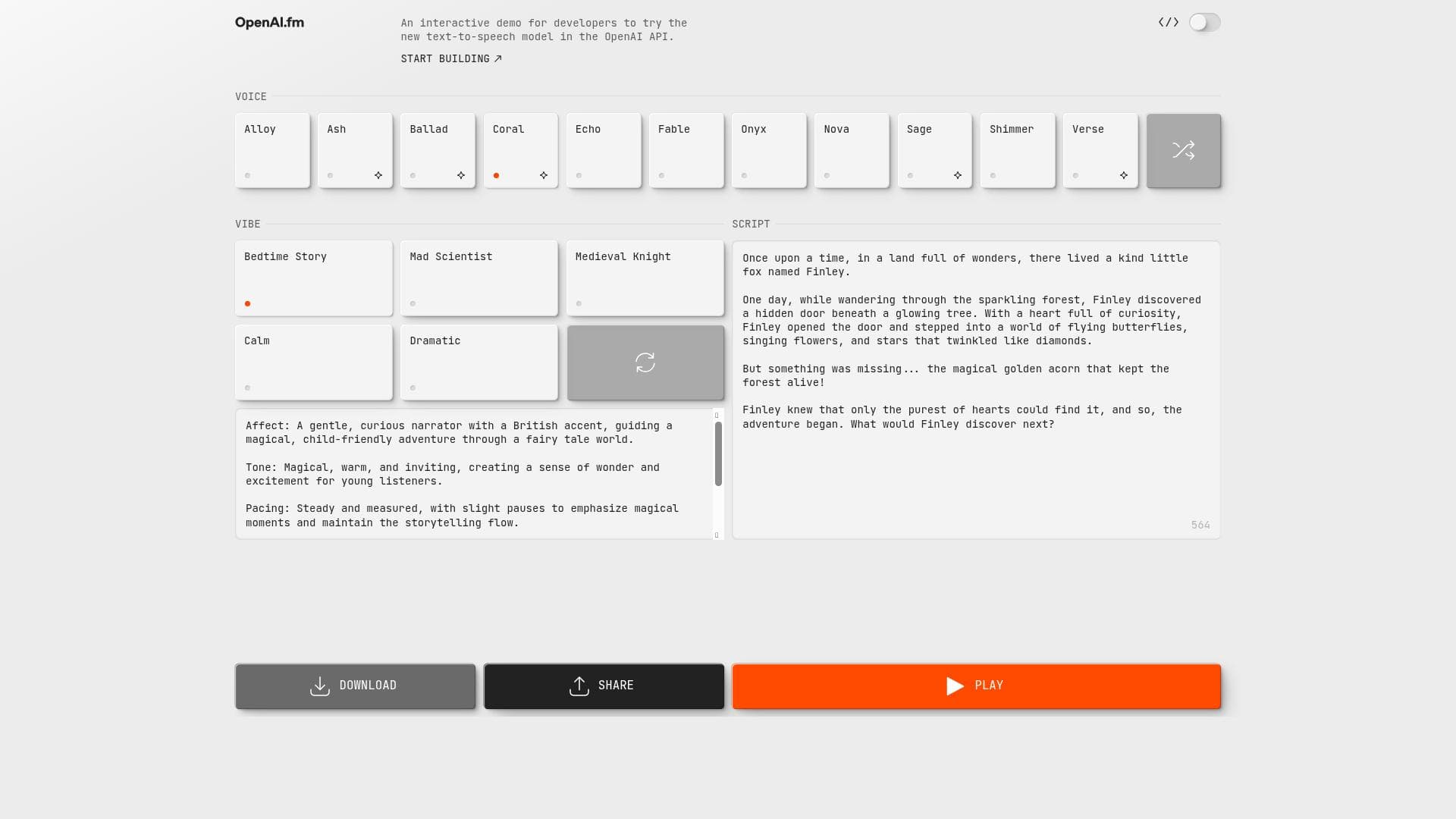
OpenAI GPT-4o Audio Models deliver state-of-the-art speech-to-text and steerable text-to-speech capabilities powered by the advanced GPT-4o architecture. Designed for developers, this free tool enables the creation of highly accurate transcriptions and natural-sounding voice agents, making it ideal for applications in customer service, content creation, and accessibility.
OpenAI GPT-4o Audio Models represent the latest advancement in audio AI technology designed specifically for developers seeking powerful speech-to-text and text-to-speech capabilities. At its core, this tool leverages the GPT-4o architecture to deliver highly accurate speech recognition that surpasses the performance of OpenAI's previous Whisper model. Additionally, it offers a steerable text-to-speech system that enables users to convert written text into natural-sounding, expressive speech. This dual functionality makes it a versatile solution for building voice-driven applications such as virtual assistants, transcription services, interactive voice agents, and accessibility tools. One of the standout features of the GPT-4o Audio Models is its interactive demo, which allows developers to test and experiment with the speech-to-text and text-to-speech functionalities in real time. This hands-on experience helps users understand the model’s capabilities and fine-tune their applications accordingly. The text-to-speech component is powered by OpenAI’s latest API, which supports nuanced voice modulation and natural intonation, enabling developers to create more engaging and human-like voice interactions. The speech-to-text model is designed to handle diverse accents, noisy environments, and complex audio inputs with higher accuracy than Whisper, making it suitable for a wide range of real-world scenarios. This tool is ideal for developers, startups, and enterprises focused on voice technology, customer service automation, content creation, and accessibility solutions. For example, companies can integrate GPT-4o Audio Models into their customer support systems to transcribe calls in real time or generate dynamic voice responses. Content creators can use it to produce podcasts or audiobooks with customizable voice styles. Additionally, it supports accessibility initiatives by converting text content into speech for visually impaired users. The flexibility and precision of the models open up numerous use cases in industries such as healthcare, education, media, and telecommunications. OpenAI offers the GPT-4o Audio Models free of charge, making it accessible for developers to experiment and build prototypes without upfront costs. This pricing model encourages innovation and lowers the barrier to entry for leveraging advanced audio AI. However, users should review OpenAI’s usage policies and API rate limits to ensure their applications scale effectively. Since the models are accessed via API, integration requires some technical expertise, but the provided documentation and demo ease the onboarding process. Compared to alternatives like Google Speech-to-Text or Amazon Polly, OpenAI GPT-4o Audio Models stand out due to their combination of cutting-edge accuracy and steerable voice synthesis within a single unified platform. While other services may specialize in either transcription or text-to-speech, GPT-4o Audio Models provide both with seamless interoperability. The enhanced accuracy over Whisper and the ability to modulate speech output dynamically give it an edge in creating more natural and context-aware voice applications. However, as a relatively new offering, it may have fewer pre-built integrations or community resources compared to more established competitors. Potential limitations include the need for reliable internet connectivity to access the API and possible latency depending on usage volume. Also, while the models excel in English and several major languages, performance may vary with less common languages or dialects. Developers should also consider data privacy and compliance requirements when processing sensitive audio content through cloud-based APIs. Overall, OpenAI GPT-4o Audio Models provide a robust, innovative audio AI toolkit that empowers developers to build sophisticated voice-enabled applications with ease and precision.

Description
OpenAI GPT-4o Audio Models deliver state-of-the-art speech-to-text and steerable text-to-speech capabilities powered by the advanced GPT-4o architecture. Designed for developers, this free tool enables the creation of highly accurate transcriptions and natural-sounding voice agents, making it ideal for applications in customer service, content creation, and accessibility.
OpenAI GPT-4o Audio Models represent the latest advancement in audio AI technology designed specifically for developers seeking powerful speech-to-text and text-to-speech capabilities. At its core, this tool leverages the GPT-4o architecture to deliver highly accurate speech recognition that surpasses the performance of OpenAI's previous Whisper model. Additionally, it offers a steerable text-to-speech system that enables users to convert written text into natural-sounding, expressive speech. This dual functionality makes it a versatile solution for building voice-driven applications such as virtual assistants, transcription services, interactive voice agents, and accessibility tools. One of the standout features of the GPT-4o Audio Models is its interactive demo, which allows developers to test and experiment with the speech-to-text and text-to-speech functionalities in real time. This hands-on experience helps users understand the model’s capabilities and fine-tune their applications accordingly. The text-to-speech component is powered by OpenAI’s latest API, which supports nuanced voice modulation and natural intonation, enabling developers to create more engaging and human-like voice interactions. The speech-to-text model is designed to handle diverse accents, noisy environments, and complex audio inputs with higher accuracy than Whisper, making it suitable for a wide range of real-world scenarios. This tool is ideal for developers, startups, and enterprises focused on voice technology, customer service automation, content creation, and accessibility solutions. For example, companies can integrate GPT-4o Audio Models into their customer support systems to transcribe calls in real time or generate dynamic voice responses. Content creators can use it to produce podcasts or audiobooks with customizable voice styles. Additionally, it supports accessibility initiatives by converting text content into speech for visually impaired users. The flexibility and precision of the models open up numerous use cases in industries such as healthcare, education, media, and telecommunications. OpenAI offers the GPT-4o Audio Models free of charge, making it accessible for developers to experiment and build prototypes without upfront costs. This pricing model encourages innovation and lowers the barrier to entry for leveraging advanced audio AI. However, users should review OpenAI’s usage policies and API rate limits to ensure their applications scale effectively. Since the models are accessed via API, integration requires some technical expertise, but the provided documentation and demo ease the onboarding process. Compared to alternatives like Google Speech-to-Text or Amazon Polly, OpenAI GPT-4o Audio Models stand out due to their combination of cutting-edge accuracy and steerable voice synthesis within a single unified platform. While other services may specialize in either transcription or text-to-speech, GPT-4o Audio Models provide both with seamless interoperability. The enhanced accuracy over Whisper and the ability to modulate speech output dynamically give it an edge in creating more natural and context-aware voice applications. However, as a relatively new offering, it may have fewer pre-built integrations or community resources compared to more established competitors. Potential limitations include the need for reliable internet connectivity to access the API and possible latency depending on usage volume. Also, while the models excel in English and several major languages, performance may vary with less common languages or dialects. Developers should also consider data privacy and compliance requirements when processing sensitive audio content through cloud-based APIs. Overall, OpenAI GPT-4o Audio Models provide a robust, innovative audio AI toolkit that empowers developers to build sophisticated voice-enabled applications with ease and precision.
Tool Features
- Interactive demo for developers
- Utilizes the new text-to-speech model from OpenAI API
- Enables conversion of text into natural-sounding speech
Frequently Asked Questions
What is OpenAI GPT-4o Audio Models?
OpenAI GPT-4o Audio Models are advanced AI-powered tools that provide highly accurate speech-to-text transcription and steerable text-to-speech synthesis. They enable developers to build voice-driven applications such as voice agents, transcription services, and natural-sounding speech generation.
How much does OpenAI GPT-4o Audio Models cost?
OpenAI GPT-4o Audio Models are currently offered for free, allowing developers to experiment and build applications without upfront costs. Users should check OpenAI's official site for any updates on pricing or usage limits.
Who is OpenAI GPT-4o Audio Models best for?
This tool is best suited for developers, startups, and enterprises working on voice technology, customer support automation, content creation, accessibility solutions, and any applications requiring accurate speech transcription or natural text-to-speech conversion.
What are the main features of OpenAI GPT-4o Audio Models?
Key features include a highly accurate speech-to-text model that outperforms Whisper, a steerable text-to-speech system for natural and expressive voice synthesis, an interactive demo for developers, and seamless integration via the OpenAI API.
Does OpenAI GPT-4o Audio Models offer a free trial?
Yes, the models are available for free use, effectively serving as a free trial or open access for developers to explore and integrate the audio capabilities into their projects.
What integrations does OpenAI GPT-4o Audio Models support?
The models are accessible through the OpenAI API, allowing integration with various development environments and platforms that support API calls. Specific third-party integrations depend on the developer’s implementation.
How does OpenAI GPT-4o Audio Models work?
The models process audio input using GPT-4o architecture to transcribe speech with high accuracy and convert text input into natural-sounding speech using a steerable text-to-speech engine. Developers access these capabilities via API endpoints, enabling real-time or batch processing.
Sponsored Tools






























Reviews
No reviews yet. Be the first to share your experience.