Description
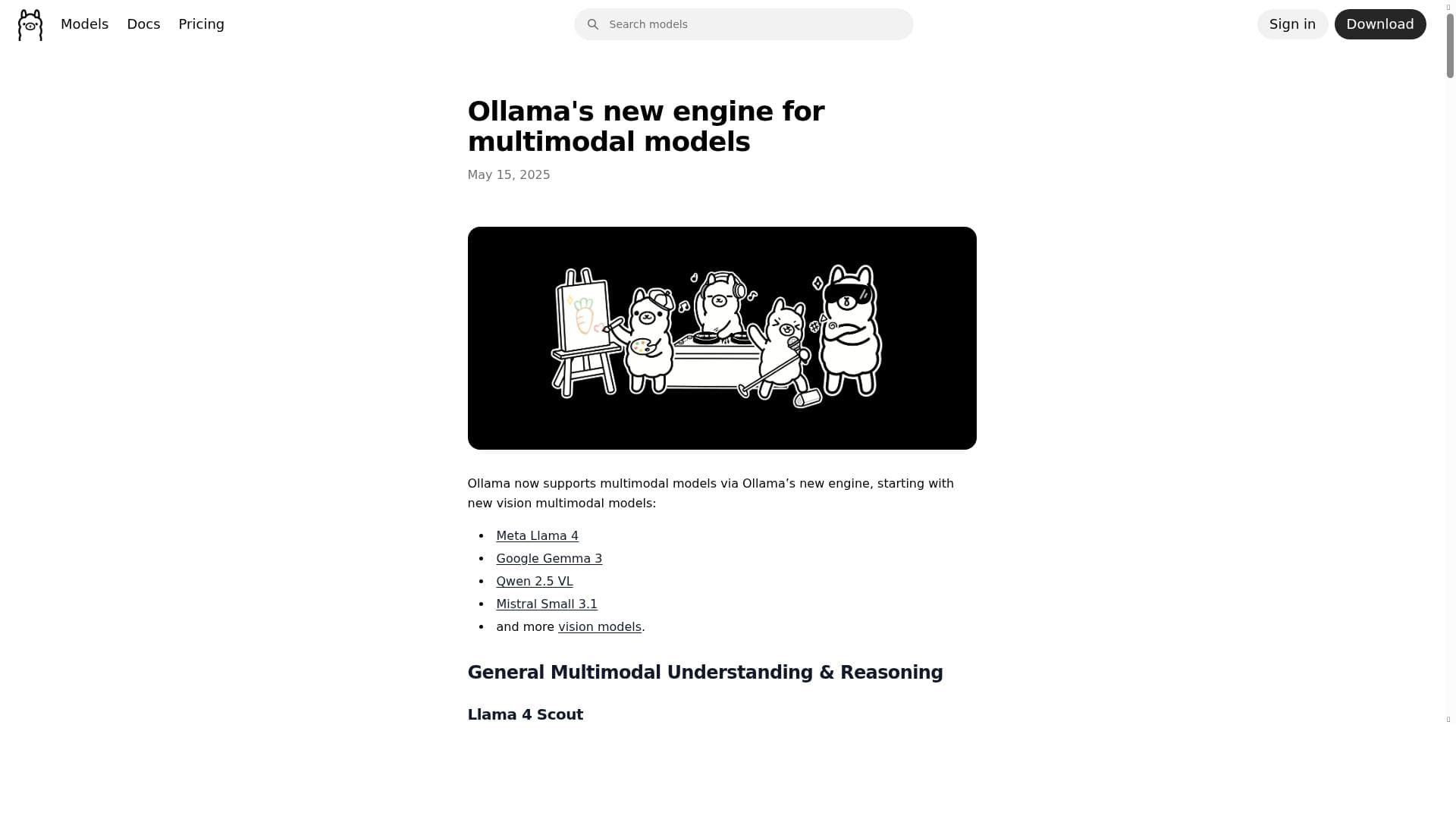
Ollama v0.7 revolutionizes multimodal AI by enabling local execution of advanced vision models like Llama 4 and Gemma 3, delivering enhanced reliability, accuracy, and memory management. Ideal for developers and enterprises seeking powerful, privacy-conscious AI solutions that seamlessly integrate multiple data types for richer insights.
Ollama v0.7 is a cutting-edge AI tool designed to bring first-class multimodal artificial intelligence capabilities to users, particularly focusing on vision models such as Llama 4 and Gemma 3. At its core, Ollama v0.7 introduces a powerful new engine that enables seamless integration and operation of large language models (LLMs) locally on users' devices. This local execution is a significant advancement, providing enhanced reliability, improved accuracy, and optimized memory management compared to previous versions or alternative cloud-dependent solutions. By supporting multimodal inputs, Ollama v0.7 allows users to work with diverse data types simultaneously, such as images combined with text, enabling richer and more context-aware AI interactions. The key features of Ollama v0.7 revolve around its support for new multimodal models and its advanced engine architecture. This engine is specifically optimized to handle complex AI model integration, allowing developers and users to deploy and run sophisticated LLMs with greater efficiency. The improved memory management ensures that even resource-intensive models can operate smoothly on local hardware without compromising performance. Additionally, Ollama v0.7 enhances performance when processing multiple data inputs, which is crucial for applications requiring simultaneous analysis of visual and textual information. This makes it particularly valuable for tasks like image captioning, visual question answering, and other AI-driven multimodal workflows. Ollama v0.7 is best suited for AI researchers, developers, and enterprises looking to leverage advanced multimodal AI models without relying heavily on cloud infrastructure. Its local execution model appeals to users concerned with data privacy, latency, and control over their AI workloads. Use cases span from academic research in AI and machine learning to practical applications in industries such as healthcare, where analyzing medical images alongside patient data is critical, or in creative fields where AI assists in multimedia content generation. The tool also benefits developers building AI-powered applications that require robust multimodal understanding and interaction. Regarding pricing, Ollama v0.7 follows a freemium model, allowing users to access core functionalities at no cost while offering premium features or expanded capabilities under paid plans. This approach makes it accessible for individual users and small teams to experiment and build with the tool before scaling up to commercial use. The freemium pricing strategy encourages adoption by lowering entry barriers while providing options for advanced users who need more extensive resources or support. When compared to alternatives, Ollama v0.7 stands out due to its emphasis on local model execution combined with multimodal AI support. Many competing platforms rely heavily on cloud-based APIs, which can introduce latency, privacy concerns, and recurring costs. Ollama's local engine addresses these issues by enabling offline operation and giving users full control over their data and models. However, this local approach may require users to have sufficiently powerful hardware to maximize performance, which could be a limitation for those with less capable devices. Notable considerations include the current scope of supported models, which, while impressive with Llama 4 and Gemma 3, may not cover all AI model types or domains yet. Users should also be aware of the technical requirements for running large models locally, including memory and processing power. Additionally, as a relatively new release, Ollama v0.7 may continue to evolve rapidly, so staying updated with the latest versions and community feedback is advisable to fully leverage its capabilities. Overall, Ollama v0.7 offers a robust, innovative solution for multimodal AI applications with a strong focus on local execution, making it a compelling choice for users prioritizing privacy, performance, and advanced multimodal integration.

Description
Ollama v0.7 revolutionizes multimodal AI by enabling local execution of advanced vision models like Llama 4 and Gemma 3, delivering enhanced reliability, accuracy, and memory management. Ideal for developers and enterprises seeking powerful, privacy-conscious AI solutions that seamlessly integrate multiple data types for richer insights.
Ollama v0.7 is a cutting-edge AI tool designed to bring first-class multimodal artificial intelligence capabilities to users, particularly focusing on vision models such as Llama 4 and Gemma 3. At its core, Ollama v0.7 introduces a powerful new engine that enables seamless integration and operation of large language models (LLMs) locally on users' devices. This local execution is a significant advancement, providing enhanced reliability, improved accuracy, and optimized memory management compared to previous versions or alternative cloud-dependent solutions. By supporting multimodal inputs, Ollama v0.7 allows users to work with diverse data types simultaneously, such as images combined with text, enabling richer and more context-aware AI interactions. The key features of Ollama v0.7 revolve around its support for new multimodal models and its advanced engine architecture. This engine is specifically optimized to handle complex AI model integration, allowing developers and users to deploy and run sophisticated LLMs with greater efficiency. The improved memory management ensures that even resource-intensive models can operate smoothly on local hardware without compromising performance. Additionally, Ollama v0.7 enhances performance when processing multiple data inputs, which is crucial for applications requiring simultaneous analysis of visual and textual information. This makes it particularly valuable for tasks like image captioning, visual question answering, and other AI-driven multimodal workflows. Ollama v0.7 is best suited for AI researchers, developers, and enterprises looking to leverage advanced multimodal AI models without relying heavily on cloud infrastructure. Its local execution model appeals to users concerned with data privacy, latency, and control over their AI workloads. Use cases span from academic research in AI and machine learning to practical applications in industries such as healthcare, where analyzing medical images alongside patient data is critical, or in creative fields where AI assists in multimedia content generation. The tool also benefits developers building AI-powered applications that require robust multimodal understanding and interaction. Regarding pricing, Ollama v0.7 follows a freemium model, allowing users to access core functionalities at no cost while offering premium features or expanded capabilities under paid plans. This approach makes it accessible for individual users and small teams to experiment and build with the tool before scaling up to commercial use. The freemium pricing strategy encourages adoption by lowering entry barriers while providing options for advanced users who need more extensive resources or support. When compared to alternatives, Ollama v0.7 stands out due to its emphasis on local model execution combined with multimodal AI support. Many competing platforms rely heavily on cloud-based APIs, which can introduce latency, privacy concerns, and recurring costs. Ollama's local engine addresses these issues by enabling offline operation and giving users full control over their data and models. However, this local approach may require users to have sufficiently powerful hardware to maximize performance, which could be a limitation for those with less capable devices. Notable considerations include the current scope of supported models, which, while impressive with Llama 4 and Gemma 3, may not cover all AI model types or domains yet. Users should also be aware of the technical requirements for running large models locally, including memory and processing power. Additionally, as a relatively new release, Ollama v0.7 may continue to evolve rapidly, so staying updated with the latest versions and community feedback is advisable to fully leverage its capabilities. Overall, Ollama v0.7 offers a robust, innovative solution for multimodal AI applications with a strong focus on local execution, making it a compelling choice for users prioritizing privacy, performance, and advanced multimodal integration.
Tool Features
- Supports new multimodal models
- Advanced engine for AI model integration
- Enhanced performance with multiple data inputs
Frequently Asked Questions
What is Ollama v0.7?
Ollama v0.7 is an AI tool featuring a new engine designed for first-class multimodal AI, supporting vision models such as Llama 4 and Gemma 3. It enables running large language models locally with improved reliability, accuracy, and memory management.
How much does Ollama v0.7 cost?
Ollama v0.7 follows a freemium pricing model, offering free access to core features with options for paid plans that unlock advanced capabilities and additional resources.
Who is Ollama v0.7 best for?
It is best suited for AI researchers, developers, and enterprises that require advanced multimodal AI capabilities, especially those prioritizing local model execution for privacy, control, and performance.
What are the main features of Ollama v0.7?
Key features include support for new multimodal models, an advanced engine for seamless AI model integration, and enhanced performance when processing multiple data inputs simultaneously.
Does Ollama v0.7 offer a free trial?
Yes, the freemium model allows users to access core functionalities for free, effectively serving as a free trial to explore the tool's capabilities before opting for paid plans.
What integrations does Ollama v0.7 support?
Ollama v0.7 supports integration with multimodal AI models like Llama 4 and Gemma 3, enabling combined processing of vision and language data within its advanced engine framework.
How does Ollama v0.7 work?
Ollama v0.7 operates by running large language models locally using a new engine optimized for multimodal AI. It processes multiple data types, such as images and text, simultaneously with improved memory management and accuracy.
Socials
Use ToolSponsored Tools































Reviews
No reviews yet. Be the first to share your experience.