Description
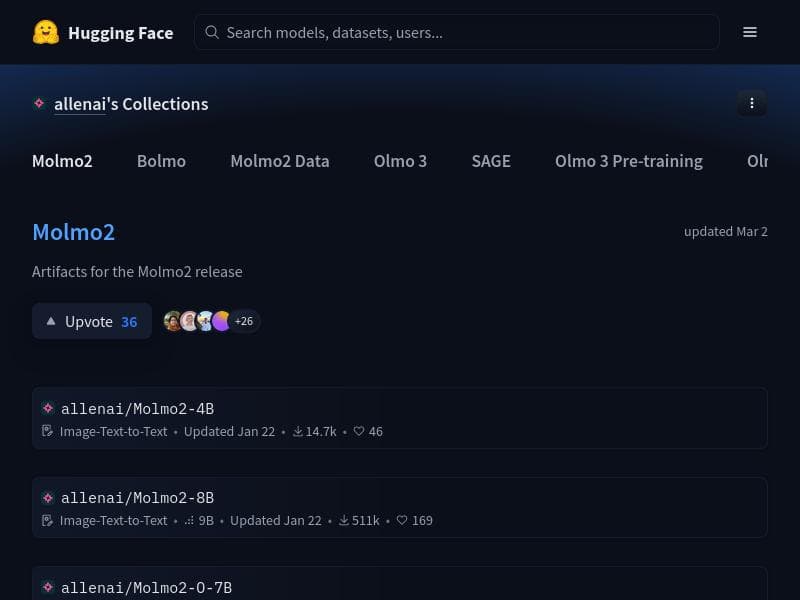
Molmo 2 is a cutting-edge, open-source suite of vision-language models designed to analyze videos and multiple images simultaneously. Ideal for researchers and developers, it offers unparalleled transparency with open weights, training data, and code, enabling advanced multimodal AI experimentation and innovation.
Molmo 2 is an advanced suite of vision-language models developed to push the boundaries of multimodal AI research. Its core purpose is to provide researchers and developers with state-of-the-art tools capable of analyzing complex visual data, including videos and multiple images simultaneously, while integrating natural language understanding. Unlike many proprietary AI models, Molmo 2 is fully open-source, offering open weights, training data, and training code. This transparency empowers the AI community to experiment, fine-tune, and build upon the models without restrictions, fostering innovation and collaboration in vision-language tasks. At its core, Molmo 2 excels in processing and interpreting visual inputs alongside textual data, enabling applications such as video content analysis, image captioning, and multimodal reasoning. The suite includes a collection of AI artifacts hosted on the Hugging Face platform, which is a widely recognized hub for machine learning models and datasets. This hosting ensures easy accessibility and integration with existing ML workflows. The open weights allow users to customize and adapt the models to specific domains or datasets, while the availability of training data and code encourages reproducibility and further research advancements. Key features of Molmo 2 include its ability to handle multiple images and video frames concurrently, a significant step beyond many vision-language models that typically focus on single images. This capability makes it particularly powerful for applications requiring temporal understanding or cross-image context, such as video summarization, event detection, or multi-scene analysis. The suite’s open-source nature means that researchers can inspect the model architectures, training procedures, and datasets, which is invaluable for academic and industrial research aiming to understand or improve vision-language integration. Additionally, being hosted on Hugging Face provides seamless integration with popular ML libraries and tools, facilitating rapid prototyping and deployment. Molmo 2 is best suited for machine learning researchers, AI developers, and organizations focused on advancing multimodal AI technologies. Its openness and comprehensive resources make it ideal for academic research projects, experimental AI applications, and startups looking to leverage cutting-edge vision-language models without the constraints of proprietary licenses. Use cases include video content analysis for media companies, automated image and video captioning for accessibility solutions, and complex multimodal reasoning tasks in robotics or surveillance. Regarding pricing, Molmo 2 is offered completely free of charge. This accessibility lowers the barrier for entry, enabling a broad range of users to experiment with and deploy the models. Since it is hosted on Hugging Face, users may incur costs related to cloud compute resources if they choose to run the models on Hugging Face’s infrastructure or other cloud platforms, but the tool itself and its assets are free. When compared to alternatives, Molmo 2 stands out due to its open-source commitment and its ability to process multiple images and videos simultaneously. Many commercial vision-language models are closed-source and focus on single-image tasks, limiting flexibility and transparency. Molmo 2’s comprehensive openness and support for video analysis provide a unique value proposition for researchers and developers seeking customizable, transparent, and powerful multimodal AI tools. However, users should consider that as an open-source research suite, Molmo 2 may require significant expertise to deploy and fine-tune effectively. It may not offer the same level of out-of-the-box user experience or customer support as commercial products. Additionally, performance and scalability depend on the user’s computational resources and implementation choices. Despite these considerations, Molmo 2 remains a highly valuable resource for advancing vision-language AI research and applications.

Description
Molmo 2 is a cutting-edge, open-source suite of vision-language models designed to analyze videos and multiple images simultaneously. Ideal for researchers and developers, it offers unparalleled transparency with open weights, training data, and code, enabling advanced multimodal AI experimentation and innovation.
Molmo 2 is an advanced suite of vision-language models developed to push the boundaries of multimodal AI research. Its core purpose is to provide researchers and developers with state-of-the-art tools capable of analyzing complex visual data, including videos and multiple images simultaneously, while integrating natural language understanding. Unlike many proprietary AI models, Molmo 2 is fully open-source, offering open weights, training data, and training code. This transparency empowers the AI community to experiment, fine-tune, and build upon the models without restrictions, fostering innovation and collaboration in vision-language tasks. At its core, Molmo 2 excels in processing and interpreting visual inputs alongside textual data, enabling applications such as video content analysis, image captioning, and multimodal reasoning. The suite includes a collection of AI artifacts hosted on the Hugging Face platform, which is a widely recognized hub for machine learning models and datasets. This hosting ensures easy accessibility and integration with existing ML workflows. The open weights allow users to customize and adapt the models to specific domains or datasets, while the availability of training data and code encourages reproducibility and further research advancements. Key features of Molmo 2 include its ability to handle multiple images and video frames concurrently, a significant step beyond many vision-language models that typically focus on single images. This capability makes it particularly powerful for applications requiring temporal understanding or cross-image context, such as video summarization, event detection, or multi-scene analysis. The suite’s open-source nature means that researchers can inspect the model architectures, training procedures, and datasets, which is invaluable for academic and industrial research aiming to understand or improve vision-language integration. Additionally, being hosted on Hugging Face provides seamless integration with popular ML libraries and tools, facilitating rapid prototyping and deployment. Molmo 2 is best suited for machine learning researchers, AI developers, and organizations focused on advancing multimodal AI technologies. Its openness and comprehensive resources make it ideal for academic research projects, experimental AI applications, and startups looking to leverage cutting-edge vision-language models without the constraints of proprietary licenses. Use cases include video content analysis for media companies, automated image and video captioning for accessibility solutions, and complex multimodal reasoning tasks in robotics or surveillance. Regarding pricing, Molmo 2 is offered completely free of charge. This accessibility lowers the barrier for entry, enabling a broad range of users to experiment with and deploy the models. Since it is hosted on Hugging Face, users may incur costs related to cloud compute resources if they choose to run the models on Hugging Face’s infrastructure or other cloud platforms, but the tool itself and its assets are free. When compared to alternatives, Molmo 2 stands out due to its open-source commitment and its ability to process multiple images and videos simultaneously. Many commercial vision-language models are closed-source and focus on single-image tasks, limiting flexibility and transparency. Molmo 2’s comprehensive openness and support for video analysis provide a unique value proposition for researchers and developers seeking customizable, transparent, and powerful multimodal AI tools. However, users should consider that as an open-source research suite, Molmo 2 may require significant expertise to deploy and fine-tune effectively. It may not offer the same level of out-of-the-box user experience or customer support as commercial products. Additionally, performance and scalability depend on the user’s computational resources and implementation choices. Despite these considerations, Molmo 2 remains a highly valuable resource for advancing vision-language AI research and applications.
Tool Features
- Collection of AI artifacts
- Supports machine learning research
- Hosted on Hugging Face platform
Frequently Asked Questions
What is Molmo 2?
Molmo 2 is a suite of state-of-the-art vision-language models that can analyze videos and multiple images at once. It provides open weights, training data, and training code to support machine learning research and development.
How much does Molmo 2 cost?
Molmo 2 is completely free to use. The models, training data, and code are openly available without any licensing fees.
Who is Molmo 2 best for?
Molmo 2 is best suited for machine learning researchers, AI developers, and organizations focused on multimodal AI research and applications, especially those needing to analyze video and multiple images simultaneously.
What are the main features of Molmo 2?
Key features include the ability to process videos and multiple images concurrently, open-source weights and training data, a collection of AI artifacts, and hosting on the Hugging Face platform for easy access and integration.
Does Molmo 2 offer a free trial?
Since Molmo 2 is fully open-source and free, there is no need for a trial period. Users can access and use the models immediately without cost.
What integrations does Molmo 2 support?
Molmo 2 is hosted on Hugging Face, allowing seamless integration with popular machine learning frameworks and tools supported by the Hugging Face ecosystem.
How does Molmo 2 work?
Molmo 2 uses advanced vision-language models trained on large datasets to analyze and interpret visual inputs like videos and multiple images alongside textual data. Its open weights and training code enable customization and further research.
Socials
Use ToolSponsored Tools


































Reviews
No reviews yet. Be the first to share your experience.