Mistral small 3.1
Description
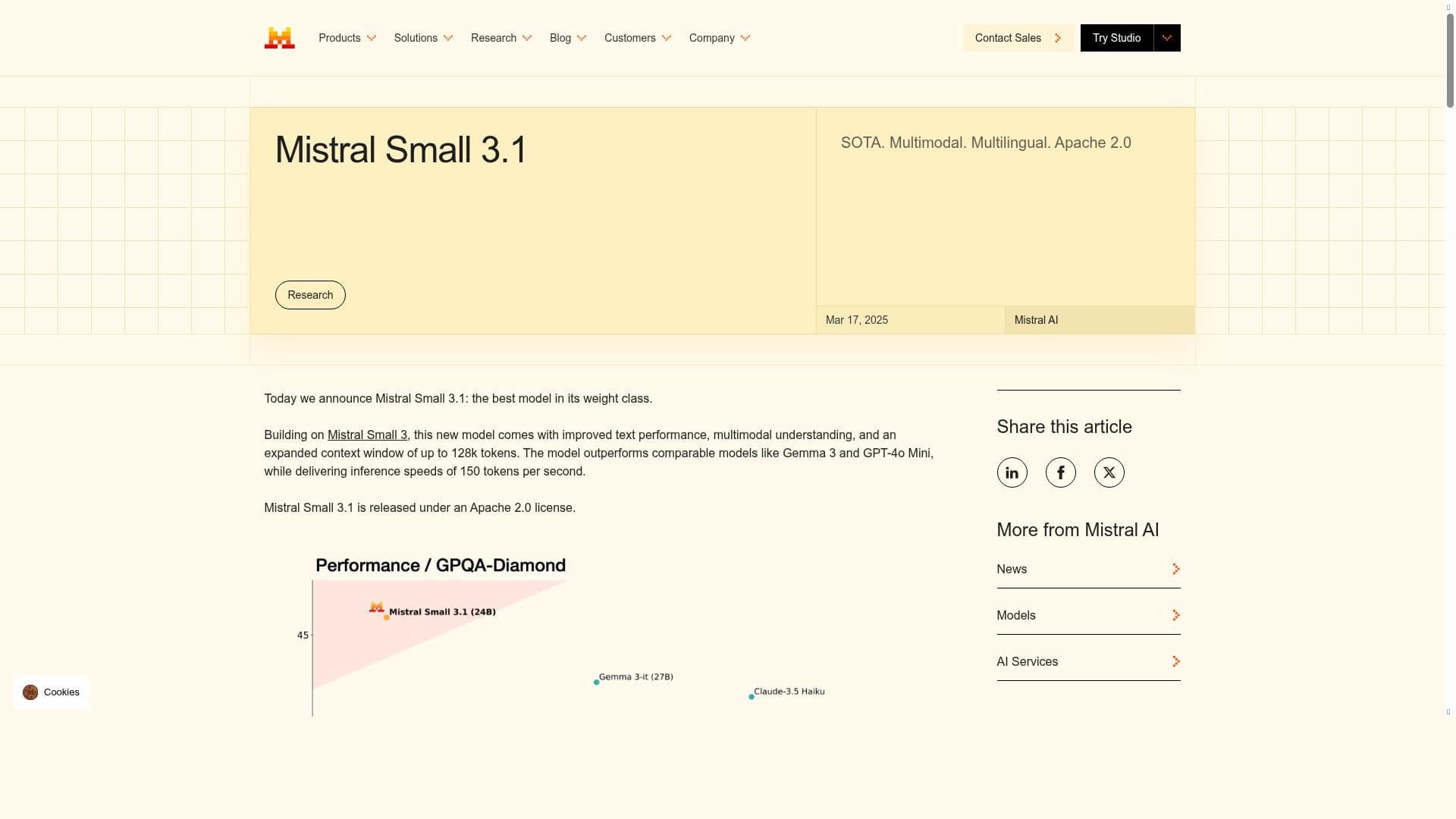
Mistral Small 3.1 is a cutting-edge, multimodal AI model that outperforms competitors like Gemma 3 and GPT 4o-mini while being freely available under an Apache 2.0 license. Its powerful multilingual and multimodal capabilities make it ideal for developers and organizations seeking a versatile, cost-effective AI solution for diverse applications.
Mistral Small 3.1 is an advanced multimodal AI model designed to deliver state-of-the-art performance across a variety of tasks involving text, images, and other data types. Developed with a focus on versatility and accessibility, this model is released under the Apache 2.0 license, making it freely available for both commercial and research purposes. Its core purpose is to provide developers, researchers, and organizations with a powerful yet lightweight AI solution that can handle complex multimodal inputs and generate high-quality outputs. By outperforming notable models like Gemma 3 and GPT 4o-mini, Mistral Small 3.1 positions itself as a competitive alternative in the rapidly evolving AI landscape. Key features of Mistral Small 3.1 include its multimodal capabilities, which allow it to process and understand multiple types of data simultaneously, such as text combined with images. This enables a wide range of applications, from enhanced content generation and summarization to more sophisticated image captioning and cross-modal retrieval. The model also supports multiple languages, broadening its usability for global applications and diverse user bases. Its architecture and training optimize both efficiency and accuracy, allowing it to deliver high performance without the heavy computational costs typically associated with larger models. Additionally, the Apache 2.0 license ensures that users can integrate, modify, and distribute the model freely, fostering innovation and collaboration within the AI community. Mistral Small 3.1 is best suited for developers, startups, and enterprises looking for a robust AI model that balances power and accessibility. It is ideal for applications requiring multimodal understanding, such as interactive chatbots that interpret images and text, content creation platforms that generate multilingual outputs, and research projects exploring cross-modal AI capabilities. Educational institutions and AI enthusiasts will also find it valuable due to its open licensing and ease of integration. Specific use cases include automated customer support with image recognition, multilingual content moderation, and AI-driven creative tools that blend visual and textual inputs. In terms of pricing, Mistral Small 3.1 is offered completely free of charge, reflecting its open-source nature under the Apache 2.0 license. This eliminates barriers to entry for users who want to experiment with or deploy advanced AI models without incurring licensing fees. The free availability encourages widespread adoption and community-driven enhancements, making it an attractive option for those seeking cost-effective AI solutions. When compared to alternatives like Gemma 3 and GPT 4o-mini, Mistral Small 3.1 demonstrates superior performance, particularly in multimodal tasks. Its multilingual support and efficient architecture give it an edge in both versatility and speed. Unlike some proprietary models that restrict usage or require paid subscriptions, Mistral Small 3.1’s open license offers greater freedom and flexibility. However, while it excels in many areas, users should consider that as a smaller model, it might not match the raw power or scale of larger, more resource-intensive AI systems, which could impact performance on extremely large or highly specialized datasets. Notable limitations include potential constraints in handling extremely large-scale or highly specialized tasks that require massive computational resources or domain-specific fine-tuning. Additionally, as with many multimodal models, the quality of outputs can depend heavily on the quality and diversity of input data. Users should also be mindful of the need for technical expertise to integrate and fine-tune the model effectively within their specific environments. Despite these considerations, Mistral Small 3.1 remains a compelling choice for those seeking a cutting-edge, accessible, and versatile AI model capable of handling complex multimodal challenges.

Description
Mistral Small 3.1 is a cutting-edge, multimodal AI model that outperforms competitors like Gemma 3 and GPT 4o-mini while being freely available under an Apache 2.0 license. Its powerful multilingual and multimodal capabilities make it ideal for developers and organizations seeking a versatile, cost-effective AI solution for diverse applications.
Mistral Small 3.1 is an advanced multimodal AI model designed to deliver state-of-the-art performance across a variety of tasks involving text, images, and other data types. Developed with a focus on versatility and accessibility, this model is released under the Apache 2.0 license, making it freely available for both commercial and research purposes. Its core purpose is to provide developers, researchers, and organizations with a powerful yet lightweight AI solution that can handle complex multimodal inputs and generate high-quality outputs. By outperforming notable models like Gemma 3 and GPT 4o-mini, Mistral Small 3.1 positions itself as a competitive alternative in the rapidly evolving AI landscape. Key features of Mistral Small 3.1 include its multimodal capabilities, which allow it to process and understand multiple types of data simultaneously, such as text combined with images. This enables a wide range of applications, from enhanced content generation and summarization to more sophisticated image captioning and cross-modal retrieval. The model also supports multiple languages, broadening its usability for global applications and diverse user bases. Its architecture and training optimize both efficiency and accuracy, allowing it to deliver high performance without the heavy computational costs typically associated with larger models. Additionally, the Apache 2.0 license ensures that users can integrate, modify, and distribute the model freely, fostering innovation and collaboration within the AI community. Mistral Small 3.1 is best suited for developers, startups, and enterprises looking for a robust AI model that balances power and accessibility. It is ideal for applications requiring multimodal understanding, such as interactive chatbots that interpret images and text, content creation platforms that generate multilingual outputs, and research projects exploring cross-modal AI capabilities. Educational institutions and AI enthusiasts will also find it valuable due to its open licensing and ease of integration. Specific use cases include automated customer support with image recognition, multilingual content moderation, and AI-driven creative tools that blend visual and textual inputs. In terms of pricing, Mistral Small 3.1 is offered completely free of charge, reflecting its open-source nature under the Apache 2.0 license. This eliminates barriers to entry for users who want to experiment with or deploy advanced AI models without incurring licensing fees. The free availability encourages widespread adoption and community-driven enhancements, making it an attractive option for those seeking cost-effective AI solutions. When compared to alternatives like Gemma 3 and GPT 4o-mini, Mistral Small 3.1 demonstrates superior performance, particularly in multimodal tasks. Its multilingual support and efficient architecture give it an edge in both versatility and speed. Unlike some proprietary models that restrict usage or require paid subscriptions, Mistral Small 3.1’s open license offers greater freedom and flexibility. However, while it excels in many areas, users should consider that as a smaller model, it might not match the raw power or scale of larger, more resource-intensive AI systems, which could impact performance on extremely large or highly specialized datasets. Notable limitations include potential constraints in handling extremely large-scale or highly specialized tasks that require massive computational resources or domain-specific fine-tuning. Additionally, as with many multimodal models, the quality of outputs can depend heavily on the quality and diversity of input data. Users should also be mindful of the need for technical expertise to integrate and fine-tune the model effectively within their specific environments. Despite these considerations, Mistral Small 3.1 remains a compelling choice for those seeking a cutting-edge, accessible, and versatile AI model capable of handling complex multimodal challenges.
Tool Features
- State-of-the-art AI model
- Multimodal capabilities
- Multilingual support
- Apache 2.0 license
Frequently Asked Questions
What is Mistral small 3.1?
Mistral Small 3.1 is a state-of-the-art multimodal AI model designed to process and generate content from multiple data types such as text and images. It offers advanced multilingual support and is released under the Apache 2.0 license, making it freely available for various applications.
How much does Mistral small 3.1 cost?
Mistral Small 3.1 is completely free to use, distributed under the Apache 2.0 license, which allows for free commercial and research use without any licensing fees.
Who is Mistral small 3.1 best for?
It is best suited for developers, startups, enterprises, researchers, and educators who need a powerful yet accessible AI model capable of handling multimodal and multilingual tasks across various industries and applications.
What are the main features of Mistral small 3.1?
The main features include state-of-the-art AI performance, multimodal capabilities to process text and images, multilingual support for global applications, and an Apache 2.0 open-source license that enables free use and modification.
Does Mistral small 3.1 offer a free trial?
Since Mistral Small 3.1 is offered for free under an open-source license, there is no need for a trial period; users can access and use the model immediately without cost.
What integrations does Mistral small 3.1 support?
While specific integrations depend on user implementation, Mistral Small 3.1’s open-source nature allows it to be integrated into various AI frameworks, applications, and platforms that support multimodal AI models.
How does Mistral small 3.1 work?
Mistral Small 3.1 works by leveraging advanced neural network architectures trained on diverse multimodal datasets, enabling it to understand and generate content from multiple input types such as text and images, with multilingual capabilities enhancing its versatility.
Socials
Use ToolSponsored Tools































Reviews
No reviews yet. Be the first to share your experience.