Microsoft Phi-4
Description
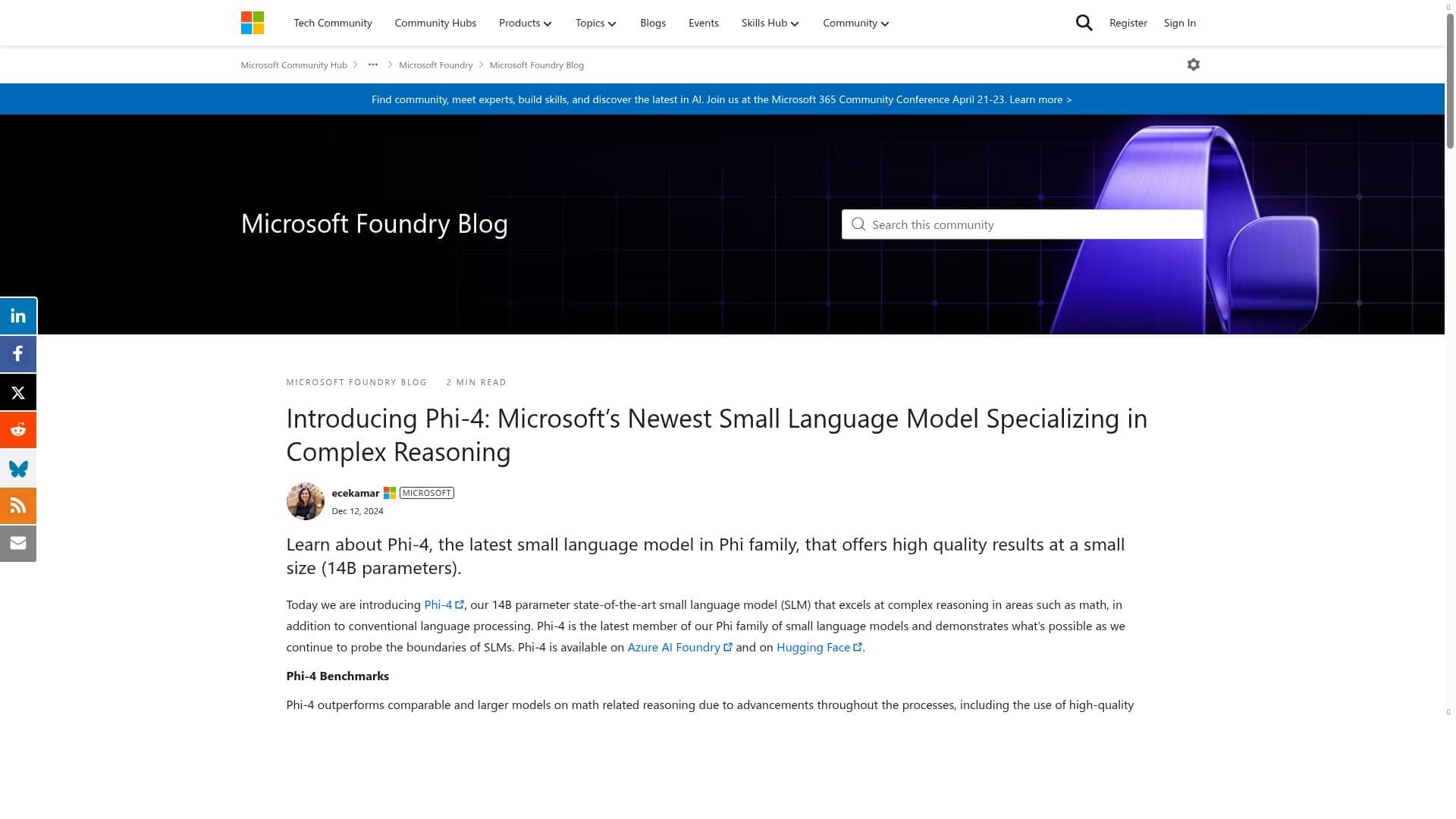
Microsoft Phi-4 is a 14-billion parameter small language model uniquely optimized for complex reasoning and mathematical problem-solving, delivering high performance with efficient resource use. Ideal for researchers and developers needing advanced AI reasoning capabilities, it offers free access via Azure AI Foundry and Hugging Face, setting a new standard for scalable AI solutions.
Microsoft Phi-4 is a cutting-edge small language model developed by Microsoft, featuring 14 billion parameters. Designed to excel in complex reasoning tasks, particularly those involving mathematical computations and intricate problem-solving, Phi-4 strikes a balance between high performance and computational efficiency. Its core purpose is to provide advanced AI capabilities that can be deployed at scale without the heavy resource demands typically associated with larger models. This makes it an ideal solution for organizations and developers seeking powerful AI reasoning tools that are both accessible and efficient. At the heart of Phi-4 is a state-of-the-art architecture optimized for reasoning-intensive applications. Unlike many large language models that prioritize general language understanding, Phi-4 specializes in mathematical reasoning and complex problem-solving, enabling it to handle tasks that require logical deduction, symbolic manipulation, and multi-step calculations. Despite its relatively compact size compared to massive models with hundreds of billions of parameters, Phi-4 maintains competitive performance, making it highly suitable for deployment in environments where computational resources and latency are critical factors. Phi-4 is available through Microsoft’s Azure AI Foundry and the Hugging Face platform, ensuring easy integration into existing AI workflows and cloud infrastructures. This accessibility allows data scientists, researchers, and developers to leverage the model’s capabilities for a variety of use cases, including academic research, financial modeling, scientific simulations, and educational tools that require advanced reasoning. Its compact size facilitates deployment on edge devices or cloud instances with limited resources, broadening its applicability across industries. The model is offered free of charge, lowering the barrier to entry for organizations and individuals interested in exploring advanced AI reasoning without incurring significant costs. This pricing strategy encourages experimentation and innovation, allowing users to incorporate Phi-4 into their projects and applications without upfront investment. Additionally, the availability on popular platforms like Hugging Face simplifies access and integration, providing a seamless user experience. Compared to other language models, Phi-4 stands out due to its specialized focus on complex reasoning and mathematical problem-solving. While larger models like GPT-4 offer broad capabilities across diverse domains, they often require substantial computational resources and may not be optimized for specific reasoning tasks. Phi-4’s design prioritizes efficiency and targeted performance, making it a compelling alternative for users whose primary needs revolve around logical and mathematical challenges. This specialization also means that Phi-4 can outperform more generalist models in its niche, delivering more accurate and reliable results in relevant applications. However, potential users should consider that Phi-4’s specialization may limit its effectiveness in tasks outside of complex reasoning and math. For applications requiring extensive natural language understanding, creative generation, or conversational AI, other models might be more suitable. Additionally, as a relatively new model, Phi-4’s ecosystem and community support may still be growing compared to more established AI models. Users should evaluate their specific requirements and test the model’s capabilities to ensure alignment with their project goals. In summary, Microsoft Phi-4 is a powerful, efficient, and accessible small language model tailored for complex reasoning and mathematical problem-solving. Its availability on major AI platforms and free pricing make it an attractive option for researchers, developers, and enterprises seeking advanced AI reasoning without the overhead of massive models. While it excels in its specialized domain, users should weigh its focused capabilities against broader AI needs to determine the best fit for their applications.

Description
Microsoft Phi-4 is a 14-billion parameter small language model uniquely optimized for complex reasoning and mathematical problem-solving, delivering high performance with efficient resource use. Ideal for researchers and developers needing advanced AI reasoning capabilities, it offers free access via Azure AI Foundry and Hugging Face, setting a new standard for scalable AI solutions.
Microsoft Phi-4 is a cutting-edge small language model developed by Microsoft, featuring 14 billion parameters. Designed to excel in complex reasoning tasks, particularly those involving mathematical computations and intricate problem-solving, Phi-4 strikes a balance between high performance and computational efficiency. Its core purpose is to provide advanced AI capabilities that can be deployed at scale without the heavy resource demands typically associated with larger models. This makes it an ideal solution for organizations and developers seeking powerful AI reasoning tools that are both accessible and efficient. At the heart of Phi-4 is a state-of-the-art architecture optimized for reasoning-intensive applications. Unlike many large language models that prioritize general language understanding, Phi-4 specializes in mathematical reasoning and complex problem-solving, enabling it to handle tasks that require logical deduction, symbolic manipulation, and multi-step calculations. Despite its relatively compact size compared to massive models with hundreds of billions of parameters, Phi-4 maintains competitive performance, making it highly suitable for deployment in environments where computational resources and latency are critical factors. Phi-4 is available through Microsoft’s Azure AI Foundry and the Hugging Face platform, ensuring easy integration into existing AI workflows and cloud infrastructures. This accessibility allows data scientists, researchers, and developers to leverage the model’s capabilities for a variety of use cases, including academic research, financial modeling, scientific simulations, and educational tools that require advanced reasoning. Its compact size facilitates deployment on edge devices or cloud instances with limited resources, broadening its applicability across industries. The model is offered free of charge, lowering the barrier to entry for organizations and individuals interested in exploring advanced AI reasoning without incurring significant costs. This pricing strategy encourages experimentation and innovation, allowing users to incorporate Phi-4 into their projects and applications without upfront investment. Additionally, the availability on popular platforms like Hugging Face simplifies access and integration, providing a seamless user experience. Compared to other language models, Phi-4 stands out due to its specialized focus on complex reasoning and mathematical problem-solving. While larger models like GPT-4 offer broad capabilities across diverse domains, they often require substantial computational resources and may not be optimized for specific reasoning tasks. Phi-4’s design prioritizes efficiency and targeted performance, making it a compelling alternative for users whose primary needs revolve around logical and mathematical challenges. This specialization also means that Phi-4 can outperform more generalist models in its niche, delivering more accurate and reliable results in relevant applications. However, potential users should consider that Phi-4’s specialization may limit its effectiveness in tasks outside of complex reasoning and math. For applications requiring extensive natural language understanding, creative generation, or conversational AI, other models might be more suitable. Additionally, as a relatively new model, Phi-4’s ecosystem and community support may still be growing compared to more established AI models. Users should evaluate their specific requirements and test the model’s capabilities to ensure alignment with their project goals. In summary, Microsoft Phi-4 is a powerful, efficient, and accessible small language model tailored for complex reasoning and mathematical problem-solving. Its availability on major AI platforms and free pricing make it an attractive option for researchers, developers, and enterprises seeking advanced AI reasoning without the overhead of massive models. While it excels in its specialized domain, users should weigh its focused capabilities against broader AI needs to determine the best fit for their applications.
Tool Features
- 14 billion parameter small language model
- Excels at complex reasoning
- Specializes in math and intricate problem-solving
- State-of-the-art architecture
- Compact model size for efficient deployment
Frequently Asked Questions
What is Microsoft Phi-4?
Microsoft Phi-4 is a 14-billion parameter small language model developed by Microsoft, designed to excel in complex reasoning tasks, especially in mathematics and intricate problem-solving, while maintaining computational efficiency.
How much does Microsoft Phi-4 cost?
Microsoft Phi-4 is available free of charge, allowing users to access and utilize the model without any licensing fees.
Who is Microsoft Phi-4 best for?
Phi-4 is best suited for researchers, developers, and organizations that require advanced AI capabilities for complex reasoning, mathematical computations, and problem-solving tasks, particularly where computational efficiency is important.
What are the main features of Microsoft Phi-4?
Key features include a 14 billion parameter architecture, specialization in complex reasoning and math, state-of-the-art model design, and a compact size that enables efficient deployment across various platforms.
Does Microsoft Phi-4 offer a free trial?
Yes, Microsoft Phi-4 is offered for free, so users can access and experiment with the model without any trial restrictions or costs.
What integrations does Microsoft Phi-4 support?
Phi-4 is available on Microsoft’s Azure AI Foundry and the Hugging Face platform, allowing seamless integration into cloud-based AI workflows and applications.
How does Microsoft Phi-4 work?
Phi-4 uses a state-of-the-art small language model architecture with 14 billion parameters optimized for reasoning-intensive tasks. It processes input data to perform complex logical deductions and mathematical problem-solving efficiently, balancing performance with resource use.
Socials
Use ToolSponsored Tools






























Reviews
No reviews yet. Be the first to share your experience.