Description
Llama 4 is a free, open-source multimodal AI model collection that excels in integrating text and image understanding through a unique mixture-of-experts architecture. Ideal for developers and researchers seeking high performance, scalability, and flexibility, it supports massive context windows and offers lightweight variants for efficient deployment.
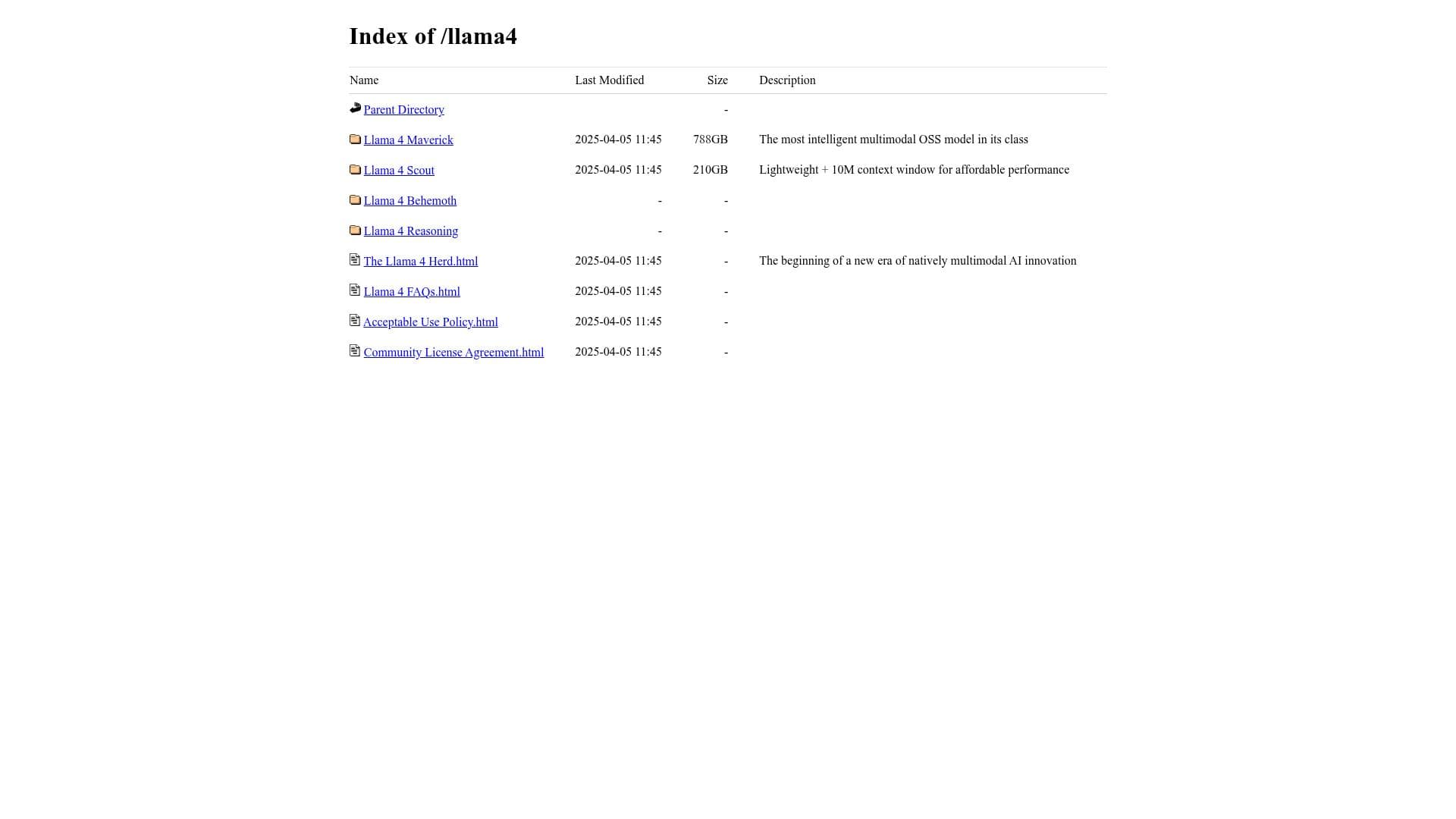
Llama 4 is a cutting-edge collection of multimodal AI models designed to seamlessly integrate text and image understanding within a single framework. At its core, Llama 4 leverages a mixture-of-experts architecture, which dynamically routes tasks to specialized sub-models or 'experts' to optimize performance and efficiency. This design enables Llama 4 to deliver industry-leading results in both natural language processing and computer vision tasks, making it a versatile tool for developers and researchers looking to build advanced AI applications that require robust multimodal capabilities. One of the standout features of Llama 4 is its native multimodality. Unlike traditional models that focus solely on text or images, Llama 4 is engineered to process and understand multiple data types simultaneously, enabling richer and more context-aware AI experiences. The model family includes several variants such as Maverick, Scout, and Behemoth, each tailored for different scales and use cases. Maverick and Scout offer lightweight, efficient options suitable for projects with limited computational resources, while Behemoth is designed for high-end applications demanding maximum performance and the ability to handle extremely large context windows. Speaking of context windows, Llama 4 supports an unprecedented token window size of up to 10 million tokens. This capability allows it to maintain context over very long documents or extensive multimodal inputs, which is a significant advantage for applications like long-form content generation, complex document analysis, or multi-turn conversational AI. Additionally, the model's architecture ensures unrivaled speed and efficiency, making it suitable for real-time applications and scalable deployments. Llama 4 is open-source, which encourages transparency, community collaboration, and customization. Developers can adapt the models to their specific needs, fine-tune them on domain-specific data, or integrate them into existing AI pipelines. This flexibility makes Llama 4 an excellent choice for AI researchers, startups, and enterprises aiming to innovate in fields such as natural language understanding, computer vision, multimodal content creation, and interactive AI systems. The tool is offered completely free of charge, removing financial barriers to access and experimentation. This pricing model is particularly attractive for academic institutions, independent developers, and organizations with budget constraints who still require state-of-the-art AI capabilities. By providing a no-cost entry point, Llama 4 fosters widespread adoption and accelerates AI innovation across diverse sectors. When compared to alternative multimodal AI models, Llama 4 stands out due to its combination of open-source availability, extensive context window support, and mixture-of-experts design. Many competing models either lack native multimodality or impose strict token limits, which constrain their applicability in complex scenarios. Moreover, Llama 4's lightweight variants offer a balance of affordability and performance that is often missing in other high-capacity models, making it accessible to a broader audience. However, potential users should consider that, as with many advanced AI models, deploying Llama 4 at scale may require significant computational resources, especially when utilizing the larger variants like Behemoth. Additionally, while the open-source nature allows for customization, it also means that users need a certain level of technical expertise to fine-tune and integrate the models effectively. Documentation and community support are crucial factors to evaluate when planning to adopt Llama 4 for production environments. In summary, Llama 4 is a powerful, versatile, and accessible multimodal AI model collection that pushes the boundaries of text and image understanding. Its innovative architecture, extensive feature set, and free availability make it an ideal choice for developers and organizations aiming to build sophisticated AI solutions that require deep contextual awareness and multimodal processing capabilities.

Description
Llama 4 is a free, open-source multimodal AI model collection that excels in integrating text and image understanding through a unique mixture-of-experts architecture. Ideal for developers and researchers seeking high performance, scalability, and flexibility, it supports massive context windows and offers lightweight variants for efficient deployment.
Llama 4 is a cutting-edge collection of multimodal AI models designed to seamlessly integrate text and image understanding within a single framework. At its core, Llama 4 leverages a mixture-of-experts architecture, which dynamically routes tasks to specialized sub-models or 'experts' to optimize performance and efficiency. This design enables Llama 4 to deliver industry-leading results in both natural language processing and computer vision tasks, making it a versatile tool for developers and researchers looking to build advanced AI applications that require robust multimodal capabilities. One of the standout features of Llama 4 is its native multimodality. Unlike traditional models that focus solely on text or images, Llama 4 is engineered to process and understand multiple data types simultaneously, enabling richer and more context-aware AI experiences. The model family includes several variants such as Maverick, Scout, and Behemoth, each tailored for different scales and use cases. Maverick and Scout offer lightweight, efficient options suitable for projects with limited computational resources, while Behemoth is designed for high-end applications demanding maximum performance and the ability to handle extremely large context windows. Speaking of context windows, Llama 4 supports an unprecedented token window size of up to 10 million tokens. This capability allows it to maintain context over very long documents or extensive multimodal inputs, which is a significant advantage for applications like long-form content generation, complex document analysis, or multi-turn conversational AI. Additionally, the model's architecture ensures unrivaled speed and efficiency, making it suitable for real-time applications and scalable deployments. Llama 4 is open-source, which encourages transparency, community collaboration, and customization. Developers can adapt the models to their specific needs, fine-tune them on domain-specific data, or integrate them into existing AI pipelines. This flexibility makes Llama 4 an excellent choice for AI researchers, startups, and enterprises aiming to innovate in fields such as natural language understanding, computer vision, multimodal content creation, and interactive AI systems. The tool is offered completely free of charge, removing financial barriers to access and experimentation. This pricing model is particularly attractive for academic institutions, independent developers, and organizations with budget constraints who still require state-of-the-art AI capabilities. By providing a no-cost entry point, Llama 4 fosters widespread adoption and accelerates AI innovation across diverse sectors. When compared to alternative multimodal AI models, Llama 4 stands out due to its combination of open-source availability, extensive context window support, and mixture-of-experts design. Many competing models either lack native multimodality or impose strict token limits, which constrain their applicability in complex scenarios. Moreover, Llama 4's lightweight variants offer a balance of affordability and performance that is often missing in other high-capacity models, making it accessible to a broader audience. However, potential users should consider that, as with many advanced AI models, deploying Llama 4 at scale may require significant computational resources, especially when utilizing the larger variants like Behemoth. Additionally, while the open-source nature allows for customization, it also means that users need a certain level of technical expertise to fine-tune and integrate the models effectively. Documentation and community support are crucial factors to evaluate when planning to adopt Llama 4 for production environments. In summary, Llama 4 is a powerful, versatile, and accessible multimodal AI model collection that pushes the boundaries of text and image understanding. Its innovative architecture, extensive feature set, and free availability make it an ideal choice for developers and organizations aiming to build sophisticated AI solutions that require deep contextual awareness and multimodal processing capabilities.
Tool Features
- Multimodal open-source model
- Variants include Maverick, Scout, and Behemoth
- Unrivaled speed and efficiency
- Supports large context windows up to 10M tokens
- Lightweight options for affordable performance
- Designed for advanced AI innovation
Frequently Asked Questions
What is Llama 4?
Llama 4 is a collection of natively multimodal AI models designed to handle both text and image data. It uses a mixture-of-experts architecture to deliver high performance and efficiency in understanding and generating multimodal content.
How much does Llama 4 cost?
Llama 4 is completely free to use, making it accessible for developers, researchers, and organizations without any licensing fees.
Who is Llama 4 best for?
Llama 4 is ideal for AI researchers, developers, startups, and enterprises looking to build advanced multimodal applications, including natural language processing, computer vision, and interactive AI systems.
What are the main features of Llama 4?
Key features include native multimodality, a mixture-of-experts architecture, variants like Maverick, Scout, and Behemoth, support for context windows up to 10 million tokens, unrivaled speed and efficiency, and lightweight options for affordable performance.
Does Llama 4 offer a free trial?
Llama 4 is offered as a free, open-source model collection, so there is no need for a trial period as it can be accessed and used without cost.
What integrations does Llama 4 support?
As an open-source model, Llama 4 can be integrated into various AI pipelines and platforms depending on user customization. It supports standard AI frameworks and can be adapted to specific workflows by developers.
How does Llama 4 work?
Llama 4 uses a mixture-of-experts architecture that dynamically routes input data to specialized sub-models, optimizing performance for both text and image understanding. Its multimodal design allows it to process and generate content across different data types efficiently.
Sponsored Tools
































Reviews
No reviews yet. Be the first to share your experience.