Description
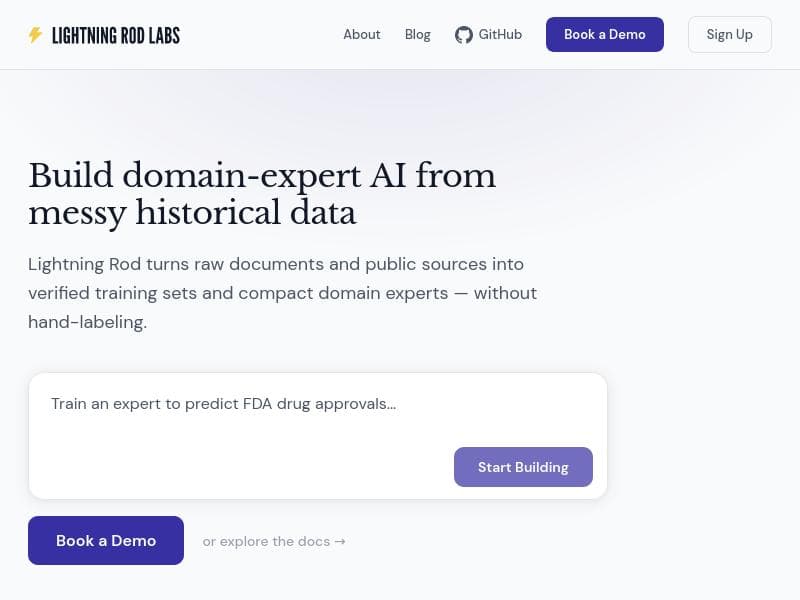
Lightning Rod SDK revolutionizes AI training by converting raw, real-world documents into verified, production-ready datasets within hours using minimal Python code. Ideal for data scientists and enterprises seeking to bypass manual labeling and synthetic data guesswork, it enables rapid, accurate fine-tuning of domain-specific AI models.
Lightning Rod is a powerful SDK designed to transform raw, real-world data such as news articles, regulatory filings, and proprietary documents into high-quality, verified training datasets rapidly and efficiently. Its core purpose is to eliminate the traditionally time-consuming and error-prone processes of manual data labeling and reliance on synthetic data generation, enabling organizations to build robust AI models with greater accuracy and speed. By leveraging just a few lines of Python code, users can convert diverse unstructured data sources into production-ready datasets within hours, significantly accelerating AI development cycles. One of the standout features of Lightning Rod is its ability to turn raw documents and public data sources into verified training sets. This capability ensures that the data used for model training is not only comprehensive but also validated against real-world outcomes, enhancing model reliability. The SDK also facilitates the creation of compact domain experts without the need for hand-labeling, which reduces human labor and potential biases. Furthermore, Lightning Rod supports fine-tuning of AI models, allowing users to customize and optimize models for specific tasks or industries based on the curated datasets it generates. This fine-tuning capability is essential for organizations seeking to deploy AI solutions tailored to niche domains or specialized applications. Lightning Rod is particularly well-suited for data scientists, machine learning engineers, and AI researchers who require rapid access to high-quality training data without the overhead of manual annotation. Industries such as finance, legal, healthcare, and media can benefit immensely from its ability to process complex documents and public records, enabling use cases like sentiment analysis from news, compliance monitoring from filings, and domain-specific model training from proprietary documents. By automating dataset creation, Lightning Rod empowers teams to focus more on model innovation and less on data preparation. Regarding pricing, Lightning Rod operates on a paid model, though specific pricing tiers or plans are not publicly detailed on their website. Interested users are encouraged to contact the company directly for customized pricing based on usage volume, data complexity, and support requirements. This approach suggests a flexible pricing strategy tailored to enterprise needs rather than a one-size-fits-all subscription. When compared to alternative data labeling and dataset generation tools, Lightning Rod stands out due to its focus on verified, real-world data and minimal manual intervention. Unlike traditional labeling platforms that depend heavily on human annotators or synthetic data augmentation, Lightning Rod leverages automated verification against actual outcomes, which can lead to more accurate and trustworthy AI models. However, users should consider that the SDK requires some familiarity with Python programming, which may present a learning curve for non-technical stakeholders. Additionally, since pricing details are not openly available, smaller organizations or individual practitioners might find it challenging to assess cost-effectiveness upfront. In summary, Lightning Rod offers a sophisticated solution for organizations aiming to streamline the creation of verified training datasets from complex, real-world data sources. Its automation capabilities reduce manual labor and improve dataset quality, making it an invaluable tool for accelerating AI model development in data-intensive industries. Potential users should evaluate their technical capacity and budget considerations to fully leverage the platform's benefits.

Description
Lightning Rod SDK revolutionizes AI training by converting raw, real-world documents into verified, production-ready datasets within hours using minimal Python code. Ideal for data scientists and enterprises seeking to bypass manual labeling and synthetic data guesswork, it enables rapid, accurate fine-tuning of domain-specific AI models.
Lightning Rod is a powerful SDK designed to transform raw, real-world data such as news articles, regulatory filings, and proprietary documents into high-quality, verified training datasets rapidly and efficiently. Its core purpose is to eliminate the traditionally time-consuming and error-prone processes of manual data labeling and reliance on synthetic data generation, enabling organizations to build robust AI models with greater accuracy and speed. By leveraging just a few lines of Python code, users can convert diverse unstructured data sources into production-ready datasets within hours, significantly accelerating AI development cycles. One of the standout features of Lightning Rod is its ability to turn raw documents and public data sources into verified training sets. This capability ensures that the data used for model training is not only comprehensive but also validated against real-world outcomes, enhancing model reliability. The SDK also facilitates the creation of compact domain experts without the need for hand-labeling, which reduces human labor and potential biases. Furthermore, Lightning Rod supports fine-tuning of AI models, allowing users to customize and optimize models for specific tasks or industries based on the curated datasets it generates. This fine-tuning capability is essential for organizations seeking to deploy AI solutions tailored to niche domains or specialized applications. Lightning Rod is particularly well-suited for data scientists, machine learning engineers, and AI researchers who require rapid access to high-quality training data without the overhead of manual annotation. Industries such as finance, legal, healthcare, and media can benefit immensely from its ability to process complex documents and public records, enabling use cases like sentiment analysis from news, compliance monitoring from filings, and domain-specific model training from proprietary documents. By automating dataset creation, Lightning Rod empowers teams to focus more on model innovation and less on data preparation. Regarding pricing, Lightning Rod operates on a paid model, though specific pricing tiers or plans are not publicly detailed on their website. Interested users are encouraged to contact the company directly for customized pricing based on usage volume, data complexity, and support requirements. This approach suggests a flexible pricing strategy tailored to enterprise needs rather than a one-size-fits-all subscription. When compared to alternative data labeling and dataset generation tools, Lightning Rod stands out due to its focus on verified, real-world data and minimal manual intervention. Unlike traditional labeling platforms that depend heavily on human annotators or synthetic data augmentation, Lightning Rod leverages automated verification against actual outcomes, which can lead to more accurate and trustworthy AI models. However, users should consider that the SDK requires some familiarity with Python programming, which may present a learning curve for non-technical stakeholders. Additionally, since pricing details are not openly available, smaller organizations or individual practitioners might find it challenging to assess cost-effectiveness upfront. In summary, Lightning Rod offers a sophisticated solution for organizations aiming to streamline the creation of verified training datasets from complex, real-world data sources. Its automation capabilities reduce manual labor and improve dataset quality, making it an invaluable tool for accelerating AI model development in data-intensive industries. Potential users should evaluate their technical capacity and budget considerations to fully leverage the platform's benefits.
Tool Features
- Turns raw documents and public sources into verified training sets
- Builds compact domain experts without hand-labeling
- Enables fine-tuning of useful AI models
- Supports generation of verified training data from real-world outcomes
Frequently Asked Questions
What is Lightning Rod?
Lightning Rod is an SDK that transforms raw real-world data such as news, filings, and documents into verified, production-ready training datasets quickly and efficiently, using just a few lines of Python code.
How much does Lightning Rod cost?
Lightning Rod operates on a paid pricing model, but specific pricing details are not publicly listed. Interested users should contact the company directly for customized pricing based on their needs.
Who is Lightning Rod best for?
Lightning Rod is best suited for data scientists, machine learning engineers, and AI researchers in industries like finance, legal, healthcare, and media who need to create high-quality training datasets rapidly without manual labeling.
What are the main features of Lightning Rod?
Key features include turning raw documents and public sources into verified training sets, building compact domain experts without hand-labeling, enabling fine-tuning of AI models, and generating verified training data from real-world outcomes.
Does Lightning Rod offer a free trial?
There is no publicly available information indicating that Lightning Rod offers a free trial. Prospective users should contact the company for details on demos or trial options.
What integrations does Lightning Rod support?
While specific integrations are not detailed publicly, Lightning Rod operates as a Python SDK, allowing it to integrate seamlessly with Python-based AI and machine learning workflows and tools.
How does Lightning Rod work?
Lightning Rod works by ingesting raw data from various real-world sources and automatically converting it into verified, production-ready training datasets using a few lines of Python code, eliminating the need for manual labeling and synthetic data generation.
Socials
Use ToolSponsored Tools


































Reviews
No reviews yet. Be the first to share your experience.