Description
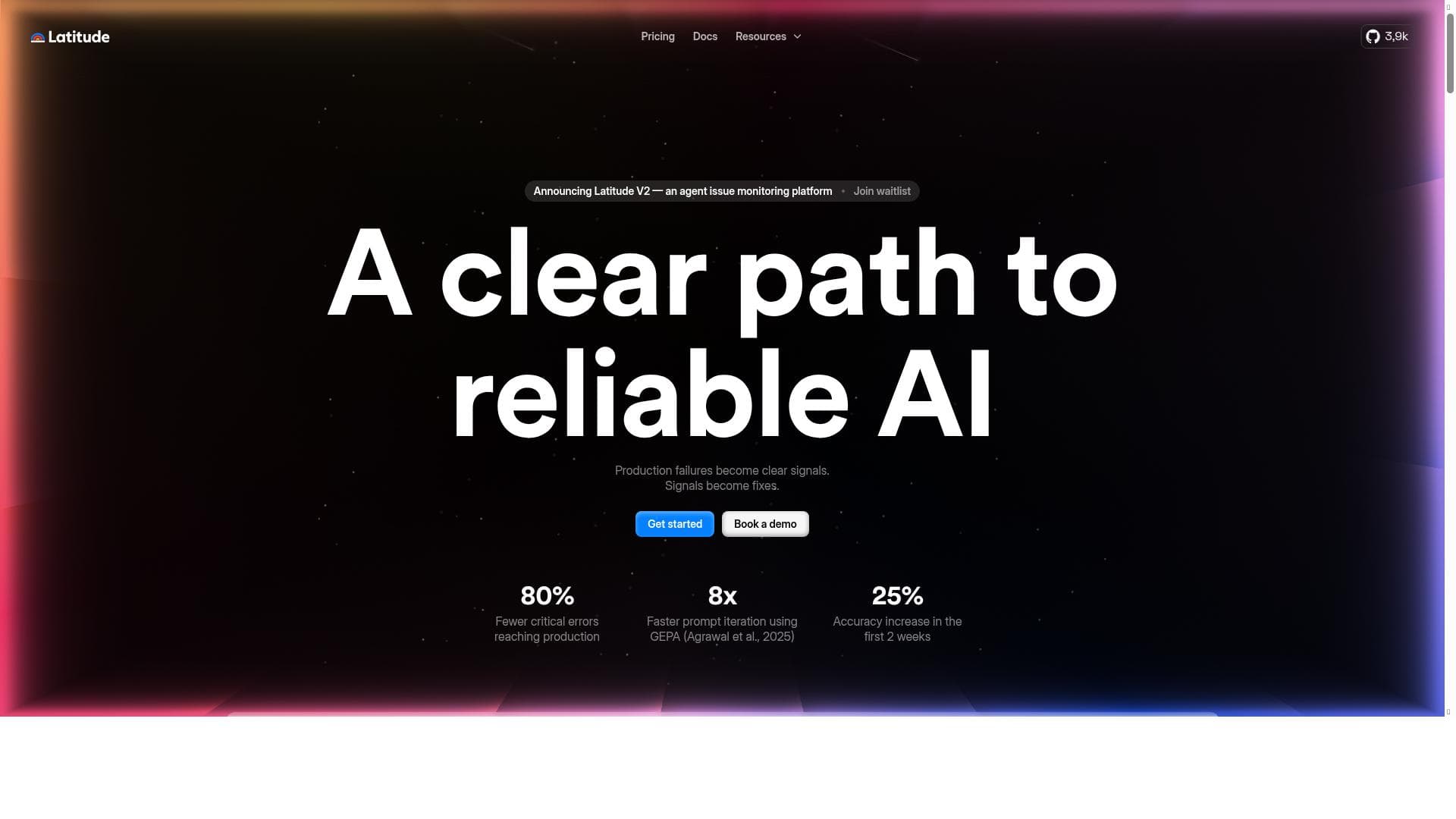
Latitude is an open-source platform that empowers AI teams to build, monitor, and refine prompts for large language models with precision and confidence. Its unique observability tools and automatic issue detection make it ideal for developers and organizations deploying AI agents who need reliable, production-ready LLM features.
Latitude is a comprehensive open-source platform designed specifically for prompt engineering, enabling developers and AI teams to build, evaluate, and refine prompts for large language models (LLMs) with confidence. Its core purpose is to provide an observability and monitoring framework that helps organizations ship LLM-powered features reliably by closely tracking AI agent behavior and performance in production environments. By focusing on prompt engineering as a critical aspect of AI development, Latitude empowers teams to optimize interactions with AI models, ensuring outputs meet quality and reliability standards before and after deployment. At the heart of Latitude’s offering is its observability platform tailored for AI agents. This platform allows users to monitor the real-time performance of AI models as they interact with end users or other systems. It captures detailed metrics and logs that reveal how prompts are interpreted and how the AI responds, enabling teams to identify patterns, bottlenecks, or unexpected behaviors. The platform also supports comprehensive evaluation of AI agent behavior, providing tools to analyze responses against desired outcomes and to detect anomalies or regressions. One standout feature is automatic issue surfacing, which proactively highlights problems such as prompt failures, degraded performance, or inconsistent outputs, allowing teams to address them swiftly before they impact users. Additionally, Latitude offers capabilities to iteratively improve AI agent performance by refining prompts based on observed data and feedback, closing the loop between development and production monitoring. Latitude is best suited for AI developers, data scientists, and product teams working with large language models who require robust tools to manage the complexity of prompt engineering at scale. Organizations deploying AI-powered chatbots, virtual assistants, content generation tools, or any application relying on LLMs can leverage Latitude to ensure their AI agents behave as intended in real-world scenarios. Use cases include monitoring conversational AI to maintain user satisfaction, evaluating prompt changes to optimize response accuracy, and quickly surfacing issues in production to minimize downtime or errors. Its open-source nature also makes it attractive for teams seeking customizable solutions that can integrate into existing AI development workflows. Regarding pricing, Latitude operates on a paid model, though specific pricing tiers or plans are not detailed in the provided information. Interested users should visit the official website to inquire about pricing options tailored to their usage scale and feature requirements. The paid model likely reflects the platform’s enterprise-grade capabilities and ongoing support. Compared to alternative AI observability or prompt engineering tools, Latitude stands out due to its open-source foundation combined with a specialized focus on prompt engineering for LLMs. While other platforms may offer general AI monitoring or model management, Latitude’s unique emphasis on prompt evaluation and refinement, coupled with automatic issue detection, provides a more targeted solution for teams shipping LLM features. Its integration of monitoring and evaluation into a single platform streamlines workflows and reduces the complexity of managing AI agent performance across development and production. However, potential users should consider that Latitude’s paid pricing may be a barrier for smaller teams or individual developers seeking free or low-cost solutions. Additionally, as an open-source platform, some technical expertise may be required to fully leverage its capabilities and customize it to specific needs. The lack of detailed public documentation on integrations or trial availability may also require prospective users to engage directly with the Latitude team for onboarding. In summary, Latitude is a powerful and specialized platform designed to help AI teams confidently ship and maintain LLM-powered features by providing deep observability, evaluation, and prompt refinement tools. Its focus on prompt engineering and automatic issue surfacing makes it an invaluable asset for organizations aiming to optimize AI agent performance in production environments.

Description
Latitude is an open-source platform that empowers AI teams to build, monitor, and refine prompts for large language models with precision and confidence. Its unique observability tools and automatic issue detection make it ideal for developers and organizations deploying AI agents who need reliable, production-ready LLM features.
Latitude is a comprehensive open-source platform designed specifically for prompt engineering, enabling developers and AI teams to build, evaluate, and refine prompts for large language models (LLMs) with confidence. Its core purpose is to provide an observability and monitoring framework that helps organizations ship LLM-powered features reliably by closely tracking AI agent behavior and performance in production environments. By focusing on prompt engineering as a critical aspect of AI development, Latitude empowers teams to optimize interactions with AI models, ensuring outputs meet quality and reliability standards before and after deployment. At the heart of Latitude’s offering is its observability platform tailored for AI agents. This platform allows users to monitor the real-time performance of AI models as they interact with end users or other systems. It captures detailed metrics and logs that reveal how prompts are interpreted and how the AI responds, enabling teams to identify patterns, bottlenecks, or unexpected behaviors. The platform also supports comprehensive evaluation of AI agent behavior, providing tools to analyze responses against desired outcomes and to detect anomalies or regressions. One standout feature is automatic issue surfacing, which proactively highlights problems such as prompt failures, degraded performance, or inconsistent outputs, allowing teams to address them swiftly before they impact users. Additionally, Latitude offers capabilities to iteratively improve AI agent performance by refining prompts based on observed data and feedback, closing the loop between development and production monitoring. Latitude is best suited for AI developers, data scientists, and product teams working with large language models who require robust tools to manage the complexity of prompt engineering at scale. Organizations deploying AI-powered chatbots, virtual assistants, content generation tools, or any application relying on LLMs can leverage Latitude to ensure their AI agents behave as intended in real-world scenarios. Use cases include monitoring conversational AI to maintain user satisfaction, evaluating prompt changes to optimize response accuracy, and quickly surfacing issues in production to minimize downtime or errors. Its open-source nature also makes it attractive for teams seeking customizable solutions that can integrate into existing AI development workflows. Regarding pricing, Latitude operates on a paid model, though specific pricing tiers or plans are not detailed in the provided information. Interested users should visit the official website to inquire about pricing options tailored to their usage scale and feature requirements. The paid model likely reflects the platform’s enterprise-grade capabilities and ongoing support. Compared to alternative AI observability or prompt engineering tools, Latitude stands out due to its open-source foundation combined with a specialized focus on prompt engineering for LLMs. While other platforms may offer general AI monitoring or model management, Latitude’s unique emphasis on prompt evaluation and refinement, coupled with automatic issue detection, provides a more targeted solution for teams shipping LLM features. Its integration of monitoring and evaluation into a single platform streamlines workflows and reduces the complexity of managing AI agent performance across development and production. However, potential users should consider that Latitude’s paid pricing may be a barrier for smaller teams or individual developers seeking free or low-cost solutions. Additionally, as an open-source platform, some technical expertise may be required to fully leverage its capabilities and customize it to specific needs. The lack of detailed public documentation on integrations or trial availability may also require prospective users to engage directly with the Latitude team for onboarding. In summary, Latitude is a powerful and specialized platform designed to help AI teams confidently ship and maintain LLM-powered features by providing deep observability, evaluation, and prompt refinement tools. Its focus on prompt engineering and automatic issue surfacing makes it an invaluable asset for organizations aiming to optimize AI agent performance in production environments.
Tool Features
- Observability platform for AI agents
- Monitor AI agent performance in production
- Evaluate AI agent behavior
- Automatic issue surfacing
- Improve AI agent performance
Frequently Asked Questions
What is Latitude?
Latitude is an open-source prompt engineering platform designed to help AI teams build, evaluate, and refine prompts for large language models. It provides observability tools to monitor AI agent performance and behavior in production, enabling teams to ship LLM-powered features with confidence.
How much does Latitude cost?
Latitude operates on a paid pricing model. Specific pricing details are not publicly listed, so interested users should visit the official website or contact the Latitude team directly for pricing information tailored to their needs.
Who is Latitude best for?
Latitude is best suited for AI developers, data scientists, and product teams working with large language models who need robust tools to monitor, evaluate, and improve AI agent performance, particularly in production environments.
What are the main features of Latitude?
Key features include an observability platform for AI agents, real-time monitoring of AI agent performance in production, tools to evaluate AI agent behavior, automatic issue surfacing to detect problems proactively, and capabilities to iteratively improve AI agent performance through prompt refinement.
Does Latitude offer a free trial?
There is no publicly available information about a free trial for Latitude. Prospective users should check the official website or contact the team for details on trial availability or demos.
What integrations does Latitude support?
Specific integrations supported by Latitude are not detailed in the provided information. Given its open-source nature, it is likely customizable to integrate with various AI development workflows and tools, but users should consult the official documentation or contact the team for precise integration capabilities.
How does Latitude work?
Latitude works by providing an observability platform that monitors AI agents interacting with large language models in real time. It collects performance data, evaluates AI behavior against expected outcomes, automatically surfaces issues, and facilitates prompt refinement to improve AI agent reliability and effectiveness in production.
Socials
Use ToolSponsored Tools




































Reviews
No reviews yet. Be the first to share your experience.