

Description
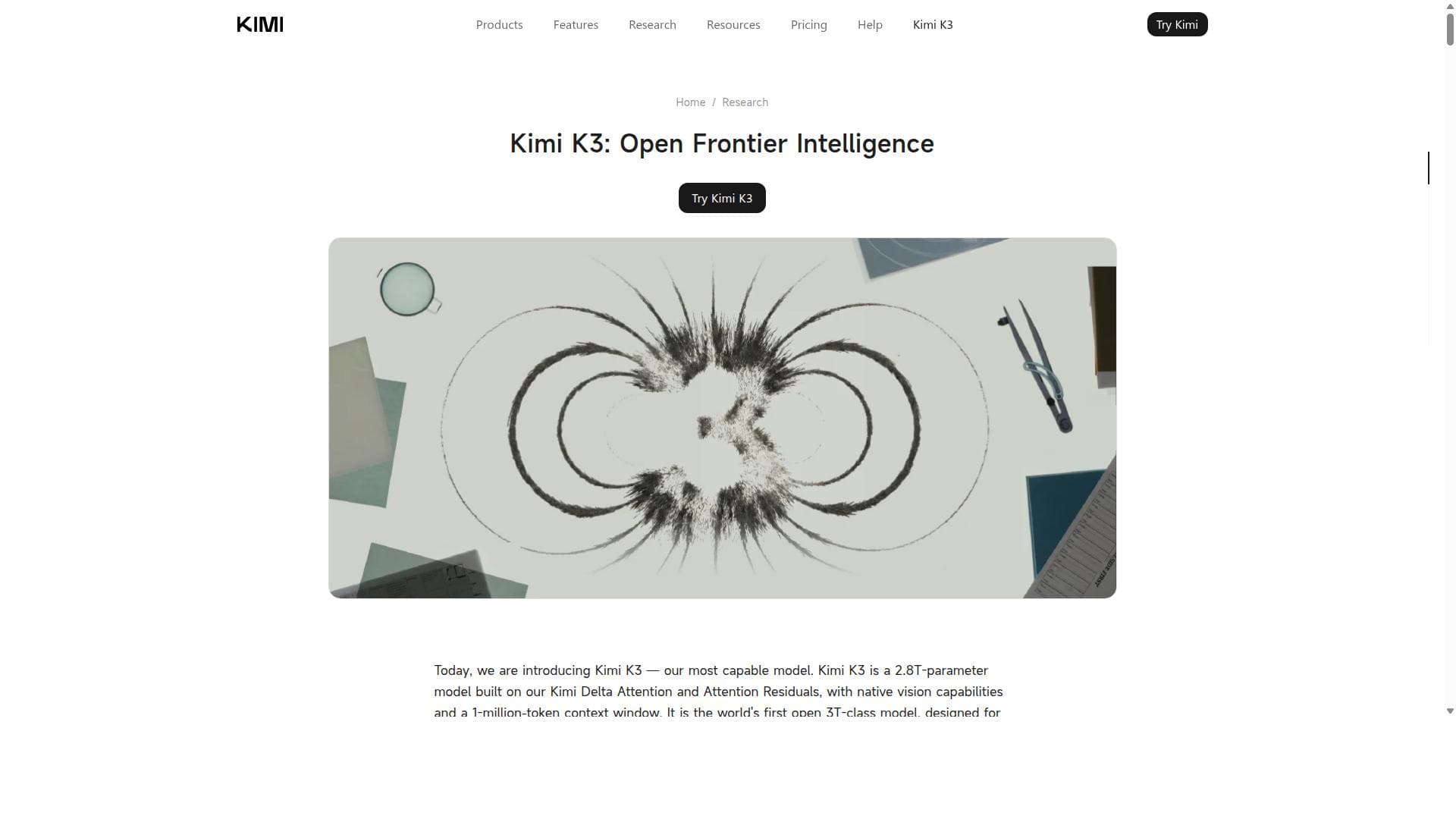
Kimi K3 is the world's first open 3T-class AI model, delivering cutting-edge performance in coding, knowledge work, and reasoning with native multimodality and a massive 1 million token context window. Ideal for developers, researchers, and enterprises, it enables advanced AI applications that require deep understanding and long-context processing.
Kimi K3 is a groundbreaking AI model designed to push the boundaries of artificial intelligence capabilities in coding, knowledge work, and complex reasoning tasks. As the world's first open 3T-class model, it offers a unique combination of scale and openness that empowers developers, researchers, and enterprises to harness frontier AI performance without the constraints of proprietary systems. The core purpose of Kimi K3 is to deliver advanced AI functionalities that can seamlessly handle diverse and demanding applications, from generating high-quality code to supporting intricate knowledge management and reasoning workflows. One of the standout features of Kimi K3 is its native multimodality support, enabling it to process and generate content across different data types natively. This capability allows users to interact with the model using text, images, and potentially other modalities, making it highly versatile for a wide range of tasks. Additionally, Kimi K3 boasts an unprecedented 1 million token context window, which means it can understand and maintain context over extremely long documents or conversations. This extended context capacity is particularly valuable for applications requiring deep understanding and continuity, such as legal document analysis, large-scale codebases, or extensive research papers. The model excels in coding tasks, providing frontier-level performance that can assist developers in writing, debugging, and optimizing code efficiently. Its advanced knowledge work capabilities make it suitable for professionals who need AI assistance in data synthesis, report generation, and decision support. Moreover, Kimi K3's high-level reasoning abilities enable it to tackle complex problem-solving scenarios, making it a powerful tool for industries that demand analytical rigor and nuanced understanding. Kimi K3 is best suited for organizations and individuals who require cutting-edge AI performance combined with flexibility and openness. This includes software developers, data scientists, researchers, and enterprises engaged in knowledge-intensive industries such as technology, finance, law, and academia. Use cases range from automated code generation and review, intelligent document summarization, multi-modal content creation, to advanced conversational agents capable of maintaining long, coherent interactions. Regarding pricing and plans, Kimi K3 is offered as an open model, which suggests that it may be accessible without traditional licensing fees, promoting broader adoption and experimentation. However, specific details about commercial plans, subscription tiers, or enterprise offerings are not explicitly stated, so interested users should consult the official website for the latest information on access and pricing. When compared to alternatives, Kimi K3 distinguishes itself through its combination of openness, scale, and multimodal native support. While many large language models offer impressive capabilities, few provide a 3T-class open model with a 1 million token context window. This makes Kimi K3 particularly competitive for applications that require handling vast amounts of data in a single context. Its open nature also encourages customization and integration, unlike some closed or proprietary models that limit user control. Despite its impressive capabilities, potential users should consider certain limitations. The sheer scale of the model may require significant computational resources for deployment and inference, which could be a barrier for smaller organizations. Additionally, as with any advanced AI system, ensuring responsible use, managing biases, and maintaining data privacy remain important considerations. Users should also verify the availability of support, documentation, and community resources to maximize the benefits of adopting Kimi K3. In summary, Kimi K3 represents a significant leap forward in AI technology, offering an open, large-scale, multimodal model capable of delivering state-of-the-art performance across coding, knowledge work, and reasoning. Its expansive context window and native multimodality make it uniquely suited for complex, data-intensive applications, appealing to a wide range of professional users seeking advanced AI solutions.

Description
Kimi K3 is the world's first open 3T-class AI model, delivering cutting-edge performance in coding, knowledge work, and reasoning with native multimodality and a massive 1 million token context window. Ideal for developers, researchers, and enterprises, it enables advanced AI applications that require deep understanding and long-context processing.
Kimi K3 is a groundbreaking AI model designed to push the boundaries of artificial intelligence capabilities in coding, knowledge work, and complex reasoning tasks. As the world's first open 3T-class model, it offers a unique combination of scale and openness that empowers developers, researchers, and enterprises to harness frontier AI performance without the constraints of proprietary systems. The core purpose of Kimi K3 is to deliver advanced AI functionalities that can seamlessly handle diverse and demanding applications, from generating high-quality code to supporting intricate knowledge management and reasoning workflows. One of the standout features of Kimi K3 is its native multimodality support, enabling it to process and generate content across different data types natively. This capability allows users to interact with the model using text, images, and potentially other modalities, making it highly versatile for a wide range of tasks. Additionally, Kimi K3 boasts an unprecedented 1 million token context window, which means it can understand and maintain context over extremely long documents or conversations. This extended context capacity is particularly valuable for applications requiring deep understanding and continuity, such as legal document analysis, large-scale codebases, or extensive research papers. The model excels in coding tasks, providing frontier-level performance that can assist developers in writing, debugging, and optimizing code efficiently. Its advanced knowledge work capabilities make it suitable for professionals who need AI assistance in data synthesis, report generation, and decision support. Moreover, Kimi K3's high-level reasoning abilities enable it to tackle complex problem-solving scenarios, making it a powerful tool for industries that demand analytical rigor and nuanced understanding. Kimi K3 is best suited for organizations and individuals who require cutting-edge AI performance combined with flexibility and openness. This includes software developers, data scientists, researchers, and enterprises engaged in knowledge-intensive industries such as technology, finance, law, and academia. Use cases range from automated code generation and review, intelligent document summarization, multi-modal content creation, to advanced conversational agents capable of maintaining long, coherent interactions. Regarding pricing and plans, Kimi K3 is offered as an open model, which suggests that it may be accessible without traditional licensing fees, promoting broader adoption and experimentation. However, specific details about commercial plans, subscription tiers, or enterprise offerings are not explicitly stated, so interested users should consult the official website for the latest information on access and pricing. When compared to alternatives, Kimi K3 distinguishes itself through its combination of openness, scale, and multimodal native support. While many large language models offer impressive capabilities, few provide a 3T-class open model with a 1 million token context window. This makes Kimi K3 particularly competitive for applications that require handling vast amounts of data in a single context. Its open nature also encourages customization and integration, unlike some closed or proprietary models that limit user control. Despite its impressive capabilities, potential users should consider certain limitations. The sheer scale of the model may require significant computational resources for deployment and inference, which could be a barrier for smaller organizations. Additionally, as with any advanced AI system, ensuring responsible use, managing biases, and maintaining data privacy remain important considerations. Users should also verify the availability of support, documentation, and community resources to maximize the benefits of adopting Kimi K3. In summary, Kimi K3 represents a significant leap forward in AI technology, offering an open, large-scale, multimodal model capable of delivering state-of-the-art performance across coding, knowledge work, and reasoning. Its expansive context window and native multimodality make it uniquely suited for complex, data-intensive applications, appealing to a wide range of professional users seeking advanced AI solutions.
Tool Features
- Open 3T-class model
- Frontier performance in coding
- Advanced knowledge work capabilities
- High-level reasoning
- Native multimodality support
- 1 million token context window
Frequently Asked Questions
What is Kimi K3?
Kimi K3 is an open 3T-class AI model designed to provide frontier performance in coding, knowledge work, and reasoning. It supports native multimodality and an extremely large 1 million token context window, enabling advanced AI capabilities across diverse applications.
How much does Kimi K3 cost?
Kimi K3 is offered as an open model, which typically means it is accessible without traditional licensing fees. However, specific pricing or subscription details are not publicly detailed, so it is recommended to visit the official website for the most current information.
Who is Kimi K3 best for?
Kimi K3 is best suited for software developers, data scientists, researchers, and enterprises that require advanced AI for coding assistance, knowledge management, and complex reasoning tasks. It is particularly valuable for those working with large datasets or needing multimodal AI support.
What are the main features of Kimi K3?
Key features include its status as an open 3T-class model, frontier-level coding performance, advanced knowledge work and reasoning capabilities, native multimodality support, and a massive 1 million token context window that enables processing of extremely long documents or conversations.
Does Kimi K3 offer a free trial?
Information about a free trial for Kimi K3 is not explicitly provided. Interested users should check the official Kimi website or contact their support team to inquire about trial options or demo access.
What integrations does Kimi K3 support?
While specific integrations are not detailed, Kimi K3’s open model nature suggests it can be integrated into various development environments and AI workflows. Users can likely customize and deploy the model according to their application needs.
How does Kimi K3 work?
Kimi K3 operates as a large-scale AI model that processes input across multiple modalities natively and maintains context over up to 1 million tokens. This allows it to generate code, perform knowledge work, and reason over extensive data inputs with high accuracy and coherence.
Socials
Use ToolSponsored Tools
































Reviews
No reviews yet. Be the first to share your experience.