Description
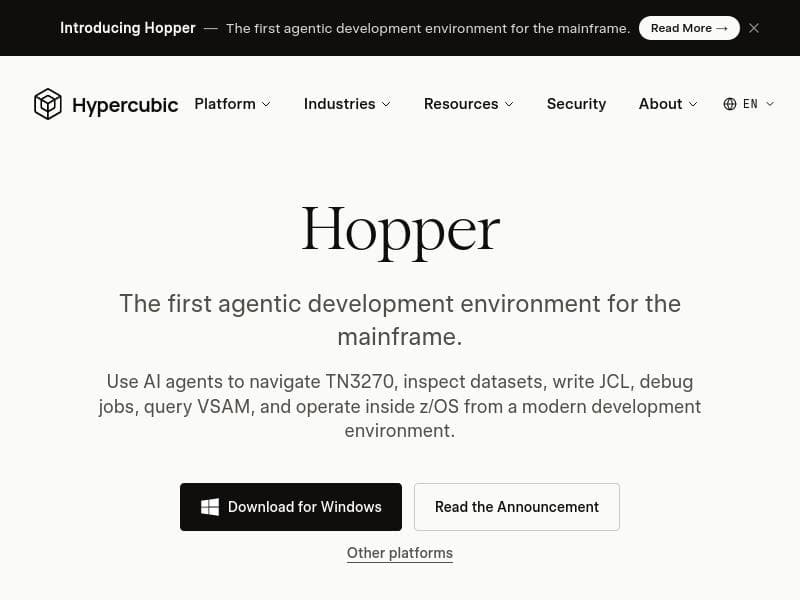
Hopper revolutionizes mainframe development by combining a real TN3270 terminal with an AI agent that automates and accelerates z/OS workflows. Ideal for enterprises modernizing legacy systems, Hopper empowers developers with natural language commands, autonomous job management, and deep integration with mainframe environments.
Hopper is a pioneering agentic development environment specifically designed for mainframe systems, marking a significant advancement in how developers interact with and modernize legacy z/OS environments. At its core, Hopper functions as a sophisticated interface that integrates a real TN3270 terminal with mainframe-aware panels, enabling seamless management of datasets, jobs, members, and spool output. What truly sets Hopper apart is its embedded AI agent, capable of operating autonomously across complex z/OS workflows. This agent can inspect datasets, read and edit Partitioned Data Set (PDS) members, write Job Control Language (JCL), submit jobs, parse Job Entry Subsystem (JES) output, and provide detailed explanations for job failures. By automating these traditionally manual and error-prone tasks, Hopper accelerates debugging and development cycles, empowering mainframe developers to work more efficiently and with greater accuracy. The platform offers a comprehensive suite of features that address the unique challenges of mainframe modernization. Hopper connects AI agents to mainframe systems via the Model Context Protocol, enabling natural language operations on mainframe workloads. This allows developers to interact with the system using conversational commands, significantly lowering the barrier to entry for complex mainframe operations. Autonomous workflows are supported, facilitating continuous integration and deployment pipelines within z/OS environments. Additionally, Hopper serves as an agentic development environment that preserves institutional knowledge and legacy system documentation, which is critical in organizations where expertise is often siloed or at risk of loss due to workforce turnover. The tool automates documentation and operational tasks for COBOL, JCL, and z/OS, streamlining batch processing and legacy modernization efforts. Hopper is best suited for enterprises and development teams that rely heavily on mainframe infrastructure and seek to modernize their workflows without disrupting critical operations. It is ideal for mainframe developers, system administrators, and IT managers who require a robust, AI-augmented platform to enhance productivity, reduce errors, and accelerate the modernization of legacy applications. Use cases include debugging complex batch jobs, automating job submissions, maintaining and updating legacy codebases, and preserving institutional knowledge through automated documentation. Its cross-platform availability on Windows, Linux, and macOS ensures it can be integrated into diverse IT environments. Regarding pricing, Hopper is a paid solution, reflecting its enterprise-grade capabilities and specialized focus. Specific pricing details are typically provided upon request or through direct engagement with the vendor, Hypercubic AI. This approach allows organizations to tailor licensing and support plans according to their scale and requirements. Compared to alternatives, Hopper stands out by combining a fully functional TN3270 terminal with AI-driven automation and natural language processing capabilities. While traditional mainframe tools often require manual intervention and specialized knowledge, Hopper’s AI agent reduces complexity and accelerates workflow execution. Unlike generic AI assistants, Hopper is purpose-built for mainframe environments, supporting critical languages and job control systems like COBOL and JCL. However, organizations should consider that adopting Hopper may require initial training and integration efforts to fully leverage its autonomous features. Additionally, as a paid product, it may represent a higher upfront investment compared to open-source or legacy tools. In summary, Hopper offers a transformative approach to mainframe development by integrating AI-driven automation with traditional mainframe interfaces. Its ability to streamline complex workflows, preserve legacy knowledge, and support modernization initiatives makes it an invaluable tool for enterprises committed to maintaining and evolving their mainframe assets in a rapidly changing technological landscape.

Description
Hopper revolutionizes mainframe development by combining a real TN3270 terminal with an AI agent that automates and accelerates z/OS workflows. Ideal for enterprises modernizing legacy systems, Hopper empowers developers with natural language commands, autonomous job management, and deep integration with mainframe environments.
Hopper is a pioneering agentic development environment specifically designed for mainframe systems, marking a significant advancement in how developers interact with and modernize legacy z/OS environments. At its core, Hopper functions as a sophisticated interface that integrates a real TN3270 terminal with mainframe-aware panels, enabling seamless management of datasets, jobs, members, and spool output. What truly sets Hopper apart is its embedded AI agent, capable of operating autonomously across complex z/OS workflows. This agent can inspect datasets, read and edit Partitioned Data Set (PDS) members, write Job Control Language (JCL), submit jobs, parse Job Entry Subsystem (JES) output, and provide detailed explanations for job failures. By automating these traditionally manual and error-prone tasks, Hopper accelerates debugging and development cycles, empowering mainframe developers to work more efficiently and with greater accuracy. The platform offers a comprehensive suite of features that address the unique challenges of mainframe modernization. Hopper connects AI agents to mainframe systems via the Model Context Protocol, enabling natural language operations on mainframe workloads. This allows developers to interact with the system using conversational commands, significantly lowering the barrier to entry for complex mainframe operations. Autonomous workflows are supported, facilitating continuous integration and deployment pipelines within z/OS environments. Additionally, Hopper serves as an agentic development environment that preserves institutional knowledge and legacy system documentation, which is critical in organizations where expertise is often siloed or at risk of loss due to workforce turnover. The tool automates documentation and operational tasks for COBOL, JCL, and z/OS, streamlining batch processing and legacy modernization efforts. Hopper is best suited for enterprises and development teams that rely heavily on mainframe infrastructure and seek to modernize their workflows without disrupting critical operations. It is ideal for mainframe developers, system administrators, and IT managers who require a robust, AI-augmented platform to enhance productivity, reduce errors, and accelerate the modernization of legacy applications. Use cases include debugging complex batch jobs, automating job submissions, maintaining and updating legacy codebases, and preserving institutional knowledge through automated documentation. Its cross-platform availability on Windows, Linux, and macOS ensures it can be integrated into diverse IT environments. Regarding pricing, Hopper is a paid solution, reflecting its enterprise-grade capabilities and specialized focus. Specific pricing details are typically provided upon request or through direct engagement with the vendor, Hypercubic AI. This approach allows organizations to tailor licensing and support plans according to their scale and requirements. Compared to alternatives, Hopper stands out by combining a fully functional TN3270 terminal with AI-driven automation and natural language processing capabilities. While traditional mainframe tools often require manual intervention and specialized knowledge, Hopper’s AI agent reduces complexity and accelerates workflow execution. Unlike generic AI assistants, Hopper is purpose-built for mainframe environments, supporting critical languages and job control systems like COBOL and JCL. However, organizations should consider that adopting Hopper may require initial training and integration efforts to fully leverage its autonomous features. Additionally, as a paid product, it may represent a higher upfront investment compared to open-source or legacy tools. In summary, Hopper offers a transformative approach to mainframe development by integrating AI-driven automation with traditional mainframe interfaces. Its ability to streamline complex workflows, preserve legacy knowledge, and support modernization initiatives makes it an invaluable tool for enterprises committed to maintaining and evolving their mainframe assets in a rapidly changing technological landscape.
Tool Features
- Connects AI agents to mainframe systems via Model Context Protocol
- Supports natural language operations on mainframe workloads
- Enables autonomous workflows for z/OS environments
- Provides an agentic development environment for mainframe modernization
- Preserves institutional knowledge and legacy system documentation
- Automates documentation and operations for COBOL, JCL, and z/OS
- Facilitates legacy modernization and batch processing automation
Frequently Asked Questions
What is Hopper?
Hopper is the first agentic development environment designed specifically for mainframe systems. It integrates a real TN3270 terminal with AI-driven automation to manage datasets, jobs, and workflows on z/OS, helping developers debug and modernize mainframe applications more efficiently.
How much does Hopper cost?
Hopper is a paid product, and pricing details are typically provided upon direct inquiry with the vendor, Hypercubic AI. Pricing may vary based on the scale of deployment and specific enterprise requirements.
Who is Hopper best for?
Hopper is best suited for mainframe developers, system administrators, and IT teams within enterprises that rely on z/OS environments and seek to modernize legacy workflows, automate batch processing, and preserve institutional knowledge.
What are the main features of Hopper?
Key features include a real TN3270 terminal interface, mainframe-aware panels for datasets and jobs, an AI agent capable of reading and editing PDS members, writing JCL, submitting jobs, parsing JES output, supporting natural language operations, enabling autonomous z/OS workflows, and automating documentation for COBOL, JCL, and z/OS.
Does Hopper offer a free trial?
There is no publicly available information about a free trial for Hopper. Interested users should contact Hypercubic AI directly to inquire about trial options or demonstrations.
What integrations does Hopper support?
Hopper connects AI agents to mainframe systems via the Model Context Protocol and integrates deeply with z/OS environments, supporting legacy languages like COBOL and JCL, as well as mainframe job and dataset management systems.
How does Hopper work?
Hopper works by combining a real TN3270 terminal interface with an AI agent that can autonomously interact with mainframe workflows. It inspects datasets, edits code, writes and submits jobs, parses job output, and uses natural language processing to enable developers to manage and debug mainframe systems more efficiently.
Socials
Use ToolSponsored Tools

































Reviews
No reviews yet. Be the first to share your experience.