Description
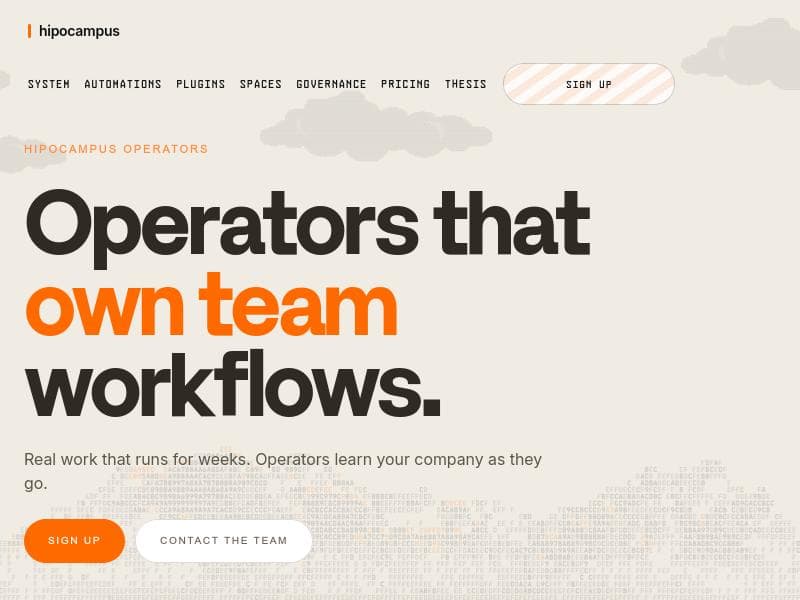
Hipocampus is a powerful workflow-ownership platform that automates and governs complex, long-running team workflows across fragmented systems. Ideal for enterprises with intricate processes, it ensures work continuity through persistent state management, approvals, and intelligent delegation, making it indispensable for teams needing high-context automation and cross-tool coordination.
Hipocampus is an advanced workflow-ownership platform designed to streamline and automate complex team workflows that span multiple fragmented systems. At its core, Hipocampus acts as a centralized layer that deploys governed operators—automated agents that take ownership of workflows, ensuring continuity and accountability across different tools and time zones. This approach addresses a common challenge in modern enterprises where work is often distributed across various software platforms, resulting in fragmented processes and lost context. By maintaining persistent workflow states, managing approvals, enabling delegation, and supporting escalation protocols, Hipocampus ensures that work progresses smoothly without manual intervention or oversight gaps. One of the standout features of Hipocampus is its ability to run real workflows that extend over weeks, rather than just simple task automation. This means it can handle long-running, multi-step processes that require ongoing monitoring and adjustments. Additionally, Hipocampus leverages machine learning to understand and adapt to company-specific processes, allowing it to tailor automation to the unique operational nuances of each organization. This learning capability enables the platform to automate high-context work—tasks that require understanding of complex rules, exceptions, and human judgment—rather than just repetitive, low-level tasks. Hipocampus also excels at optimizing business workflows by continuously analyzing process efficiency and identifying bottlenecks or delays. Its shared context feature ensures that all team members and stakeholders have visibility into the current state of workflows, approvals, and any pending actions, fostering transparency and collaboration. The platform’s governance model ensures that workflows comply with company policies and regulatory requirements, which is critical for industries with strict compliance standards. This tool is particularly well-suited for medium to large enterprises with complex operational processes that span multiple departments and software tools. Teams in industries such as finance, healthcare, legal, and manufacturing can benefit greatly from Hipocampus, as these sectors often deal with intricate workflows requiring approvals, escalations, and cross-functional coordination. Use cases include automating contract review cycles, managing compliance workflows, coordinating multi-team project handoffs, and streamlining customer onboarding processes. Hipocampus is a paid solution, with pricing details available upon request from the vendor. The investment in Hipocampus is justified by its ability to reduce manual workload, minimize errors, and accelerate time-to-completion for critical business processes. While exact pricing tiers are not publicly listed, organizations can expect enterprise-grade support and customization options. Compared to traditional workflow automation tools that focus on task-level automation within a single system, Hipocampus stands out by owning end-to-end workflows across multiple systems with persistent state management. Unlike generic automation platforms, it learns company-specific processes and handles high-context work, making it more adaptable and intelligent. However, potential users should consider the onboarding time and complexity involved in integrating Hipocampus with their existing systems and training it on their unique workflows. Additionally, as a paid platform, smaller teams or startups with simpler workflows might find it less cost-effective compared to lighter automation tools. In summary, Hipocampus offers a sophisticated solution for organizations seeking to automate and govern complex, long-running workflows that span multiple tools and require human-like contextual understanding. Its combination of persistent workflow ownership, machine learning-driven process adaptation, and comprehensive governance features make it a powerful asset for improving productivity and operational resilience in demanding business environments.

Description
Hipocampus is a powerful workflow-ownership platform that automates and governs complex, long-running team workflows across fragmented systems. Ideal for enterprises with intricate processes, it ensures work continuity through persistent state management, approvals, and intelligent delegation, making it indispensable for teams needing high-context automation and cross-tool coordination.
Hipocampus is an advanced workflow-ownership platform designed to streamline and automate complex team workflows that span multiple fragmented systems. At its core, Hipocampus acts as a centralized layer that deploys governed operators—automated agents that take ownership of workflows, ensuring continuity and accountability across different tools and time zones. This approach addresses a common challenge in modern enterprises where work is often distributed across various software platforms, resulting in fragmented processes and lost context. By maintaining persistent workflow states, managing approvals, enabling delegation, and supporting escalation protocols, Hipocampus ensures that work progresses smoothly without manual intervention or oversight gaps. One of the standout features of Hipocampus is its ability to run real workflows that extend over weeks, rather than just simple task automation. This means it can handle long-running, multi-step processes that require ongoing monitoring and adjustments. Additionally, Hipocampus leverages machine learning to understand and adapt to company-specific processes, allowing it to tailor automation to the unique operational nuances of each organization. This learning capability enables the platform to automate high-context work—tasks that require understanding of complex rules, exceptions, and human judgment—rather than just repetitive, low-level tasks. Hipocampus also excels at optimizing business workflows by continuously analyzing process efficiency and identifying bottlenecks or delays. Its shared context feature ensures that all team members and stakeholders have visibility into the current state of workflows, approvals, and any pending actions, fostering transparency and collaboration. The platform’s governance model ensures that workflows comply with company policies and regulatory requirements, which is critical for industries with strict compliance standards. This tool is particularly well-suited for medium to large enterprises with complex operational processes that span multiple departments and software tools. Teams in industries such as finance, healthcare, legal, and manufacturing can benefit greatly from Hipocampus, as these sectors often deal with intricate workflows requiring approvals, escalations, and cross-functional coordination. Use cases include automating contract review cycles, managing compliance workflows, coordinating multi-team project handoffs, and streamlining customer onboarding processes. Hipocampus is a paid solution, with pricing details available upon request from the vendor. The investment in Hipocampus is justified by its ability to reduce manual workload, minimize errors, and accelerate time-to-completion for critical business processes. While exact pricing tiers are not publicly listed, organizations can expect enterprise-grade support and customization options. Compared to traditional workflow automation tools that focus on task-level automation within a single system, Hipocampus stands out by owning end-to-end workflows across multiple systems with persistent state management. Unlike generic automation platforms, it learns company-specific processes and handles high-context work, making it more adaptable and intelligent. However, potential users should consider the onboarding time and complexity involved in integrating Hipocampus with their existing systems and training it on their unique workflows. Additionally, as a paid platform, smaller teams or startups with simpler workflows might find it less cost-effective compared to lighter automation tools. In summary, Hipocampus offers a sophisticated solution for organizations seeking to automate and govern complex, long-running workflows that span multiple tools and require human-like contextual understanding. Its combination of persistent workflow ownership, machine learning-driven process adaptation, and comprehensive governance features make it a powerful asset for improving productivity and operational resilience in demanding business environments.
Tool Features
- Runs real workflows across weeks
- Learns company-specific processes
- Automates high-context work
- Optimizes business workflows
Frequently Asked Questions
What is Hipocampus?
Hipocampus is a workflow-ownership layer designed to automate and manage team workflows that span multiple fragmented systems. It deploys governed operators to maintain persistent workflow states, handle approvals, delegation, and escalation, ensuring work progresses smoothly across tools and time.
How much does Hipocampus cost?
Hipocampus is a paid platform, and specific pricing details are provided by the vendor upon inquiry. Pricing typically reflects enterprise-level features and support, tailored to the complexity and scale of the organization's workflows.
Who is Hipocampus best for?
Hipocampus is best suited for medium to large enterprises with complex, multi-system workflows requiring governance, approvals, and long-running process management. Industries like finance, healthcare, legal, and manufacturing benefit greatly from its high-context automation capabilities.
What are the main features of Hipocampus?
Key features include running real workflows that span weeks, learning and adapting to company-specific processes, automating high-context work, optimizing business workflows, maintaining persistent workflow state, managing approvals, delegation, escalation, and providing shared context for team collaboration.
Does Hipocampus offer a free trial?
There is no publicly available information indicating that Hipocampus offers a free trial. Interested organizations should contact the vendor directly to inquire about demos or trial options.
What integrations does Hipocampus support?
While specific integrations are not detailed publicly, Hipocampus is designed to operate across fragmented systems, implying it supports integration with multiple enterprise tools and platforms to coordinate workflows across diverse software environments.
How does Hipocampus work?
Hipocampus works by deploying governed operators that automate and own workflows across different systems. It maintains a persistent state of workflows, manages approvals, delegation, and escalation, and provides shared context so that work continues seamlessly across tools and over extended periods.
Socials
Use ToolSponsored Tools





































Reviews
No reviews yet. Be the first to share your experience.