Description
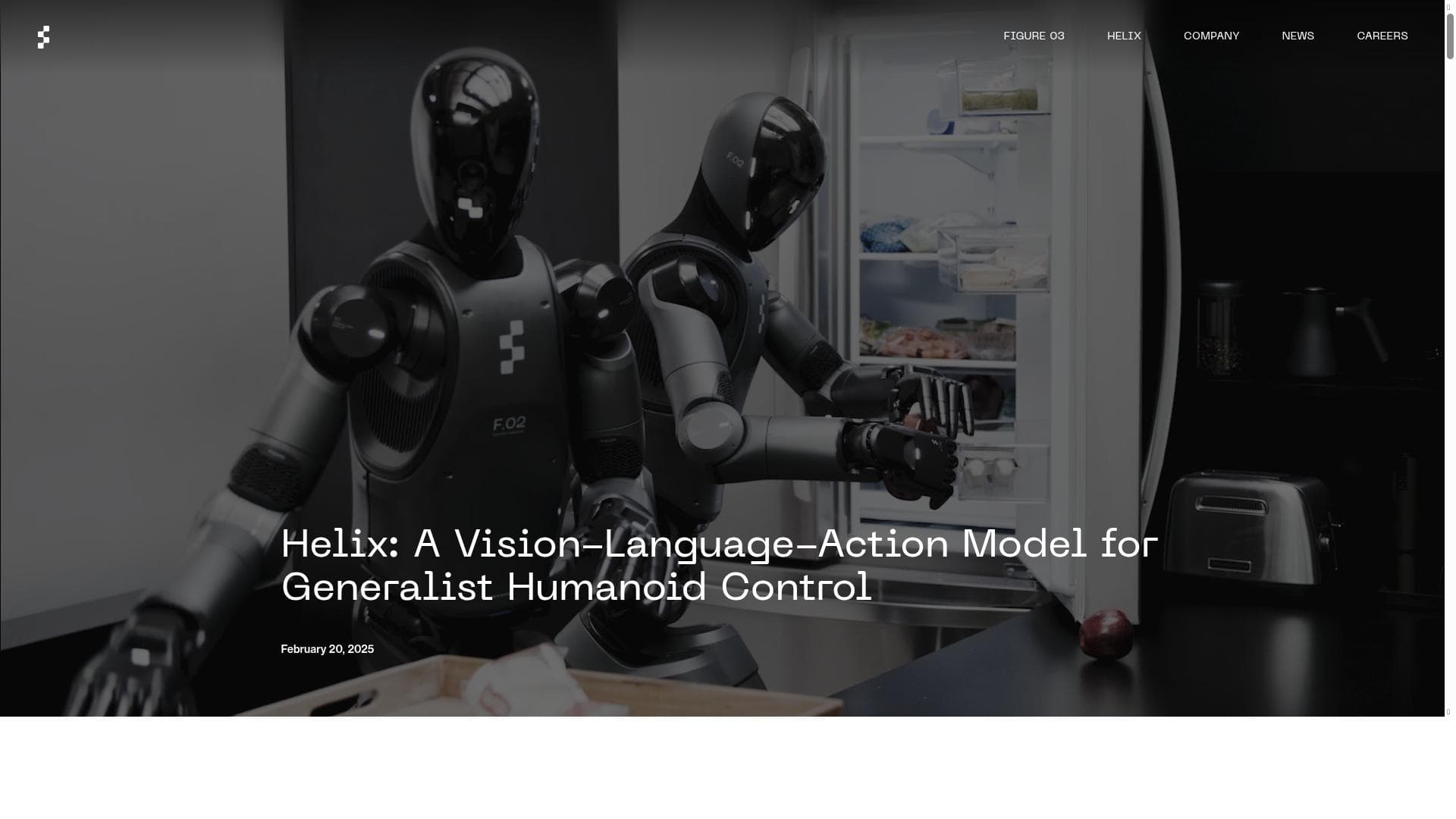
Helix from Figure AI is a groundbreaking Vision-Language-Action model that enables full upper-body control of humanoid robots with zero-shot generalization to new tasks and objects. Designed for real-time use on embedded GPUs, it’s ideal for developers and companies seeking advanced, flexible robotic manipulation through natural language commands.
Helix, developed by Figure AI, is an advanced Vision-Language-Action model designed specifically for comprehensive upper-body humanoid robot control. Its core purpose is to enable robots to perform complex, dexterous tasks involving the wrists, torso, head, and individual fingers, all through intuitive natural language commands. Unlike many robotic control systems that require extensive task-specific training or fine-tuning, Helix leverages zero-shot generalization capabilities, allowing it to adapt seamlessly to new objects and tasks without additional training. This makes it a highly flexible and scalable solution for real-world applications in robotics. One of the standout features of Helix is its ability to control the full upper body of humanoid robots, including intricate movements of the fingers and wrists, as well as coordinated motions of the torso and head. This level of control enables robots to perform delicate manipulations, such as picking up small household objects, with precision and reliability. The system operates using a single set of neural network weights that govern all behaviors, eliminating the need for separate models or fine-tuning for different tasks. This unified approach simplifies deployment and maintenance. Helix also supports multi-robot collaboration, allowing two robots to work simultaneously on shared tasks. This feature is particularly valuable in industrial or commercial environments where coordinated efforts can improve efficiency and task completion speed. Additionally, Helix is designed to run entirely onboard embedded GPUs that are low-power and commercially viable, ensuring that the system can be deployed in real-time scenarios without reliance on external computing resources. This embedded operation enhances responsiveness and reduces latency, critical factors for interactive robotic applications. Ideal users of Helix include robotics researchers, developers, and companies focused on humanoid robot applications in sectors such as home automation, service robotics, manufacturing, and logistics. Its ability to handle diverse objects and tasks through natural language commands makes it suitable for environments where robots must interact safely and effectively with humans and everyday items. For example, Helix can be used in smart homes to assist with household chores, in warehouses for object sorting, or in collaborative manufacturing lines where robots and humans work side by side. Helix is offered as a paid solution, reflecting its advanced capabilities and commercial readiness. While specific pricing details are not publicly disclosed, prospective users can expect enterprise-level pricing aligned with high-performance robotics software. This investment is justified by Helix's unique combination of full upper-body control, multi-robot collaboration, and onboard embedded processing. Compared to alternative robotic control models, Helix stands out due to its zero-shot generalization ability and the integration of vision, language, and action in a single neural network. Many other systems require extensive retraining or rely on separate modules for perception and control, which can increase complexity and reduce adaptability. Helix's embedded GPU operation also differentiates it from cloud-dependent solutions, offering greater autonomy and lower latency. However, potential users should consider that Helix is specialized for upper-body humanoid control and may not be suitable for robots with significantly different morphologies or for tasks requiring full-body locomotion. Additionally, as a paid product, it may represent a higher upfront cost compared to open-source or less advanced robotic control frameworks. Integration into existing robotic platforms may require technical expertise to fully leverage its capabilities. In summary, Helix by Figure AI is a cutting-edge Vision-Language-Action model that empowers humanoid robots with sophisticated upper-body control and natural language-driven task execution. Its zero-shot generalization, multi-robot collaboration, and embedded GPU operation make it a powerful tool for advancing commercial and research robotics applications where dexterity, flexibility, and real-time responsiveness are paramount.

Description
Helix from Figure AI is a groundbreaking Vision-Language-Action model that enables full upper-body control of humanoid robots with zero-shot generalization to new tasks and objects. Designed for real-time use on embedded GPUs, it’s ideal for developers and companies seeking advanced, flexible robotic manipulation through natural language commands.
Helix, developed by Figure AI, is an advanced Vision-Language-Action model designed specifically for comprehensive upper-body humanoid robot control. Its core purpose is to enable robots to perform complex, dexterous tasks involving the wrists, torso, head, and individual fingers, all through intuitive natural language commands. Unlike many robotic control systems that require extensive task-specific training or fine-tuning, Helix leverages zero-shot generalization capabilities, allowing it to adapt seamlessly to new objects and tasks without additional training. This makes it a highly flexible and scalable solution for real-world applications in robotics. One of the standout features of Helix is its ability to control the full upper body of humanoid robots, including intricate movements of the fingers and wrists, as well as coordinated motions of the torso and head. This level of control enables robots to perform delicate manipulations, such as picking up small household objects, with precision and reliability. The system operates using a single set of neural network weights that govern all behaviors, eliminating the need for separate models or fine-tuning for different tasks. This unified approach simplifies deployment and maintenance. Helix also supports multi-robot collaboration, allowing two robots to work simultaneously on shared tasks. This feature is particularly valuable in industrial or commercial environments where coordinated efforts can improve efficiency and task completion speed. Additionally, Helix is designed to run entirely onboard embedded GPUs that are low-power and commercially viable, ensuring that the system can be deployed in real-time scenarios without reliance on external computing resources. This embedded operation enhances responsiveness and reduces latency, critical factors for interactive robotic applications. Ideal users of Helix include robotics researchers, developers, and companies focused on humanoid robot applications in sectors such as home automation, service robotics, manufacturing, and logistics. Its ability to handle diverse objects and tasks through natural language commands makes it suitable for environments where robots must interact safely and effectively with humans and everyday items. For example, Helix can be used in smart homes to assist with household chores, in warehouses for object sorting, or in collaborative manufacturing lines where robots and humans work side by side. Helix is offered as a paid solution, reflecting its advanced capabilities and commercial readiness. While specific pricing details are not publicly disclosed, prospective users can expect enterprise-level pricing aligned with high-performance robotics software. This investment is justified by Helix's unique combination of full upper-body control, multi-robot collaboration, and onboard embedded processing. Compared to alternative robotic control models, Helix stands out due to its zero-shot generalization ability and the integration of vision, language, and action in a single neural network. Many other systems require extensive retraining or rely on separate modules for perception and control, which can increase complexity and reduce adaptability. Helix's embedded GPU operation also differentiates it from cloud-dependent solutions, offering greater autonomy and lower latency. However, potential users should consider that Helix is specialized for upper-body humanoid control and may not be suitable for robots with significantly different morphologies or for tasks requiring full-body locomotion. Additionally, as a paid product, it may represent a higher upfront cost compared to open-source or less advanced robotic control frameworks. Integration into existing robotic platforms may require technical expertise to fully leverage its capabilities. In summary, Helix by Figure AI is a cutting-edge Vision-Language-Action model that empowers humanoid robots with sophisticated upper-body control and natural language-driven task execution. Its zero-shot generalization, multi-robot collaboration, and embedded GPU operation make it a powerful tool for advancing commercial and research robotics applications where dexterity, flexibility, and real-time responsiveness are paramount.
Tool Features
- Full-upper-body control of humanoid robots including wrists, torso, head, and individual fingers
- Multi-robot collaboration enabling simultaneous operation on two robots for shared tasks
- Capability to pick up virtually any small household object using natural language prompts
- Single neural network weights for all behaviors without task-specific fine-tuning
- Runs entirely onboard embedded low-power-consumption GPUs for commercial readiness
Frequently Asked Questions
What is Helix?
Helix is a Vision-Language-Action model developed by Figure AI that provides full upper-body control of humanoid robots, enabling them to perform complex tasks using natural language commands without task-specific fine-tuning.
How much does Helix cost?
Helix is a paid product, but specific pricing details are not publicly available. Interested users should contact Figure AI directly for pricing and licensing information.
Who is Helix best for?
Helix is best suited for robotics researchers, developers, and companies working with humanoid robots in sectors like home automation, manufacturing, logistics, and service robotics that require advanced upper-body manipulation.
What are the main features of Helix?
Key features include full upper-body humanoid control (wrists, torso, head, fingers), multi-robot collaboration, the ability to pick up small household objects via natural language prompts, a single neural network for all behaviors without fine-tuning, and onboard operation on embedded low-power GPUs.
Does Helix offer a free trial?
There is no publicly available information indicating that Helix offers a free trial. Prospective users should contact Figure AI for trial or demo opportunities.
What integrations does Helix support?
Helix is designed to run on embedded GPUs within humanoid robots and supports multi-robot collaboration. Specific integrations with other platforms or software are not detailed publicly and may require direct consultation with Figure AI.
How does Helix work?
Helix operates by combining vision, language, and action in a single neural network that controls the full upper body of humanoid robots. It processes natural language commands and visual input to perform tasks without needing task-specific retraining, running entirely on embedded GPUs for real-time responsiveness.
Socials
Use ToolSponsored Tools







































Reviews
No reviews yet. Be the first to share your experience.