Google Gemini 2.0
Description
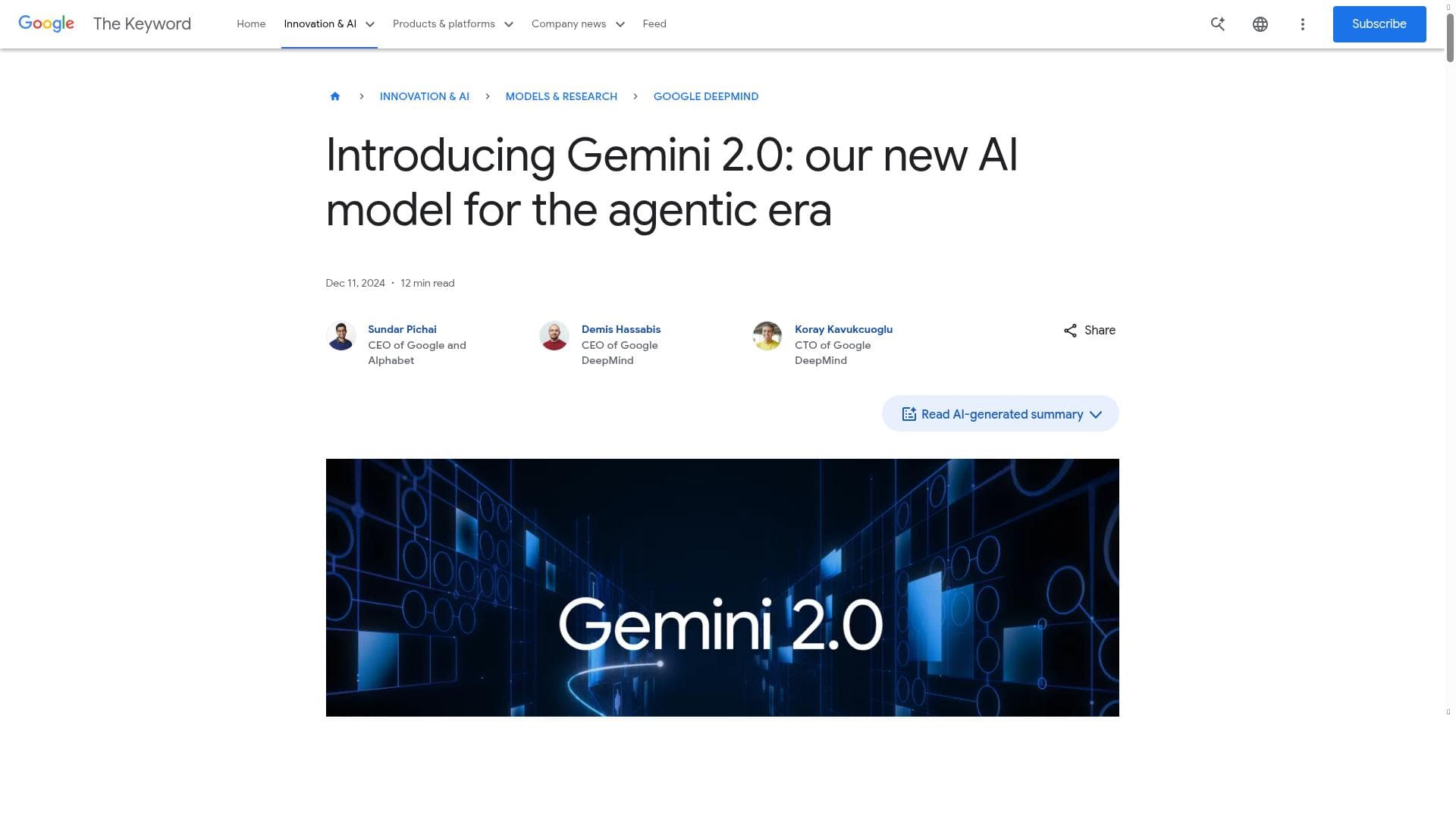
Google Gemini 2.0 is Google's most advanced AI model, uniquely capable of handling multimodal inputs like text, audio, and images with deep reasoning and fast performance. Ideal for developers and enterprises, it powers smarter, autonomous AI agents that transform how applications interact with users and perform complex tasks.
Google Gemini 2.0 represents the pinnacle of Google's AI development, designed to usher in a new era of intelligent, multimodal AI applications. At its core, Gemini 2.0 is a highly advanced AI model that processes and generates content across multiple modalities including text, audio, and images. This capability allows developers and businesses to create applications that interact with users in more natural and versatile ways, breaking the traditional boundaries of text-only AI. The model's architecture emphasizes faster performance and deeper reasoning abilities, enabling it to handle complex tasks that require nuanced understanding and multi-step problem-solving. Furthermore, Gemini 2.0 integrates seamlessly with various tools and APIs, empowering autonomous AI agents that can perform tasks independently and interact with external systems effectively. This positions Gemini 2.0 not just as a language model but as a comprehensive AI platform for the agentic era, where AI systems can act with greater autonomy and intelligence. Key features of Gemini 2.0 include its status as the most capable AI model Google has announced to date, reflecting significant advancements in AI research and engineering. Its multimodal input and output capabilities mean it can understand and generate content that combines text, audio, and images, making it ideal for applications such as virtual assistants, content creation, customer support, and interactive educational tools. The model's design supports complex task performance, allowing it to interpret intricate instructions, reason through multiple layers of information, and produce coherent and contextually relevant responses. Additionally, Gemini 2.0 enables natural user interaction by understanding conversational nuances and adapting its responses accordingly, which enhances user experience in AI-driven applications. The integration with external tools further extends its functionality, allowing developers to build AI agents that can autonomously execute workflows, access real-time data, and interact with other software systems. Google Gemini 2.0 is best suited for developers, enterprises, and innovators looking to build next-generation AI-powered applications that require sophisticated understanding and multimodal interaction. Use cases span a broad spectrum including intelligent virtual assistants capable of handling voice commands and visual inputs, advanced content generation platforms that produce multimedia content, customer service bots that can interpret and respond to complex queries, and autonomous AI agents that perform tasks such as scheduling, data analysis, and workflow automation. Its versatility makes it a valuable tool for industries such as technology, education, healthcare, entertainment, and finance where AI can significantly enhance productivity and user engagement. In terms of pricing, Google Gemini 2.0 follows a freemium model, making it accessible for developers to experiment and build prototypes without upfront costs. This approach encourages innovation and lowers the barrier to entry for startups and individual developers. For larger-scale or enterprise usage, Google likely offers tiered pricing plans that provide enhanced access, higher usage limits, and dedicated support, although specific details may be available through direct consultation or on Google’s developer platform. When compared to other AI models and platforms, Gemini 2.0 stands out due to its multimodal capabilities and deep integration with Google's ecosystem and tools. Unlike many AI models that focus primarily on text, Gemini 2.0’s ability to process audio and images alongside text allows for richer, more interactive applications. Its emphasis on autonomous agent functionality also differentiates it from standard language models, positioning it as a leader in the emerging field of agentic AI. However, as with any cutting-edge AI technology, users should consider potential limitations such as the need for substantial computational resources, the complexity of integrating multimodal data effectively, and ensuring ethical use and data privacy compliance. Overall, Google Gemini 2.0 is a transformative AI platform that pushes the boundaries of what AI can achieve today. Its combination of multimodal processing, advanced reasoning, and tool integration makes it a powerful choice for developers and organizations aiming to create smarter, more autonomous AI applications that redefine user interaction and task automation.

Description
Google Gemini 2.0 is Google's most advanced AI model, uniquely capable of handling multimodal inputs like text, audio, and images with deep reasoning and fast performance. Ideal for developers and enterprises, it powers smarter, autonomous AI agents that transform how applications interact with users and perform complex tasks.
Google Gemini 2.0 represents the pinnacle of Google's AI development, designed to usher in a new era of intelligent, multimodal AI applications. At its core, Gemini 2.0 is a highly advanced AI model that processes and generates content across multiple modalities including text, audio, and images. This capability allows developers and businesses to create applications that interact with users in more natural and versatile ways, breaking the traditional boundaries of text-only AI. The model's architecture emphasizes faster performance and deeper reasoning abilities, enabling it to handle complex tasks that require nuanced understanding and multi-step problem-solving. Furthermore, Gemini 2.0 integrates seamlessly with various tools and APIs, empowering autonomous AI agents that can perform tasks independently and interact with external systems effectively. This positions Gemini 2.0 not just as a language model but as a comprehensive AI platform for the agentic era, where AI systems can act with greater autonomy and intelligence. Key features of Gemini 2.0 include its status as the most capable AI model Google has announced to date, reflecting significant advancements in AI research and engineering. Its multimodal input and output capabilities mean it can understand and generate content that combines text, audio, and images, making it ideal for applications such as virtual assistants, content creation, customer support, and interactive educational tools. The model's design supports complex task performance, allowing it to interpret intricate instructions, reason through multiple layers of information, and produce coherent and contextually relevant responses. Additionally, Gemini 2.0 enables natural user interaction by understanding conversational nuances and adapting its responses accordingly, which enhances user experience in AI-driven applications. The integration with external tools further extends its functionality, allowing developers to build AI agents that can autonomously execute workflows, access real-time data, and interact with other software systems. Google Gemini 2.0 is best suited for developers, enterprises, and innovators looking to build next-generation AI-powered applications that require sophisticated understanding and multimodal interaction. Use cases span a broad spectrum including intelligent virtual assistants capable of handling voice commands and visual inputs, advanced content generation platforms that produce multimedia content, customer service bots that can interpret and respond to complex queries, and autonomous AI agents that perform tasks such as scheduling, data analysis, and workflow automation. Its versatility makes it a valuable tool for industries such as technology, education, healthcare, entertainment, and finance where AI can significantly enhance productivity and user engagement. In terms of pricing, Google Gemini 2.0 follows a freemium model, making it accessible for developers to experiment and build prototypes without upfront costs. This approach encourages innovation and lowers the barrier to entry for startups and individual developers. For larger-scale or enterprise usage, Google likely offers tiered pricing plans that provide enhanced access, higher usage limits, and dedicated support, although specific details may be available through direct consultation or on Google’s developer platform. When compared to other AI models and platforms, Gemini 2.0 stands out due to its multimodal capabilities and deep integration with Google's ecosystem and tools. Unlike many AI models that focus primarily on text, Gemini 2.0’s ability to process audio and images alongside text allows for richer, more interactive applications. Its emphasis on autonomous agent functionality also differentiates it from standard language models, positioning it as a leader in the emerging field of agentic AI. However, as with any cutting-edge AI technology, users should consider potential limitations such as the need for substantial computational resources, the complexity of integrating multimodal data effectively, and ensuring ethical use and data privacy compliance. Overall, Google Gemini 2.0 is a transformative AI platform that pushes the boundaries of what AI can achieve today. Its combination of multimodal processing, advanced reasoning, and tool integration makes it a powerful choice for developers and organizations aiming to create smarter, more autonomous AI applications that redefine user interaction and task automation.
Tool Features
- Most capable AI model announced by Google
- Designed for the agentic era enabling autonomous AI agents
- Supports complex task performance
- Enables natural user interaction
Frequently Asked Questions
What is Google Gemini 2.0?
Google Gemini 2.0 is Google's latest and most advanced AI model that supports multimodal inputs and outputs, including text, audio, and images. It is designed to enable smarter, faster, and more autonomous AI applications capable of complex reasoning and natural user interaction.
How much does Google Gemini 2.0 cost?
Google Gemini 2.0 follows a freemium pricing model, allowing developers to access and experiment with the AI for free at a basic level. For higher usage or enterprise features, tiered paid plans are available, though specific pricing details are provided through Google’s developer platform or sales team.
Who is Google Gemini 2.0 best for?
Google Gemini 2.0 is best suited for developers, startups, and enterprises looking to build advanced AI-powered applications that require multimodal interaction, deep reasoning, and autonomous agent capabilities. It is ideal for industries such as technology, education, healthcare, and customer service.
What are the main features of Google Gemini 2.0?
Key features include multimodal input and output support (text, audio, images), faster performance, deep reasoning abilities, integration with external tools and APIs, support for complex task execution, and enabling natural, conversational user interactions.
Does Google Gemini 2.0 offer a free trial?
Yes, Google Gemini 2.0 offers a freemium access model, allowing developers to try out the AI capabilities for free with certain usage limits before opting for paid plans.
What integrations does Google Gemini 2.0 support?
Google Gemini 2.0 supports integration with various external tools and APIs, enabling autonomous AI agents to interact with other software systems, access real-time data, and execute complex workflows.
How does Google Gemini 2.0 work?
Google Gemini 2.0 processes multimodal inputs such as text, audio, and images using advanced AI architectures to understand context and perform deep reasoning. It then generates appropriate multimodal outputs and can interact with external tools to autonomously complete tasks.
Socials
Use ToolSponsored Tools
































Reviews
No reviews yet. Be the first to share your experience.