Description
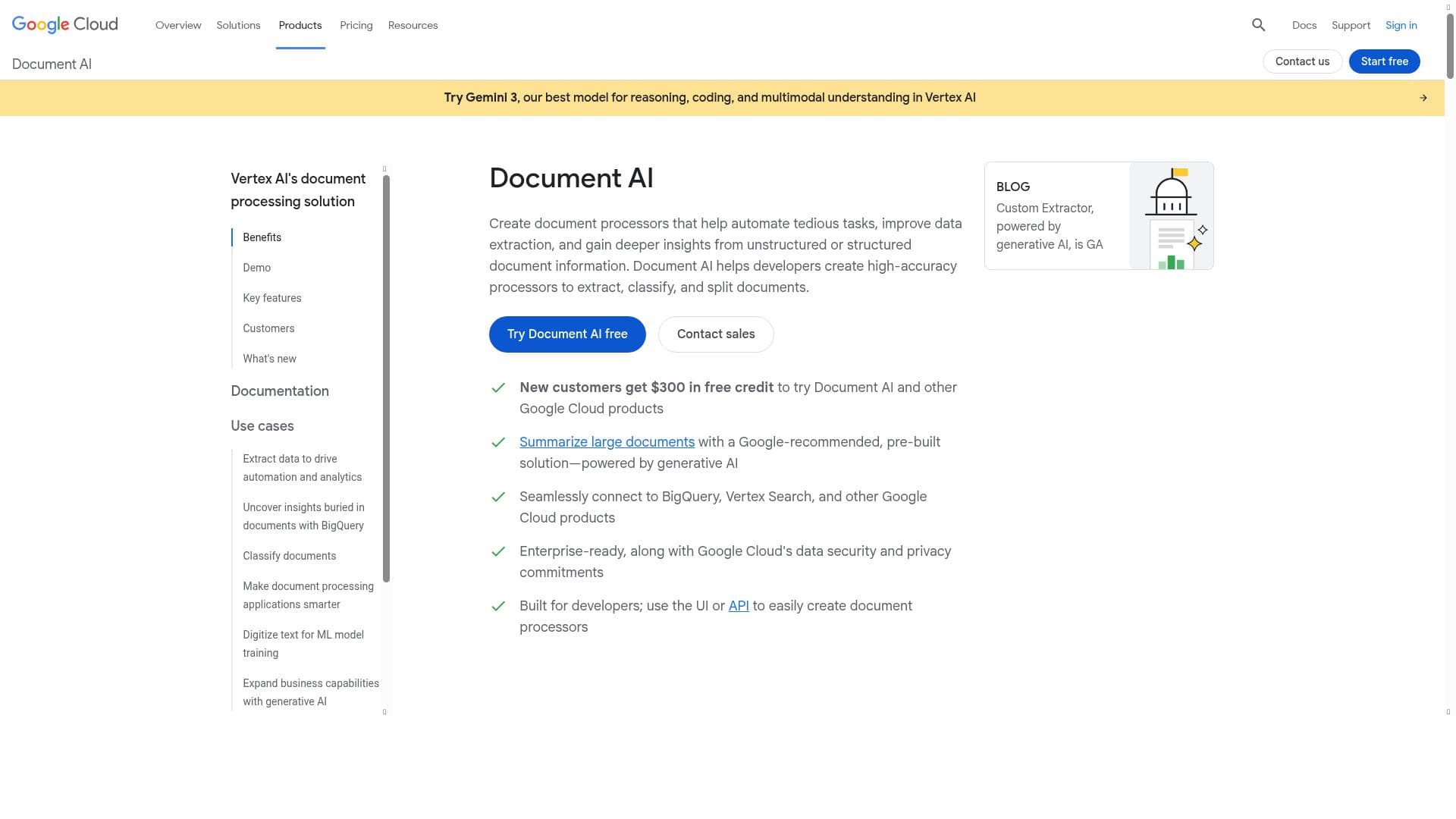
Google Document AI transforms unstructured document data into structured, actionable insights using advanced machine learning, making it ideal for organizations seeking to automate and streamline document processing. Its versatility across multiple document types and seamless integration with existing systems set it apart as a powerful tool for industries like finance, healthcare, and legal.
Google Document AI, also known as DocAI, is a powerful artificial intelligence tool designed to transform unstructured data contained within various documents into structured, actionable information. Its core purpose is to automate the traditionally manual and time-consuming process of document handling, enabling organizations to extract meaningful data efficiently and accurately. By leveraging advanced machine learning models and natural language processing, Document AI can interpret complex document layouts and diverse content types, making it an indispensable solution for businesses dealing with large volumes of paperwork. At its heart, Google Document AI offers a suite of robust features tailored to streamline document processing workflows. One of its standout capabilities is automated document processing, which eliminates the need for manual data entry by intelligently reading and understanding documents such as invoices, contracts, receipts, and forms. This automation significantly reduces errors and accelerates data throughput. The tool excels at structured data extraction, converting unstructured text, tables, and other elements into organized formats that can be easily integrated into databases or business applications. It supports a wide array of document types and formats, ensuring versatility across industries and use cases. Additionally, Document AI is designed for seamless integration with existing enterprise systems, allowing organizations to embed its functionalities into their current workflows without disruption. Google Document AI is particularly well-suited for enterprises and organizations that handle large volumes of documents and require high accuracy in data extraction. Industries such as finance, insurance, healthcare, legal, and logistics benefit immensely from its capabilities. For example, financial institutions can automate invoice and receipt processing to speed up accounts payable cycles, while healthcare providers can extract patient information from medical records to improve data management. Legal firms can use Document AI to analyze contracts and legal documents quickly, enhancing review efficiency. Its adaptability also makes it valuable for government agencies and educational institutions that manage extensive documentation. Regarding pricing, Google Document AI operates on a freemium model, allowing users to access basic features at no cost with usage limits, making it accessible for small businesses or those wanting to evaluate the tool before committing. For higher volumes and advanced features, paid plans are available, which typically scale based on the number of pages processed or the complexity of document types. This flexible pricing structure ensures that organizations of varying sizes can leverage Document AI according to their needs and budget. When compared to alternatives, Google Document AI stands out due to its integration within the Google Cloud ecosystem, providing robust scalability, security, and access to complementary AI services. Its advanced AI models, backed by Google's research, offer high accuracy and adaptability across document types. While competitors may offer similar document processing capabilities, Document AI's seamless integration with other Google Cloud tools and its support for multiple languages and document formats provide a competitive edge. However, some alternatives might offer more specialized features for niche industries or on-premises deployment options, which Document AI currently lacks. Despite its strengths, there are some considerations to keep in mind. The tool requires internet connectivity and is cloud-based, which may pose challenges for organizations with strict data residency or privacy requirements. Additionally, while Document AI supports a broad range of document types, extremely complex or highly customized documents may require additional configuration or manual review to ensure accuracy. Users should also consider the learning curve associated with integrating and optimizing the tool within their existing systems. Overall, Google Document AI offers a comprehensive, scalable, and intelligent solution for transforming document workflows but should be evaluated in the context of specific organizational needs and compliance requirements.
Description
Google Document AI transforms unstructured document data into structured, actionable insights using advanced machine learning, making it ideal for organizations seeking to automate and streamline document processing. Its versatility across multiple document types and seamless integration with existing systems set it apart as a powerful tool for industries like finance, healthcare, and legal.
Google Document AI, also known as DocAI, is a powerful artificial intelligence tool designed to transform unstructured data contained within various documents into structured, actionable information. Its core purpose is to automate the traditionally manual and time-consuming process of document handling, enabling organizations to extract meaningful data efficiently and accurately. By leveraging advanced machine learning models and natural language processing, Document AI can interpret complex document layouts and diverse content types, making it an indispensable solution for businesses dealing with large volumes of paperwork. At its heart, Google Document AI offers a suite of robust features tailored to streamline document processing workflows. One of its standout capabilities is automated document processing, which eliminates the need for manual data entry by intelligently reading and understanding documents such as invoices, contracts, receipts, and forms. This automation significantly reduces errors and accelerates data throughput. The tool excels at structured data extraction, converting unstructured text, tables, and other elements into organized formats that can be easily integrated into databases or business applications. It supports a wide array of document types and formats, ensuring versatility across industries and use cases. Additionally, Document AI is designed for seamless integration with existing enterprise systems, allowing organizations to embed its functionalities into their current workflows without disruption. Google Document AI is particularly well-suited for enterprises and organizations that handle large volumes of documents and require high accuracy in data extraction. Industries such as finance, insurance, healthcare, legal, and logistics benefit immensely from its capabilities. For example, financial institutions can automate invoice and receipt processing to speed up accounts payable cycles, while healthcare providers can extract patient information from medical records to improve data management. Legal firms can use Document AI to analyze contracts and legal documents quickly, enhancing review efficiency. Its adaptability also makes it valuable for government agencies and educational institutions that manage extensive documentation. Regarding pricing, Google Document AI operates on a freemium model, allowing users to access basic features at no cost with usage limits, making it accessible for small businesses or those wanting to evaluate the tool before committing. For higher volumes and advanced features, paid plans are available, which typically scale based on the number of pages processed or the complexity of document types. This flexible pricing structure ensures that organizations of varying sizes can leverage Document AI according to their needs and budget. When compared to alternatives, Google Document AI stands out due to its integration within the Google Cloud ecosystem, providing robust scalability, security, and access to complementary AI services. Its advanced AI models, backed by Google's research, offer high accuracy and adaptability across document types. While competitors may offer similar document processing capabilities, Document AI's seamless integration with other Google Cloud tools and its support for multiple languages and document formats provide a competitive edge. However, some alternatives might offer more specialized features for niche industries or on-premises deployment options, which Document AI currently lacks. Despite its strengths, there are some considerations to keep in mind. The tool requires internet connectivity and is cloud-based, which may pose challenges for organizations with strict data residency or privacy requirements. Additionally, while Document AI supports a broad range of document types, extremely complex or highly customized documents may require additional configuration or manual review to ensure accuracy. Users should also consider the learning curve associated with integrating and optimizing the tool within their existing systems. Overall, Google Document AI offers a comprehensive, scalable, and intelligent solution for transforming document workflows but should be evaluated in the context of specific organizational needs and compliance requirements.
Tool Features
- Automated document processing
- Structured data extraction from unstructured documents
- Supports multiple document types
- Seamless integration with existing systems
Frequently Asked Questions
What is Google Document AI?
Google Document AI is an AI-powered tool that automates the extraction of structured data from unstructured documents, enabling organizations to process and analyze documents efficiently.
How much does Google Document AI cost?
Google Document AI offers a freemium pricing model with basic features available for free under usage limits, while paid plans scale based on document volume and feature requirements.
Who is Google Document AI best for?
It is best suited for businesses and organizations in industries such as finance, healthcare, legal, insurance, logistics, and government that handle large volumes of documents and need accurate data extraction.
What are the main features of Google Document AI?
Key features include automated document processing, structured data extraction from unstructured documents, support for multiple document types, and seamless integration with existing enterprise systems.
Does Google Document AI offer a free trial?
Yes, the freemium model allows users to access basic features for free with certain usage limits, effectively serving as a free trial for evaluation purposes.
What integrations does Google Document AI support?
Google Document AI integrates seamlessly with other Google Cloud services and can be embedded into existing workflows and enterprise systems via APIs.
How does Google Document AI work?
It uses advanced machine learning and natural language processing models to analyze the content and layout of documents, extracting relevant data and converting it into structured formats for easy use.
Socials
Use ToolSponsored Tools









































Reviews
No reviews yet. Be the first to share your experience.