Description
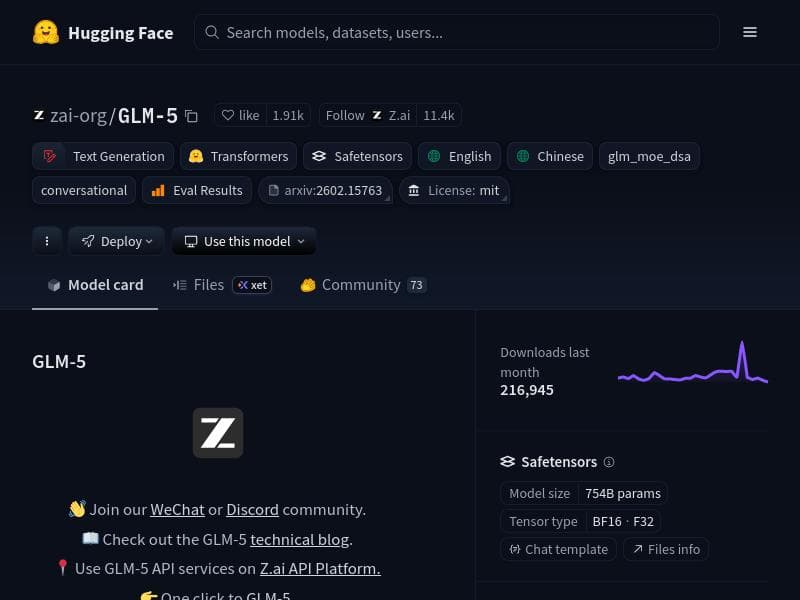
GLM-5 is a groundbreaking 744 billion parameter open-source AI model designed for complex systems and agentic tasks, featuring innovative DeepSeek Sparse Attention and slime RL infrastructure. Ideal for researchers and developers seeking advanced, scalable AI capabilities without proprietary restrictions, GLM-5 democratizes access to cutting-edge technology while competing with top commercial models.
GLM-5 is a cutting-edge open-source AI model designed to tackle complex systems and agentic tasks with remarkable efficiency and scalability. At its core, GLM-5 is a massive 744 billion parameter Mixture of Experts (MoE) model, with 40 billion parameters actively engaged during inference. This architecture enables it to handle intricate problem-solving scenarios and dynamic decision-making processes that require nuanced understanding and adaptability. Developed to bridge the performance gap with proprietary models like Claude Opus 4.5, GLM-5 stands out as the top open-source model on the Vending Bench 2 leaderboard, showcasing its advanced capabilities in natural language understanding and reasoning tasks. One of the defining features of GLM-5 is its implementation of DeepSeek Sparse Attention, a novel attention mechanism that optimizes computational resources by focusing on the most relevant parts of the input data. This approach significantly enhances the model's ability to process long sequences and complex inputs without the usual exponential increase in computational cost. Additionally, GLM-5 incorporates the "slime" reinforcement learning infrastructure, which facilitates more efficient training and fine-tuning through advanced RL techniques. This infrastructure supports dynamic adaptation and continuous learning, making GLM-5 highly suitable for evolving real-world applications. GLM-5 is particularly well-suited for researchers, developers, and organizations engaged in advanced AI research and development. Its open-source nature democratizes access to state-of-the-art AI technology, enabling a broad community to experiment, collaborate, and innovate without the barriers of proprietary restrictions. Use cases for GLM-5 span from complex system simulations, multi-agent coordination tasks, and autonomous decision-making frameworks to natural language processing applications requiring deep contextual understanding. Its scalability and modular design also make it an excellent choice for academic institutions and AI labs aiming to push the boundaries of large-scale model research. In terms of pricing, GLM-5 is available completely free of charge, reflecting its commitment to open science and community-driven progress. Users can access the model and its resources via the Hugging Face platform, which provides an ecosystem for sharing, deploying, and fine-tuning AI models. This accessibility ensures that even smaller teams and independent researchers can leverage GLM-5's powerful capabilities without financial constraints. When compared to alternatives, GLM-5 narrows the performance gap with leading proprietary models such as Claude Opus 4.5, offering competitive results while maintaining transparency and openness. Unlike closed-source models, GLM-5 encourages collaborative development and peer review, fostering a more inclusive AI ecosystem. Its unique combination of DeepSeek Sparse Attention and slime RL infrastructure distinguishes it from other MoE models by enhancing efficiency and adaptability. However, users should consider certain limitations. The sheer size of the model demands substantial computational resources for training and deployment, which may pose challenges for those without access to high-performance hardware. Additionally, while the model excels in complex and agentic tasks, it may require domain-specific fine-tuning to achieve optimal results in niche applications. As with any advanced AI system, responsible usage and ethical considerations are paramount to ensure beneficial outcomes. Overall, GLM-5 represents a significant advancement in open-source AI modeling, offering powerful tools for complex problem-solving and fostering a collaborative environment for AI innovation.

Description
GLM-5 is a groundbreaking 744 billion parameter open-source AI model designed for complex systems and agentic tasks, featuring innovative DeepSeek Sparse Attention and slime RL infrastructure. Ideal for researchers and developers seeking advanced, scalable AI capabilities without proprietary restrictions, GLM-5 democratizes access to cutting-edge technology while competing with top commercial models.
GLM-5 is a cutting-edge open-source AI model designed to tackle complex systems and agentic tasks with remarkable efficiency and scalability. At its core, GLM-5 is a massive 744 billion parameter Mixture of Experts (MoE) model, with 40 billion parameters actively engaged during inference. This architecture enables it to handle intricate problem-solving scenarios and dynamic decision-making processes that require nuanced understanding and adaptability. Developed to bridge the performance gap with proprietary models like Claude Opus 4.5, GLM-5 stands out as the top open-source model on the Vending Bench 2 leaderboard, showcasing its advanced capabilities in natural language understanding and reasoning tasks. One of the defining features of GLM-5 is its implementation of DeepSeek Sparse Attention, a novel attention mechanism that optimizes computational resources by focusing on the most relevant parts of the input data. This approach significantly enhances the model's ability to process long sequences and complex inputs without the usual exponential increase in computational cost. Additionally, GLM-5 incorporates the "slime" reinforcement learning infrastructure, which facilitates more efficient training and fine-tuning through advanced RL techniques. This infrastructure supports dynamic adaptation and continuous learning, making GLM-5 highly suitable for evolving real-world applications. GLM-5 is particularly well-suited for researchers, developers, and organizations engaged in advanced AI research and development. Its open-source nature democratizes access to state-of-the-art AI technology, enabling a broad community to experiment, collaborate, and innovate without the barriers of proprietary restrictions. Use cases for GLM-5 span from complex system simulations, multi-agent coordination tasks, and autonomous decision-making frameworks to natural language processing applications requiring deep contextual understanding. Its scalability and modular design also make it an excellent choice for academic institutions and AI labs aiming to push the boundaries of large-scale model research. In terms of pricing, GLM-5 is available completely free of charge, reflecting its commitment to open science and community-driven progress. Users can access the model and its resources via the Hugging Face platform, which provides an ecosystem for sharing, deploying, and fine-tuning AI models. This accessibility ensures that even smaller teams and independent researchers can leverage GLM-5's powerful capabilities without financial constraints. When compared to alternatives, GLM-5 narrows the performance gap with leading proprietary models such as Claude Opus 4.5, offering competitive results while maintaining transparency and openness. Unlike closed-source models, GLM-5 encourages collaborative development and peer review, fostering a more inclusive AI ecosystem. Its unique combination of DeepSeek Sparse Attention and slime RL infrastructure distinguishes it from other MoE models by enhancing efficiency and adaptability. However, users should consider certain limitations. The sheer size of the model demands substantial computational resources for training and deployment, which may pose challenges for those without access to high-performance hardware. Additionally, while the model excels in complex and agentic tasks, it may require domain-specific fine-tuning to achieve optimal results in niche applications. As with any advanced AI system, responsible usage and ethical considerations are paramount to ensure beneficial outcomes. Overall, GLM-5 represents a significant advancement in open-source AI modeling, offering powerful tools for complex problem-solving and fostering a collaborative environment for AI innovation.
Tool Features
- Open source AI model
- Supports advanced AI research
- Democratizes access to AI technology
- Encourages collaboration in AI community
Frequently Asked Questions
What is GLM-5?
GLM-5 is a large-scale open-source AI model with 744 billion parameters (40 billion active) designed to handle complex systems and agentic tasks. It incorporates advanced technologies like DeepSeek Sparse Attention and slime reinforcement learning infrastructure to optimize performance and adaptability.
How much does GLM-5 cost?
GLM-5 is completely free to use, reflecting its open-source nature and commitment to democratizing AI technology.
Who is GLM-5 best for?
GLM-5 is best suited for AI researchers, developers, academic institutions, and organizations focused on advanced AI research, complex system modeling, and multi-agent tasks who require a powerful, scalable, and open-source AI solution.
What are the main features of GLM-5?
Key features include its massive 744B parameter MoE architecture with 40B active parameters, DeepSeek Sparse Attention for efficient processing of long sequences, slime reinforcement learning infrastructure for enhanced training, and its open-source accessibility promoting collaboration.
Does GLM-5 offer a free trial?
Since GLM-5 is open source and freely available, there is no need for a free trial; users can access and use the model directly without cost.
What integrations does GLM-5 support?
GLM-5 is hosted on Hugging Face, enabling integration with various AI development tools and platforms that support Hugging Face models, including APIs for deployment, fine-tuning, and experimentation.
How does GLM-5 work?
GLM-5 operates as a Mixture of Experts model that activates a subset of its 744 billion parameters (40 billion active) during inference, using DeepSeek Sparse Attention to focus computational resources efficiently and slime RL infrastructure to facilitate adaptive learning and fine-tuning.
Socials
Use ToolSponsored Tools































Reviews
No reviews yet. Be the first to share your experience.