Description
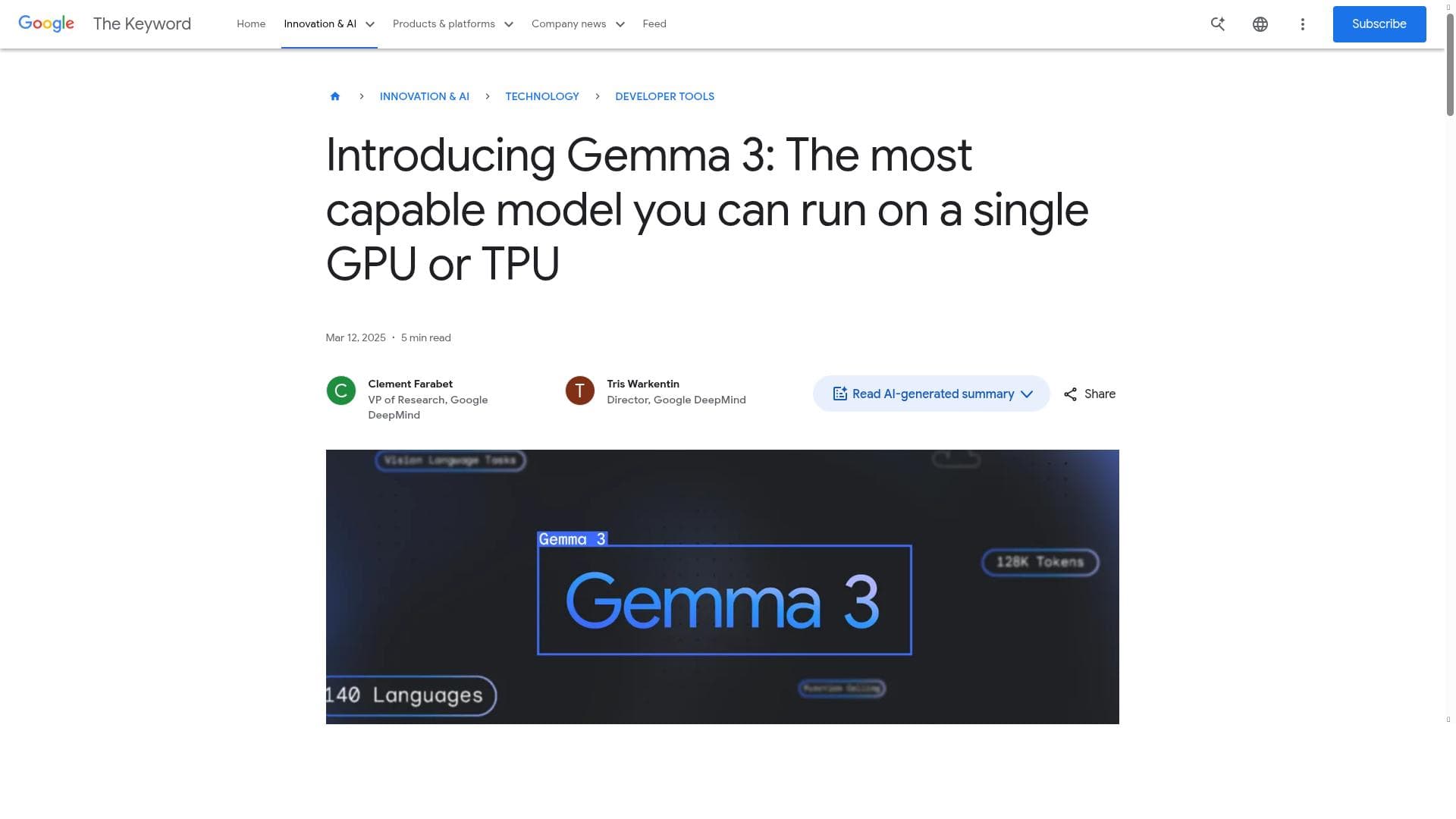
Gemma 3 is Google's cutting-edge multimodal AI model that seamlessly integrates text, images, and video processing with support for over 140 languages and an enormous 128K token context window. Designed for efficiency and ethical AI use, it empowers developers and researchers to build advanced, responsible AI applications on accessible hardware.
Gemma 3 is an advanced multimodal AI model developed by Google, designed to process and generate content across text, images, and video modalities. Its core purpose is to provide developers and researchers with a highly capable, versatile AI system that supports a wide range of applications in natural language understanding, computer vision, and multimedia content generation. With model sizes ranging from 1 billion to 27 billion parameters, Gemma 3 offers scalable performance tailored to different computational resources and use cases. It supports an extensive context window of up to 128,000 tokens, enabling it to handle long-form content and complex interactions seamlessly. Additionally, Gemma 3 supports over 140 languages, making it a truly global AI solution suitable for diverse linguistic and cultural contexts. A notable component of the Gemma 3 suite is ShieldGemma 2, a safety-focused model designed to ensure responsible AI deployment by mitigating harmful or biased outputs, reflecting Google's commitment to ethical AI development. Key features of Gemma 3 include its open model architecture, which promotes transparency and accessibility for developers and researchers. Despite its advanced capabilities, Gemma 3 is optimized for portability and efficiency, capable of running on a single GPU or TPU, which lowers the barrier to entry for organizations without extensive computational infrastructure. This efficiency does not compromise performance; instead, it enables real-time or near-real-time processing for complex multimodal tasks. The model's design incorporates ethical considerations from the ground up, including mechanisms for content moderation and bias reduction, making it suitable for sensitive applications. Gemma 3's support for a broad range of languages and modalities allows it to power AI assistants, content creation tools, and advertising technologies that require nuanced understanding and generation of multimedia content. Gemma 3 is best suited for AI developers, researchers, and enterprises looking to integrate cutting-edge multimodal AI capabilities into their products or workflows. Its flexibility makes it ideal for applications such as AI-powered assistants that can interpret and generate responses involving text, images, and video; content moderation systems that require contextual understanding across media types; and creative tools that assist in generating multimedia content. Researchers can leverage Gemma 3's open model to experiment with novel AI techniques or to build upon Google's safety-focused ShieldGemma 2 to develop responsible AI applications. The model's extensive language support also makes it valuable for global companies aiming to deploy AI solutions across multiple regions and languages. Pricing for Gemma 3 is free, which significantly enhances its accessibility for a wide range of users, from individual developers to large organizations. This free availability encourages experimentation, innovation, and adoption without the typical financial barriers associated with large-scale AI models. Users can deploy Gemma 3 on their own hardware, such as a single GPU or TPU, further reducing costs related to cloud computing resources. Compared to alternative multimodal AI models, Gemma 3 stands out due to its combination of scale, efficiency, and ethical design. While some models may offer similar multimodal capabilities, Gemma 3's ability to run efficiently on modest hardware and its extensive language and context support provide a unique value proposition. Additionally, the integration of ShieldGemma 2 for safety distinguishes it from many competitors by embedding responsible AI principles directly into the model architecture. However, unlike some proprietary models that may offer extensive commercial support or ecosystem integrations, Gemma 3's open model approach may require users to have more technical expertise to fully leverage its capabilities. Notable limitations of Gemma 3 include the potential complexity involved in deploying and fine-tuning such a large multimodal model, which may require specialized knowledge in AI and machine learning. While it is optimized for single GPU or TPU use, extremely large-scale deployments or highly specialized use cases might still necessitate more powerful infrastructure. Furthermore, as with any AI model, there remains the risk of unintended biases or inaccuracies, despite the inclusion of ShieldGemma 2 for safety. Users should carefully evaluate and monitor outputs, especially in sensitive or high-stakes applications. Finally, while the model supports a vast number of languages, performance may vary depending on the language and modality, and ongoing updates may be necessary to maintain state-of-the-art results.

Description
Gemma 3 is Google's cutting-edge multimodal AI model that seamlessly integrates text, images, and video processing with support for over 140 languages and an enormous 128K token context window. Designed for efficiency and ethical AI use, it empowers developers and researchers to build advanced, responsible AI applications on accessible hardware.
Gemma 3 is an advanced multimodal AI model developed by Google, designed to process and generate content across text, images, and video modalities. Its core purpose is to provide developers and researchers with a highly capable, versatile AI system that supports a wide range of applications in natural language understanding, computer vision, and multimedia content generation. With model sizes ranging from 1 billion to 27 billion parameters, Gemma 3 offers scalable performance tailored to different computational resources and use cases. It supports an extensive context window of up to 128,000 tokens, enabling it to handle long-form content and complex interactions seamlessly. Additionally, Gemma 3 supports over 140 languages, making it a truly global AI solution suitable for diverse linguistic and cultural contexts. A notable component of the Gemma 3 suite is ShieldGemma 2, a safety-focused model designed to ensure responsible AI deployment by mitigating harmful or biased outputs, reflecting Google's commitment to ethical AI development. Key features of Gemma 3 include its open model architecture, which promotes transparency and accessibility for developers and researchers. Despite its advanced capabilities, Gemma 3 is optimized for portability and efficiency, capable of running on a single GPU or TPU, which lowers the barrier to entry for organizations without extensive computational infrastructure. This efficiency does not compromise performance; instead, it enables real-time or near-real-time processing for complex multimodal tasks. The model's design incorporates ethical considerations from the ground up, including mechanisms for content moderation and bias reduction, making it suitable for sensitive applications. Gemma 3's support for a broad range of languages and modalities allows it to power AI assistants, content creation tools, and advertising technologies that require nuanced understanding and generation of multimedia content. Gemma 3 is best suited for AI developers, researchers, and enterprises looking to integrate cutting-edge multimodal AI capabilities into their products or workflows. Its flexibility makes it ideal for applications such as AI-powered assistants that can interpret and generate responses involving text, images, and video; content moderation systems that require contextual understanding across media types; and creative tools that assist in generating multimedia content. Researchers can leverage Gemma 3's open model to experiment with novel AI techniques or to build upon Google's safety-focused ShieldGemma 2 to develop responsible AI applications. The model's extensive language support also makes it valuable for global companies aiming to deploy AI solutions across multiple regions and languages. Pricing for Gemma 3 is free, which significantly enhances its accessibility for a wide range of users, from individual developers to large organizations. This free availability encourages experimentation, innovation, and adoption without the typical financial barriers associated with large-scale AI models. Users can deploy Gemma 3 on their own hardware, such as a single GPU or TPU, further reducing costs related to cloud computing resources. Compared to alternative multimodal AI models, Gemma 3 stands out due to its combination of scale, efficiency, and ethical design. While some models may offer similar multimodal capabilities, Gemma 3's ability to run efficiently on modest hardware and its extensive language and context support provide a unique value proposition. Additionally, the integration of ShieldGemma 2 for safety distinguishes it from many competitors by embedding responsible AI principles directly into the model architecture. However, unlike some proprietary models that may offer extensive commercial support or ecosystem integrations, Gemma 3's open model approach may require users to have more technical expertise to fully leverage its capabilities. Notable limitations of Gemma 3 include the potential complexity involved in deploying and fine-tuning such a large multimodal model, which may require specialized knowledge in AI and machine learning. While it is optimized for single GPU or TPU use, extremely large-scale deployments or highly specialized use cases might still necessitate more powerful infrastructure. Furthermore, as with any AI model, there remains the risk of unintended biases or inaccuracies, despite the inclusion of ShieldGemma 2 for safety. Users should carefully evaluate and monitor outputs, especially in sensitive or high-stakes applications. Finally, while the model supports a vast number of languages, performance may vary depending on the language and modality, and ongoing updates may be necessary to maintain state-of-the-art results.
Tool Features
- Highly capable open model
- Portable and efficient to run on a single GPU or TPU
- Designed with responsibility and ethical considerations
- Supports developers and researchers with advanced AI capabilities
Frequently Asked Questions
What is Gemma 3?
Gemma 3 is Google's latest multimodal AI model that processes and generates text, images, and video. It offers scalable model sizes from 1 billion to 27 billion parameters, supports over 140 languages, and includes a large 128K token context window for handling complex, long-form content.
How much does Gemma 3 cost?
Gemma 3 is available for free, allowing developers and researchers to access and deploy the model without any licensing fees.
Who is Gemma 3 best for?
Gemma 3 is ideal for AI developers, researchers, and enterprises seeking advanced multimodal AI capabilities for applications like AI assistants, content creation, moderation, and multilingual solutions.
What are the main features of Gemma 3?
Key features include its highly capable open model architecture, portability to run efficiently on a single GPU or TPU, support for over 140 languages, a massive 128K token context window, and integrated safety mechanisms via ShieldGemma 2.
Does Gemma 3 offer a free trial?
Yes, Gemma 3 is provided free of charge, so users can access and experiment with the model without any trial limitations.
What integrations does Gemma 3 support?
While specific integrations depend on user implementation, Gemma 3's open model design allows it to be integrated into a wide range of AI applications, including AI assistants, content generation platforms, and multimedia processing tools.
How does Gemma 3 work?
Gemma 3 processes multiple data modalities—text, images, and video—using large-scale transformer-based architectures. It leverages extensive training across languages and media types, combined with a large context window, to generate coherent, contextually relevant outputs. Safety features like ShieldGemma 2 help ensure responsible AI behavior.
Socials
Use ToolSponsored Tools
































Reviews
No reviews yet. Be the first to share your experience.