Gemini Embedding 2
Description
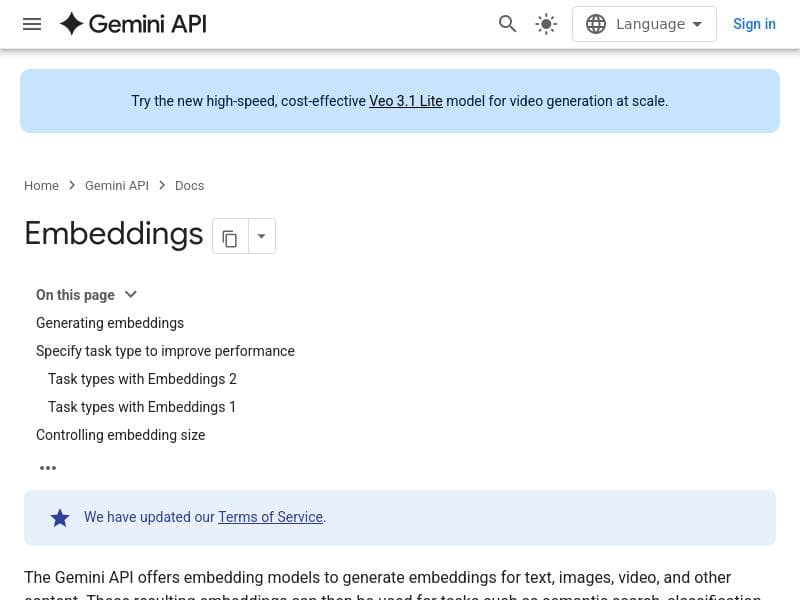
Gemini Embedding 2 is Google's first natively multimodal embedding model that unifies text, images, video, audio, and documents into a single semantic space, enabling powerful cross-media retrieval and classification. Ideal for developers and enterprises working with diverse data types, it enhances search, recommendation, and analysis systems with seamless multimodal understanding.
Gemini Embedding 2 is a groundbreaking multimodal embedding model developed by Google, designed to unify diverse data types such as text, images, video, audio, and documents into a single, coherent embedding space. This native multimodal capability allows developers and organizations to perform retrieval, classification, and clustering tasks across multiple media formats seamlessly, which is a significant advancement over traditional unimodal embedding models that focus on only one data type at a time. By mapping various content types into a shared semantic space, Gemini Embedding 2 enables more intuitive and powerful search, recommendation, and analysis systems that can understand and relate information regardless of its original format. Currently available in public preview, this tool represents a major step forward in AI-driven multimodal understanding and processing. At its core, Gemini Embedding 2 offers advanced embedding generation that captures the semantic essence of inputs across different modalities. This means that whether the input is a piece of text, an image, a segment of video, an audio clip, or a document, the model generates embeddings that reflect the underlying meaning and context, allowing for meaningful comparisons and retrievals. Its support for various data types makes it highly versatile, enabling applications ranging from multimedia search engines to cross-modal recommendation systems and complex classification workflows that involve heterogeneous data. The model integrates tightly with Google AI developer tools, facilitating easy adoption and deployment within existing AI pipelines and cloud environments. Additionally, Gemini Embedding 2 supports classification and clustering tasks, empowering users to organize and analyze large datasets more effectively by grouping related content regardless of its format. Gemini Embedding 2 is particularly well-suited for enterprises and developers working with large-scale, multimodal datasets who require a unified approach to data representation. Use cases include multimedia content platforms seeking to improve search relevance by combining text and visual data, e-commerce sites enhancing product recommendations by integrating images and descriptions, and research institutions analyzing diverse data types for pattern discovery and knowledge extraction. Its ability to handle multiple modalities simultaneously makes it invaluable for any application that relies on understanding and correlating information across different media. Regarding pricing, Gemini Embedding 2 operates on a freemium model, allowing users to access core functionalities at no cost during the public preview phase. This approach encourages experimentation and integration by developers and businesses before committing to paid plans, which are expected to offer expanded usage limits and additional enterprise features. The freemium model ensures accessibility while providing a pathway for scaling usage based on demand and application complexity. Compared to alternative embedding models, Gemini Embedding 2 stands out due to its native multimodal design, whereas many competitors focus on single modalities or require complex pipelines to combine embeddings from separate models. This native integration reduces complexity, improves performance, and enhances the quality of semantic understanding across data types. While some other models may offer strong performance in specific domains, Gemini Embedding 2’s versatility and Google’s robust AI infrastructure provide a compelling advantage for broad, multimodal applications. Despite its strengths, users should consider that Gemini Embedding 2 is currently in public preview, which may imply ongoing updates and potential limitations in terms of API stability or feature completeness. Additionally, as with any embedding model, the quality of results depends on the nature of the input data and the specific use case. Organizations should evaluate the model’s performance on their datasets and consider privacy and compliance requirements when integrating multimodal data. Overall, Gemini Embedding 2 offers a powerful, unified embedding solution that is poised to transform how multimodal data is processed and leveraged across industries.

Description
Gemini Embedding 2 is Google's first natively multimodal embedding model that unifies text, images, video, audio, and documents into a single semantic space, enabling powerful cross-media retrieval and classification. Ideal for developers and enterprises working with diverse data types, it enhances search, recommendation, and analysis systems with seamless multimodal understanding.
Gemini Embedding 2 is a groundbreaking multimodal embedding model developed by Google, designed to unify diverse data types such as text, images, video, audio, and documents into a single, coherent embedding space. This native multimodal capability allows developers and organizations to perform retrieval, classification, and clustering tasks across multiple media formats seamlessly, which is a significant advancement over traditional unimodal embedding models that focus on only one data type at a time. By mapping various content types into a shared semantic space, Gemini Embedding 2 enables more intuitive and powerful search, recommendation, and analysis systems that can understand and relate information regardless of its original format. Currently available in public preview, this tool represents a major step forward in AI-driven multimodal understanding and processing. At its core, Gemini Embedding 2 offers advanced embedding generation that captures the semantic essence of inputs across different modalities. This means that whether the input is a piece of text, an image, a segment of video, an audio clip, or a document, the model generates embeddings that reflect the underlying meaning and context, allowing for meaningful comparisons and retrievals. Its support for various data types makes it highly versatile, enabling applications ranging from multimedia search engines to cross-modal recommendation systems and complex classification workflows that involve heterogeneous data. The model integrates tightly with Google AI developer tools, facilitating easy adoption and deployment within existing AI pipelines and cloud environments. Additionally, Gemini Embedding 2 supports classification and clustering tasks, empowering users to organize and analyze large datasets more effectively by grouping related content regardless of its format. Gemini Embedding 2 is particularly well-suited for enterprises and developers working with large-scale, multimodal datasets who require a unified approach to data representation. Use cases include multimedia content platforms seeking to improve search relevance by combining text and visual data, e-commerce sites enhancing product recommendations by integrating images and descriptions, and research institutions analyzing diverse data types for pattern discovery and knowledge extraction. Its ability to handle multiple modalities simultaneously makes it invaluable for any application that relies on understanding and correlating information across different media. Regarding pricing, Gemini Embedding 2 operates on a freemium model, allowing users to access core functionalities at no cost during the public preview phase. This approach encourages experimentation and integration by developers and businesses before committing to paid plans, which are expected to offer expanded usage limits and additional enterprise features. The freemium model ensures accessibility while providing a pathway for scaling usage based on demand and application complexity. Compared to alternative embedding models, Gemini Embedding 2 stands out due to its native multimodal design, whereas many competitors focus on single modalities or require complex pipelines to combine embeddings from separate models. This native integration reduces complexity, improves performance, and enhances the quality of semantic understanding across data types. While some other models may offer strong performance in specific domains, Gemini Embedding 2’s versatility and Google’s robust AI infrastructure provide a compelling advantage for broad, multimodal applications. Despite its strengths, users should consider that Gemini Embedding 2 is currently in public preview, which may imply ongoing updates and potential limitations in terms of API stability or feature completeness. Additionally, as with any embedding model, the quality of results depends on the nature of the input data and the specific use case. Organizations should evaluate the model’s performance on their datasets and consider privacy and compliance requirements when integrating multimodal data. Overall, Gemini Embedding 2 offers a powerful, unified embedding solution that is poised to transform how multimodal data is processed and leveraged across industries.
Tool Features
- Advanced embedding generation for semantic understanding
- Supports various data types for versatile applications
- Enables improved search and recommendation systems
- Integrates with Google AI developer tools
- Facilitates classification and clustering tasks
Frequently Asked Questions
What is Gemini Embedding 2?
Gemini Embedding 2 is Google's first natively multimodal embedding model that maps various data types—including text, images, video, audio, and documents—into a single embedding space to enable multimodal retrieval, classification, and clustering.
How much does Gemini Embedding 2 cost?
Gemini Embedding 2 is available under a freemium pricing model during its public preview phase, allowing users to access core features for free with options to upgrade for expanded usage and enterprise capabilities.
Who is Gemini Embedding 2 best for?
It is best suited for developers, enterprises, and organizations that work with large-scale, multimodal datasets and need unified embeddings for enhanced search, recommendation, classification, and clustering across different media types.
What are the main features of Gemini Embedding 2?
Key features include advanced semantic embedding generation, native support for multiple data types (text, images, video, audio, documents), integration with Google AI developer tools, and capabilities for improved search, recommendation, classification, and clustering.
Does Gemini Embedding 2 offer a free trial?
Yes, Gemini Embedding 2 is currently available in public preview with a freemium model, effectively allowing users to try the service for free with certain usage limits.
What integrations does Gemini Embedding 2 support?
Gemini Embedding 2 integrates seamlessly with Google AI developer tools and cloud services, enabling easy incorporation into existing AI workflows and applications.
How does Gemini Embedding 2 work?
It generates embeddings by mapping inputs from multiple modalities—such as text, images, video, audio, and documents—into a shared semantic space, allowing for cross-modal retrieval and classification based on the underlying meaning rather than just the data format.
Socials
Use ToolSponsored Tools































Reviews
No reviews yet. Be the first to share your experience.