Description
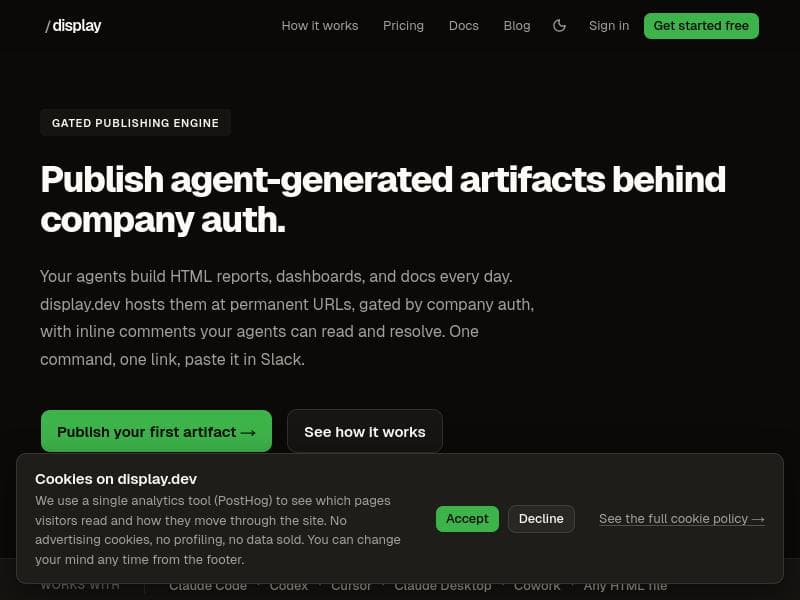
display.dev uniquely transforms HTML and Markdown files into secure, permanent URLs behind company authentication, enabling seamless sharing and collaboration on agent-generated artifacts. Ideal for teams leveraging AI-generated reports and documentation, it combines one-command publishing with inline comments and Slack integration to streamline iteration and feedback.
display.dev is a specialized platform designed to simplify the publication and sharing of agent-generated artifacts such as reports, dashboards, and documentation within a secure company environment. Its core purpose is to transform HTML and Markdown files into permanent, authenticated URLs that can be easily accessed and iterated upon by authorized team members. This approach streamlines collaboration by ensuring that sensitive or proprietary content remains protected behind company authentication protocols, while also enabling seamless feedback and version control through inline commenting features. At its heart, display.dev offers a one-command publishing system that instantly generates a shareable link for any HTML or Markdown file. This eliminates the cumbersome process of manual hosting or complex deployment pipelines. Users can securely sign in using one-time passwords (OTP) or single sign-on (SSO) options via Google or Microsoft accounts, ensuring that access is restricted strictly to company personnel. The platform supports multiple access methods including command-line interface (CLI), managed cloud platform (MCP), and browser-based interactions, catering to diverse user preferences and workflows. Key features include the ability to host a wide variety of agent-generated content, from dynamic dashboards to detailed reports and technical documentation. Inline commenting functionality allows colleagues to leave feedback directly on the artifact, which agents can then read and resolve, fostering a collaborative iteration process. Integration with Slack further enhances communication by enabling artifact sharing and notifications within team channels, keeping everyone aligned without switching contexts. This combination of secure access, ease of publishing, and collaborative tools makes display.dev a powerful asset for teams relying on AI or automated agents to generate critical business content. display.dev is particularly well-suited for organizations that generate frequent automated reports or documentation requiring controlled distribution and iterative feedback. This includes data science teams, analytics departments, product teams, and any group that leverages AI agents to produce content that must be reviewed and refined by multiple stakeholders. Its authentication features make it ideal for companies with strict security requirements, while the simplicity of one-command publishing appeals to users who want to avoid complex deployment processes. The platform operates on a freemium pricing model, allowing users to start with a free tier that covers essential features and gradually scale up as their needs grow. This approach lowers the barrier to entry and enables teams to evaluate the tool’s benefits before committing financially. While specific pricing details beyond the freemium tier are not disclosed, the model typically supports incremental upgrades for enhanced features, increased storage, or additional user seats. Compared to alternatives, display.dev stands out by combining secure, company-authenticated access with a focus on agent-generated content and inline collaboration. Many traditional document sharing or hosting platforms lack the seamless integration of authentication and commenting tailored for automated artifacts. Additionally, its support for multiple access methods and Slack integration provides flexibility that some competitors do not offer. However, unlike fully featured content management systems or enterprise document platforms, display.dev is specialized for a niche use case centered on AI-generated HTML and Markdown files, which may limit its applicability for broader content management needs. Potential limitations include the reliance on company authentication systems, which may require IT involvement to configure SSO or OTP settings properly. The platform’s focus on HTML and Markdown means it may not support other file formats or complex multimedia content natively. Furthermore, while inline comments enhance collaboration, teams accustomed to more robust project management or document review tools might find the feature set basic. Lastly, as a relatively new and specialized tool, integration options beyond Slack may be limited compared to more established platforms. In summary, display.dev offers a streamlined, secure, and collaborative solution for publishing and iterating on agent-generated HTML and Markdown artifacts within company environments. Its ease of use, combined with robust authentication and communication features, makes it an excellent choice for teams seeking to enhance productivity and control over automated content sharing and review processes.

Description
display.dev uniquely transforms HTML and Markdown files into secure, permanent URLs behind company authentication, enabling seamless sharing and collaboration on agent-generated artifacts. Ideal for teams leveraging AI-generated reports and documentation, it combines one-command publishing with inline comments and Slack integration to streamline iteration and feedback.
display.dev is a specialized platform designed to simplify the publication and sharing of agent-generated artifacts such as reports, dashboards, and documentation within a secure company environment. Its core purpose is to transform HTML and Markdown files into permanent, authenticated URLs that can be easily accessed and iterated upon by authorized team members. This approach streamlines collaboration by ensuring that sensitive or proprietary content remains protected behind company authentication protocols, while also enabling seamless feedback and version control through inline commenting features. At its heart, display.dev offers a one-command publishing system that instantly generates a shareable link for any HTML or Markdown file. This eliminates the cumbersome process of manual hosting or complex deployment pipelines. Users can securely sign in using one-time passwords (OTP) or single sign-on (SSO) options via Google or Microsoft accounts, ensuring that access is restricted strictly to company personnel. The platform supports multiple access methods including command-line interface (CLI), managed cloud platform (MCP), and browser-based interactions, catering to diverse user preferences and workflows. Key features include the ability to host a wide variety of agent-generated content, from dynamic dashboards to detailed reports and technical documentation. Inline commenting functionality allows colleagues to leave feedback directly on the artifact, which agents can then read and resolve, fostering a collaborative iteration process. Integration with Slack further enhances communication by enabling artifact sharing and notifications within team channels, keeping everyone aligned without switching contexts. This combination of secure access, ease of publishing, and collaborative tools makes display.dev a powerful asset for teams relying on AI or automated agents to generate critical business content. display.dev is particularly well-suited for organizations that generate frequent automated reports or documentation requiring controlled distribution and iterative feedback. This includes data science teams, analytics departments, product teams, and any group that leverages AI agents to produce content that must be reviewed and refined by multiple stakeholders. Its authentication features make it ideal for companies with strict security requirements, while the simplicity of one-command publishing appeals to users who want to avoid complex deployment processes. The platform operates on a freemium pricing model, allowing users to start with a free tier that covers essential features and gradually scale up as their needs grow. This approach lowers the barrier to entry and enables teams to evaluate the tool’s benefits before committing financially. While specific pricing details beyond the freemium tier are not disclosed, the model typically supports incremental upgrades for enhanced features, increased storage, or additional user seats. Compared to alternatives, display.dev stands out by combining secure, company-authenticated access with a focus on agent-generated content and inline collaboration. Many traditional document sharing or hosting platforms lack the seamless integration of authentication and commenting tailored for automated artifacts. Additionally, its support for multiple access methods and Slack integration provides flexibility that some competitors do not offer. However, unlike fully featured content management systems or enterprise document platforms, display.dev is specialized for a niche use case centered on AI-generated HTML and Markdown files, which may limit its applicability for broader content management needs. Potential limitations include the reliance on company authentication systems, which may require IT involvement to configure SSO or OTP settings properly. The platform’s focus on HTML and Markdown means it may not support other file formats or complex multimedia content natively. Furthermore, while inline comments enhance collaboration, teams accustomed to more robust project management or document review tools might find the feature set basic. Lastly, as a relatively new and specialized tool, integration options beyond Slack may be limited compared to more established platforms. In summary, display.dev offers a streamlined, secure, and collaborative solution for publishing and iterating on agent-generated HTML and Markdown artifacts within company environments. Its ease of use, combined with robust authentication and communication features, makes it an excellent choice for teams seeking to enhance productivity and control over automated content sharing and review processes.
Tool Features
- Turns any HTML or Markdown into a permanent, authenticated URL
- Restricts access to company users via authentication
- Supports CLI, MCP, or browser access methods
- Hosts agent-generated artifacts like reports, dashboards, and docs
- Inline comments for agents to read and resolve
- One command publishing with a single link for easy sharing
- Integration with Slack for artifact sharing
Frequently Asked Questions
What is display.dev?
display.dev is a platform that allows users to publish agent-generated HTML and Markdown artifacts securely behind company authentication, providing permanent URLs for easy sharing and collaboration with inline commenting.
How much does display.dev cost?
display.dev offers a freemium pricing model, allowing users to access essential features for free with options to upgrade for additional capabilities and increased usage.
Who is display.dev best for?
display.dev is best suited for organizations and teams that generate automated reports, dashboards, or documentation using AI agents and require secure, authenticated sharing and collaborative iteration.
What are the main features of display.dev?
Key features include one-command publishing of HTML and Markdown files to permanent authenticated URLs, company user access restriction via OTP or Google/Microsoft SSO, support for CLI, MCP, and browser access, inline commenting for feedback, and Slack integration for artifact sharing.
Does display.dev offer a free trial?
Yes, display.dev provides a freemium plan that allows users to try core features at no cost, effectively serving as a free trial.
What integrations does display.dev support?
display.dev integrates with Slack to facilitate artifact sharing and notifications within team communication channels.
How does display.dev work?
Users publish their HTML or Markdown files with a single command, which generates a permanent URL protected by company authentication. Authorized colleagues access the content securely via OTP or SSO, collaborate through inline comments, and can share artifacts easily via Slack integration.
Socials
Use ToolSponsored Tools





























Reviews
No reviews yet. Be the first to share your experience.