DeepSeek-VL2
Description
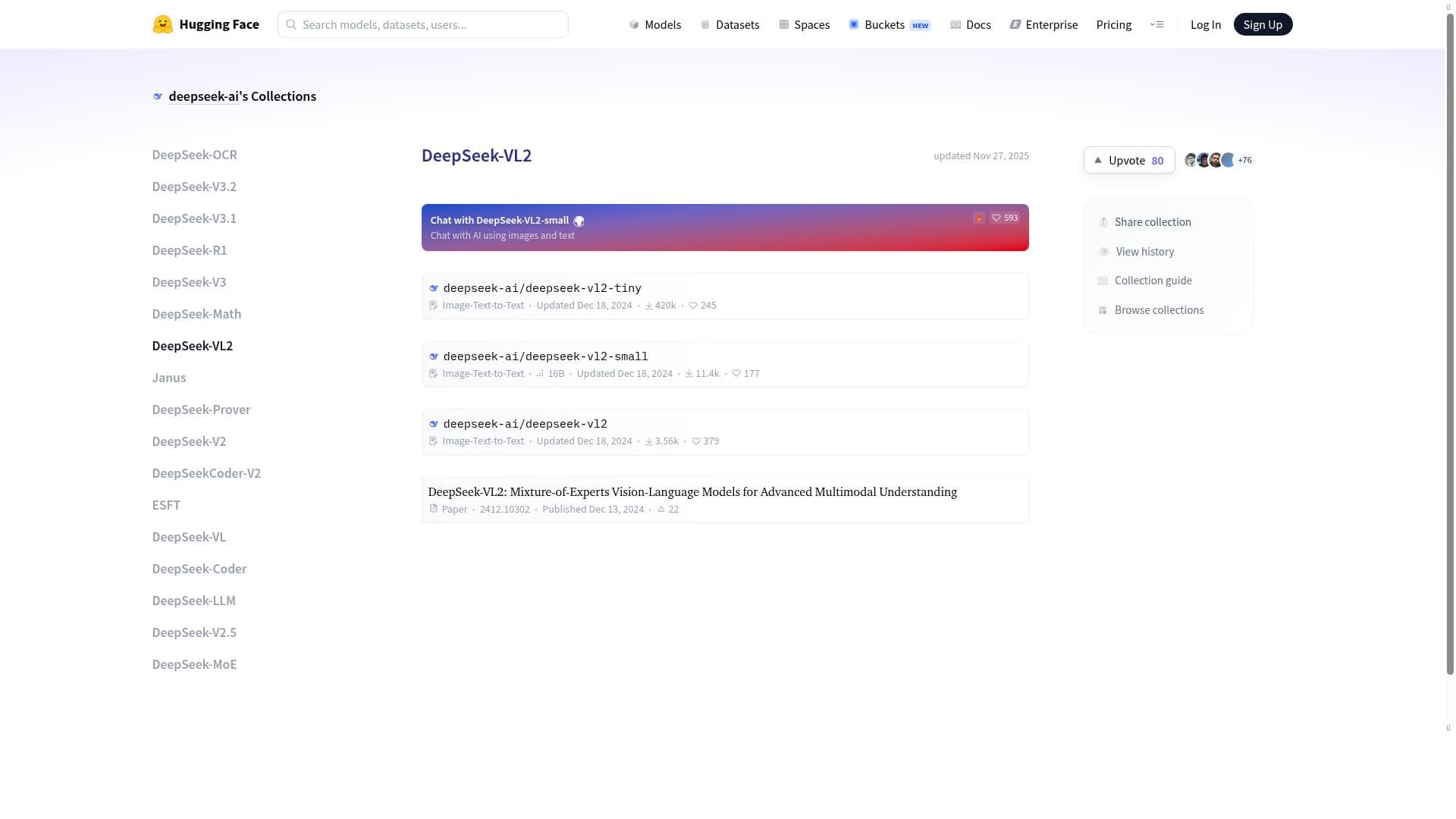
DeepSeek-VL2 is a powerful open-source vision-language model that excels in multimodal understanding through an efficient MoE architecture. Ideal for AI researchers and developers, it democratizes access to advanced AI by offering free, easy-to-test models via Hugging Face, enabling innovative applications that combine visual and textual data.
DeepSeek-VL2 is an advanced open-source vision-language model designed to facilitate strong multimodal understanding by integrating visual and textual information seamlessly. At its core, DeepSeek-VL2 leverages an efficient Mixture of Experts (MoE) architecture, which enhances the model's ability to process and interpret complex data inputs from multiple modalities. This design enables the model to perform sophisticated tasks such as image captioning, visual question answering, and cross-modal retrieval with high accuracy and efficiency. The tool is accessible through a user-friendly Hugging Face demo, allowing researchers and developers to easily test and experiment with its capabilities without extensive setup requirements. One of the standout features of DeepSeek-VL2 is its open-source nature, which promotes transparency and collaboration within the AI community. By being part of a larger collaborative AI collection on Hugging Face, it supports ongoing research and development efforts aimed at pushing the boundaries of multimodal AI. The model’s architecture is optimized for scalability and performance, making it suitable for both academic research and practical applications. Its democratization of AI technology ensures that cutting-edge vision-language models are accessible to a broad audience, including independent researchers, startups, and educational institutions. DeepSeek-VL2 is particularly well-suited for AI researchers and developers who require robust multimodal understanding capabilities. Use cases include developing intelligent systems that can interpret and generate natural language descriptions of images, enhancing content-based image retrieval systems, and building assistive technologies for visually impaired users. Additionally, it can be employed in automated content moderation, digital asset management, and interactive AI applications that rely on the fusion of visual and textual data. Its open-source status also makes it an excellent resource for those looking to customize or extend vision-language models for specialized domains. The tool is offered free of charge, reflecting its commitment to open access and community-driven innovation. Users can immediately start experimenting with DeepSeek-VL2 via the Hugging Face platform without any subscription or payment barriers. This free availability contrasts with many proprietary vision-language models that require costly licenses or usage fees, making DeepSeek-VL2 an attractive option for budget-conscious projects. Compared to alternative vision-language models, DeepSeek-VL2 stands out due to its efficient MoE architecture, which balances computational resource demands with high performance. While some models may offer similar multimodal capabilities, DeepSeek-VL2’s open-source license and integration within a collaborative AI ecosystem provide unique advantages for transparency, extensibility, and community support. However, as with many open-source models, users may need to invest time in understanding the underlying architecture and tuning the model for specific tasks, which can be a consideration for those seeking turnkey commercial solutions. Potential limitations include the need for computational resources to run the model effectively, especially for large-scale applications. Additionally, while the Hugging Face demo offers an accessible testing environment, deploying DeepSeek-VL2 in production may require technical expertise in AI model integration and optimization. Users should also be mindful of the typical challenges associated with vision-language models, such as biases in training data and the complexity of interpreting multimodal outputs. Nonetheless, DeepSeek-VL2’s open-source framework allows for ongoing improvements and community-driven enhancements to address these issues over time.

Description
DeepSeek-VL2 is a powerful open-source vision-language model that excels in multimodal understanding through an efficient MoE architecture. Ideal for AI researchers and developers, it democratizes access to advanced AI by offering free, easy-to-test models via Hugging Face, enabling innovative applications that combine visual and textual data.
DeepSeek-VL2 is an advanced open-source vision-language model designed to facilitate strong multimodal understanding by integrating visual and textual information seamlessly. At its core, DeepSeek-VL2 leverages an efficient Mixture of Experts (MoE) architecture, which enhances the model's ability to process and interpret complex data inputs from multiple modalities. This design enables the model to perform sophisticated tasks such as image captioning, visual question answering, and cross-modal retrieval with high accuracy and efficiency. The tool is accessible through a user-friendly Hugging Face demo, allowing researchers and developers to easily test and experiment with its capabilities without extensive setup requirements. One of the standout features of DeepSeek-VL2 is its open-source nature, which promotes transparency and collaboration within the AI community. By being part of a larger collaborative AI collection on Hugging Face, it supports ongoing research and development efforts aimed at pushing the boundaries of multimodal AI. The model’s architecture is optimized for scalability and performance, making it suitable for both academic research and practical applications. Its democratization of AI technology ensures that cutting-edge vision-language models are accessible to a broad audience, including independent researchers, startups, and educational institutions. DeepSeek-VL2 is particularly well-suited for AI researchers and developers who require robust multimodal understanding capabilities. Use cases include developing intelligent systems that can interpret and generate natural language descriptions of images, enhancing content-based image retrieval systems, and building assistive technologies for visually impaired users. Additionally, it can be employed in automated content moderation, digital asset management, and interactive AI applications that rely on the fusion of visual and textual data. Its open-source status also makes it an excellent resource for those looking to customize or extend vision-language models for specialized domains. The tool is offered free of charge, reflecting its commitment to open access and community-driven innovation. Users can immediately start experimenting with DeepSeek-VL2 via the Hugging Face platform without any subscription or payment barriers. This free availability contrasts with many proprietary vision-language models that require costly licenses or usage fees, making DeepSeek-VL2 an attractive option for budget-conscious projects. Compared to alternative vision-language models, DeepSeek-VL2 stands out due to its efficient MoE architecture, which balances computational resource demands with high performance. While some models may offer similar multimodal capabilities, DeepSeek-VL2’s open-source license and integration within a collaborative AI ecosystem provide unique advantages for transparency, extensibility, and community support. However, as with many open-source models, users may need to invest time in understanding the underlying architecture and tuning the model for specific tasks, which can be a consideration for those seeking turnkey commercial solutions. Potential limitations include the need for computational resources to run the model effectively, especially for large-scale applications. Additionally, while the Hugging Face demo offers an accessible testing environment, deploying DeepSeek-VL2 in production may require technical expertise in AI model integration and optimization. Users should also be mindful of the typical challenges associated with vision-language models, such as biases in training data and the complexity of interpreting multimodal outputs. Nonetheless, DeepSeek-VL2’s open-source framework allows for ongoing improvements and community-driven enhancements to address these issues over time.
Tool Features
- Open source AI models
- Supports AI research and development
- Part of a collaborative AI collection
- Democratizes access to AI technology
Frequently Asked Questions
What is DeepSeek-VL2?
DeepSeek-VL2 is an open-source vision-language model designed to understand and process both visual and textual data using an efficient Mixture of Experts (MoE) architecture, enabling advanced multimodal AI applications.
How much does DeepSeek-VL2 cost?
DeepSeek-VL2 is completely free to use, with no subscription or payment required, making it accessible to researchers and developers without financial barriers.
Who is DeepSeek-VL2 best for?
It is best suited for AI researchers, developers, and organizations interested in multimodal AI research, content-based image retrieval, assistive technologies, and other applications that combine vision and language.
What are the main features of DeepSeek-VL2?
Key features include its open-source availability, strong multimodal understanding powered by an efficient MoE architecture, support for AI research and development, and inclusion in a collaborative AI collection on Hugging Face.
Does DeepSeek-VL2 offer a free trial?
Yes, since DeepSeek-VL2 is free and open-source, users can immediately test and experiment with the model via the Hugging Face demo without any trial restrictions.
What integrations does DeepSeek-VL2 support?
DeepSeek-VL2 is accessible through the Hugging Face platform, allowing integration with various AI workflows and tools supported by Hugging Face, including APIs and model deployment pipelines.
How does DeepSeek-VL2 work?
DeepSeek-VL2 uses a Mixture of Experts (MoE) architecture to efficiently combine visual and textual inputs, enabling it to perform tasks like image captioning, visual question answering, and cross-modal retrieval with strong multimodal understanding.
Socials
Use ToolSponsored Tools





























Reviews
No reviews yet. Be the first to share your experience.