Description
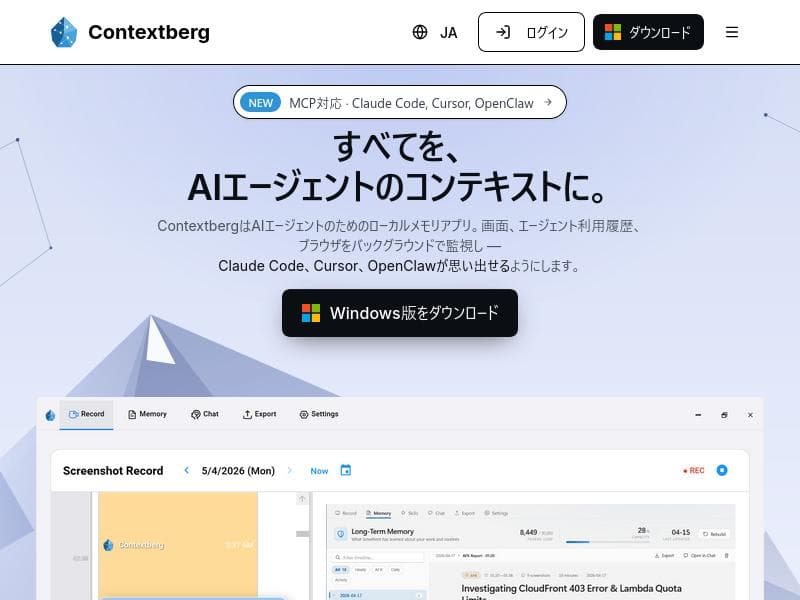
Contextberg is a privacy-focused local memory app that enhances AI agents like Claude Code and Cursor by continuously monitoring your screen, browser, and conversations to provide richer, context-aware interactions. Ideal for developers, researchers, and power users, it enables AI assistants to remember and understand your workflow seamlessly on Windows devices.
Contextberg is an innovative local memory application designed specifically for AI agents, aiming to significantly enhance their contextual understanding and recall capabilities. At its core, Contextberg operates by continuously monitoring your screen activity, browser history, and conversations with AI agents in the background. This persistent observation allows AI models such as Claude Code, Cursor, and OpenClaw to access a rich, dynamic memory of your interactions and digital environment, enabling them to provide more relevant, coherent, and contextually aware responses. By acting as a local memory repository, Contextberg bridges the gap between isolated AI interactions and a more continuous, personalized user experience. One of the standout features of Contextberg is its local-first, privacy-focused design. Unlike cloud-based memory solutions that raise concerns about data security and privacy, Contextberg stores all monitored data locally on the user's Windows device. This approach ensures that sensitive information never leaves the user's control, addressing a critical concern for users who prioritize confidentiality and data protection. The application runs unobtrusively in the background, seamlessly capturing relevant context without interrupting workflow or requiring manual input. Contextberg supports a range of popular AI agents, including Claude Code, Cursor, and OpenClaw, making it a versatile tool for users who engage with multiple AI platforms. By feeding these agents with continuous contextual data, it enhances their ability to remember past interactions, understand ongoing tasks, and maintain continuity across sessions. This results in AI assistants that feel more intuitive and responsive, capable of assisting with complex workflows, coding projects, research, or creative writing with improved accuracy and personalization. The tool is particularly beneficial for professionals, developers, researchers, and power users who rely heavily on AI agents for productivity and creative tasks. For example, software developers using Claude Code can benefit from an AI that recalls previous debugging conversations or code snippets, while content creators using Cursor can enjoy a more contextually aware writing assistant. Researchers can also leverage Contextberg to maintain continuity in data analysis or literature review sessions, reducing the cognitive load of re-establishing context with each interaction. Contextberg operates on a freemium pricing model, allowing users to access core functionalities at no cost while offering premium features or expanded capabilities through paid plans. This model provides an accessible entry point for users to experience the benefits of enhanced AI memory without upfront investment. Details on specific premium features or pricing tiers are typically available on the official website or product listing. When compared to alternative AI memory or context tools, Contextberg’s local-first approach and broad agent compatibility set it apart. Many competing solutions rely on cloud storage or are limited to specific AI platforms, which can restrict flexibility and raise privacy concerns. Contextberg’s ability to unobtrusively monitor multiple data sources locally and integrate with various AI agents offers a unique combination of privacy, versatility, and enhanced AI performance. However, there are some considerations to keep in mind. Currently, Contextberg is available only on the Windows platform, which may limit accessibility for users on macOS or Linux. Additionally, because it operates by monitoring screen activity and browser history, users should be mindful of privacy implications and ensure they are comfortable with the scope of data being accessed locally. While the local storage mitigates risks associated with cloud data breaches, users should still maintain good security practices on their devices. In summary, Contextberg is a powerful tool that elevates the capabilities of AI agents by providing them with a continuous, local memory of user interactions and digital context. Its privacy-centric design, multi-agent support, and seamless background operation make it an excellent choice for users seeking more intelligent, context-aware AI assistance in their daily workflows.

Description
Contextberg is a privacy-focused local memory app that enhances AI agents like Claude Code and Cursor by continuously monitoring your screen, browser, and conversations to provide richer, context-aware interactions. Ideal for developers, researchers, and power users, it enables AI assistants to remember and understand your workflow seamlessly on Windows devices.
Contextberg is an innovative local memory application designed specifically for AI agents, aiming to significantly enhance their contextual understanding and recall capabilities. At its core, Contextberg operates by continuously monitoring your screen activity, browser history, and conversations with AI agents in the background. This persistent observation allows AI models such as Claude Code, Cursor, and OpenClaw to access a rich, dynamic memory of your interactions and digital environment, enabling them to provide more relevant, coherent, and contextually aware responses. By acting as a local memory repository, Contextberg bridges the gap between isolated AI interactions and a more continuous, personalized user experience. One of the standout features of Contextberg is its local-first, privacy-focused design. Unlike cloud-based memory solutions that raise concerns about data security and privacy, Contextberg stores all monitored data locally on the user's Windows device. This approach ensures that sensitive information never leaves the user's control, addressing a critical concern for users who prioritize confidentiality and data protection. The application runs unobtrusively in the background, seamlessly capturing relevant context without interrupting workflow or requiring manual input. Contextberg supports a range of popular AI agents, including Claude Code, Cursor, and OpenClaw, making it a versatile tool for users who engage with multiple AI platforms. By feeding these agents with continuous contextual data, it enhances their ability to remember past interactions, understand ongoing tasks, and maintain continuity across sessions. This results in AI assistants that feel more intuitive and responsive, capable of assisting with complex workflows, coding projects, research, or creative writing with improved accuracy and personalization. The tool is particularly beneficial for professionals, developers, researchers, and power users who rely heavily on AI agents for productivity and creative tasks. For example, software developers using Claude Code can benefit from an AI that recalls previous debugging conversations or code snippets, while content creators using Cursor can enjoy a more contextually aware writing assistant. Researchers can also leverage Contextberg to maintain continuity in data analysis or literature review sessions, reducing the cognitive load of re-establishing context with each interaction. Contextberg operates on a freemium pricing model, allowing users to access core functionalities at no cost while offering premium features or expanded capabilities through paid plans. This model provides an accessible entry point for users to experience the benefits of enhanced AI memory without upfront investment. Details on specific premium features or pricing tiers are typically available on the official website or product listing. When compared to alternative AI memory or context tools, Contextberg’s local-first approach and broad agent compatibility set it apart. Many competing solutions rely on cloud storage or are limited to specific AI platforms, which can restrict flexibility and raise privacy concerns. Contextberg’s ability to unobtrusively monitor multiple data sources locally and integrate with various AI agents offers a unique combination of privacy, versatility, and enhanced AI performance. However, there are some considerations to keep in mind. Currently, Contextberg is available only on the Windows platform, which may limit accessibility for users on macOS or Linux. Additionally, because it operates by monitoring screen activity and browser history, users should be mindful of privacy implications and ensure they are comfortable with the scope of data being accessed locally. While the local storage mitigates risks associated with cloud data breaches, users should still maintain good security practices on their devices. In summary, Contextberg is a powerful tool that elevates the capabilities of AI agents by providing them with a continuous, local memory of user interactions and digital context. Its privacy-centric design, multi-agent support, and seamless background operation make it an excellent choice for users seeking more intelligent, context-aware AI assistance in their daily workflows.
Tool Features
- Local memory application for AI agents
- Background monitoring of screen, agent usage history, and browser
- Supports AI agents such as Claude Code, Cursor, and OpenClaw
- Enhances AI agent recall and context awareness
- Privacy-focused and local-first design
- Available on Windows platform
Frequently Asked Questions
What is Contextberg?
Contextberg is a local memory application for AI agents that monitors your screen, browser history, and agent conversations in the background to provide AI models like Claude Code, Cursor, and OpenClaw with enhanced contextual awareness and recall.
How much does Contextberg cost?
Contextberg offers a freemium pricing model, allowing users to access basic features for free, with premium plans available for additional capabilities. Specific pricing details can be found on their official website.
Who is Contextberg best for?
Contextberg is best suited for developers, researchers, content creators, and power users who frequently interact with AI agents and need enhanced context retention and memory for improved productivity and workflow continuity.
What are the main features of Contextberg?
Key features include local memory storage for AI agents, background monitoring of screen activity, browser history, and agent conversations, support for AI agents like Claude Code, Cursor, and OpenClaw, privacy-focused local-first design, and availability on Windows.
Does Contextberg offer a free trial?
Yes, Contextberg operates on a freemium model, providing free access to core features, allowing users to try the app before opting for any premium plans.
What integrations does Contextberg support?
Contextberg supports integration with AI agents such as Claude Code, Cursor, and OpenClaw, enabling these platforms to leverage the local memory Contextberg provides.
How does Contextberg work?
Contextberg runs in the background on your Windows device, monitoring your screen, browser history, and AI agent conversations locally. It collects and stores this contextual data to help supported AI agents remember past interactions and provide more contextually relevant responses.
Sponsored Tools
































Reviews
No reviews yet. Be the first to share your experience.