Description
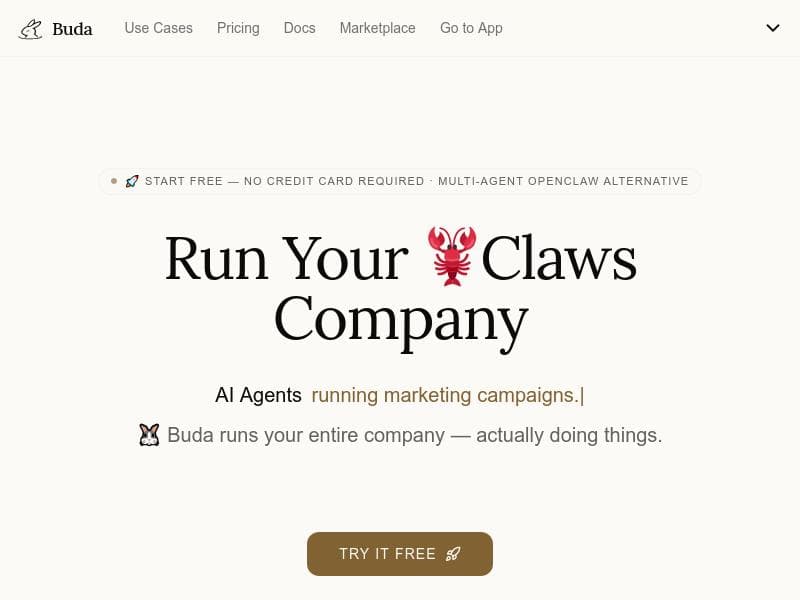
Buda revolutionizes AI workforce management by offering a cloud-native platform where companies can recruit, coordinate, and monitor AI agents and teams live in one seamless interface. Ideal for businesses seeking to scale AI collaboration without hardware hassles, Buda integrates across major communication tools and runs secure, long-running sandboxes to keep your AI company productive and secure.
Buda is an innovative AI platform designed to transform how companies manage and deploy AI agents by providing a comprehensive, cloud-native environment that simulates an entire AI-driven company. Unlike traditional AI tools that offer isolated agents, Buda enables users to recruit, sell, and coordinate Skills, Agents, and Teams through an integrated Marketplace and Organizer, all accessible within a single interface. This approach allows businesses to build and oversee a dynamic workforce of AI agents working collaboratively on diverse tasks in real time, directly from the browser or terminal. The platform's core purpose is to streamline AI workforce management by eliminating hardware dependencies and complex setup processes, making it accessible and scalable for organizations of all sizes. At its core, Buda offers a suite of powerful features designed to maximize productivity and coordination. Users can recruit Claw agents specialized in various skills to form collaborative teams tailored to specific projects or workflows. The Organizer feature acts as a centralized command center, enabling seamless coordination and task assignment across multiple agents and teams. One of Buda's standout capabilities is live monitoring, which provides real-time visibility into every agent's activity, allowing managers to track progress, troubleshoot issues, and optimize workflows instantly. The platform runs agents within long-running, isolated sandboxes equipped with SSD volumes, ensuring security and performance without the need for physical hardware like Mac Minis. Additionally, Buda supports integration across popular communication platforms such as Slack, Discord, WeChat, Microsoft Teams, and web browsers, facilitating smooth interaction and management within existing organizational ecosystems. Buda is ideally suited for businesses and teams looking to leverage AI for complex, multi-agent workflows that require coordination and live oversight. It benefits organizations that need to manage diverse AI capabilities across departments, such as marketing teams deploying AI assistants for ad campaigns, customer service centers automating support tasks, or development teams orchestrating AI-driven code generation and testing. Its marketplace model also appeals to freelancers and AI service providers who want to offer their specialized agents or skills to a broader audience. By providing a unified platform for recruitment, coordination, and execution, Buda empowers companies to scale their AI workforce efficiently and securely. Regarding pricing, Buda operates on a paid model, reflecting its enterprise-grade features and cloud infrastructure. While specific pricing tiers or plans are not detailed publicly, potential users can expect a subscription-based service that aligns with the scale of agent deployment and usage. This paid structure supports ongoing platform maintenance, security, and feature enhancements, ensuring a robust and reliable experience for businesses relying on AI-driven operations. When compared to alternatives like OpenClaw or Hermes, Buda distinguishes itself by offering a more holistic and integrated solution for AI workforce management. While OpenClaw provides individual agents, Buda extends this concept to entire companies of agents, complete with marketplaces and organizers that facilitate team formation and live collaboration. Its cloud-native architecture removes the need for local hardware setups, which can be a significant barrier in other platforms. This makes Buda more scalable and easier to adopt for organizations without extensive IT resources. However, users should consider that Buda's advanced features and paid model may present a learning curve and cost barrier for smaller teams or individual users seeking lightweight AI tools. Additionally, as a relatively new platform, the ecosystem of available agents and skills in the marketplace may still be growing, which could impact immediate availability of specialized capabilities. Integration with multiple communication platforms is a strength, but organizations relying on less common tools might face limitations. Overall, Buda is a powerful, secure, and scalable solution for enterprises aiming to build and manage AI-driven teams, but prospective users should evaluate their specific needs and readiness for such a comprehensive platform.

Description
Buda revolutionizes AI workforce management by offering a cloud-native platform where companies can recruit, coordinate, and monitor AI agents and teams live in one seamless interface. Ideal for businesses seeking to scale AI collaboration without hardware hassles, Buda integrates across major communication tools and runs secure, long-running sandboxes to keep your AI company productive and secure.
Buda is an innovative AI platform designed to transform how companies manage and deploy AI agents by providing a comprehensive, cloud-native environment that simulates an entire AI-driven company. Unlike traditional AI tools that offer isolated agents, Buda enables users to recruit, sell, and coordinate Skills, Agents, and Teams through an integrated Marketplace and Organizer, all accessible within a single interface. This approach allows businesses to build and oversee a dynamic workforce of AI agents working collaboratively on diverse tasks in real time, directly from the browser or terminal. The platform's core purpose is to streamline AI workforce management by eliminating hardware dependencies and complex setup processes, making it accessible and scalable for organizations of all sizes. At its core, Buda offers a suite of powerful features designed to maximize productivity and coordination. Users can recruit Claw agents specialized in various skills to form collaborative teams tailored to specific projects or workflows. The Organizer feature acts as a centralized command center, enabling seamless coordination and task assignment across multiple agents and teams. One of Buda's standout capabilities is live monitoring, which provides real-time visibility into every agent's activity, allowing managers to track progress, troubleshoot issues, and optimize workflows instantly. The platform runs agents within long-running, isolated sandboxes equipped with SSD volumes, ensuring security and performance without the need for physical hardware like Mac Minis. Additionally, Buda supports integration across popular communication platforms such as Slack, Discord, WeChat, Microsoft Teams, and web browsers, facilitating smooth interaction and management within existing organizational ecosystems. Buda is ideally suited for businesses and teams looking to leverage AI for complex, multi-agent workflows that require coordination and live oversight. It benefits organizations that need to manage diverse AI capabilities across departments, such as marketing teams deploying AI assistants for ad campaigns, customer service centers automating support tasks, or development teams orchestrating AI-driven code generation and testing. Its marketplace model also appeals to freelancers and AI service providers who want to offer their specialized agents or skills to a broader audience. By providing a unified platform for recruitment, coordination, and execution, Buda empowers companies to scale their AI workforce efficiently and securely. Regarding pricing, Buda operates on a paid model, reflecting its enterprise-grade features and cloud infrastructure. While specific pricing tiers or plans are not detailed publicly, potential users can expect a subscription-based service that aligns with the scale of agent deployment and usage. This paid structure supports ongoing platform maintenance, security, and feature enhancements, ensuring a robust and reliable experience for businesses relying on AI-driven operations. When compared to alternatives like OpenClaw or Hermes, Buda distinguishes itself by offering a more holistic and integrated solution for AI workforce management. While OpenClaw provides individual agents, Buda extends this concept to entire companies of agents, complete with marketplaces and organizers that facilitate team formation and live collaboration. Its cloud-native architecture removes the need for local hardware setups, which can be a significant barrier in other platforms. This makes Buda more scalable and easier to adopt for organizations without extensive IT resources. However, users should consider that Buda's advanced features and paid model may present a learning curve and cost barrier for smaller teams or individual users seeking lightweight AI tools. Additionally, as a relatively new platform, the ecosystem of available agents and skills in the marketplace may still be growing, which could impact immediate availability of specialized capabilities. Integration with multiple communication platforms is a strength, but organizations relying on less common tools might face limitations. Overall, Buda is a powerful, secure, and scalable solution for enterprises aiming to build and manage AI-driven teams, but prospective users should evaluate their specific needs and readiness for such a comprehensive platform.
Tool Features
- Recruit Claw agents for team collaboration
- Coordinate agents with an Organizer
- Live monitoring of agent activities
- Cloud-native platform eliminating hardware dependencies
- Alternative to OpenClaw for AI workforce management
Frequently Asked Questions
What is Buda?
Buda is a cloud-native AI platform that enables users to recruit, coordinate, and manage AI agents and teams as if running an entire AI-driven company. It provides a marketplace for Skills, Agents, and Teams, an Organizer for task coordination, and live monitoring of agent activities—all accessible through a single interface.
How much does Buda cost?
Buda operates on a paid subscription model. While specific pricing details are not publicly disclosed, the cost typically depends on the scale of agent deployment and usage. Interested users should contact Buda directly for detailed pricing information.
Who is Buda best for?
Buda is best suited for businesses and teams that require coordinated AI workflows involving multiple agents and skills. It benefits enterprises looking to scale AI collaboration across departments, freelancers offering AI services, and organizations seeking to integrate AI workforce management within existing communication platforms.
What are the main features of Buda?
Key features of Buda include recruiting Claw agents for team collaboration, coordinating agents with an Organizer, live monitoring of agent activities, running agents in secure, long-running isolated sandboxes with SSD volumes, and seamless integration with platforms like Slack, Discord, WeChat, Microsoft Teams, and web browsers.
Does Buda offer a free trial?
There is no publicly available information indicating that Buda offers a free trial. Prospective users should check the official website or contact Buda support for the most current trial or demo options.
What integrations does Buda support?
Buda supports integrations with major communication and collaboration platforms including Slack, Discord, WeChat, Microsoft Teams, and web browsers, allowing users to manage and interact with AI agents within their existing workflows.
How does Buda work?
Buda works by allowing users to recruit AI agents and teams from a marketplace, coordinate their tasks using an Organizer, and monitor their activities live within a unified interface. Agents run in secure, isolated sandboxes on the cloud, eliminating the need for local hardware or complex setup, and enabling seamless collaboration across multiple communication platforms.
Socials
Use ToolSponsored Tools
































Reviews
No reviews yet. Be the first to share your experience.