Basedash MCP server
Description
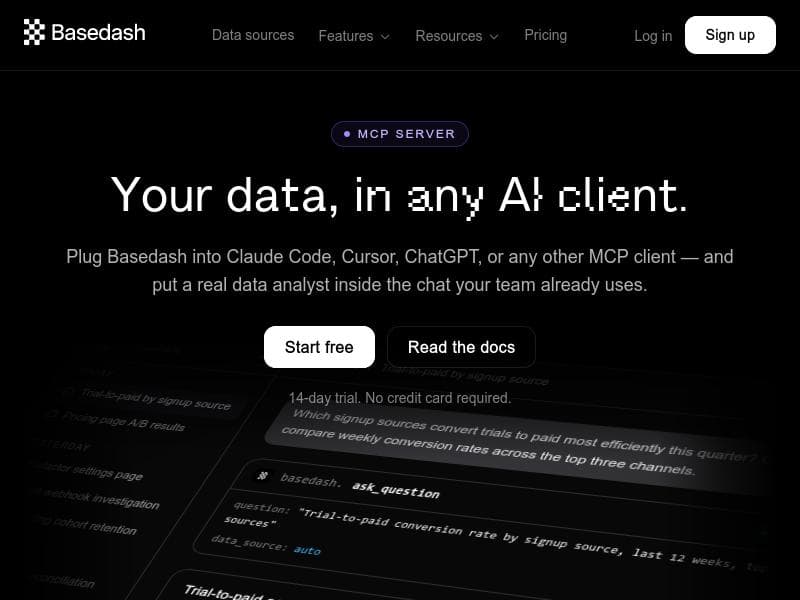
Basedash MCP server transforms your workspace into an AI-powered data analyst hub by connecting any MCP-compatible AI client to your databases and SaaS tools. Ideal for data teams and analysts, it enables real-time, secure data queries and insights without complex setup or API keys, making data-driven decisions faster and easier.
Basedash MCP server is a powerful AI-driven data assistant platform designed to seamlessly integrate with your existing data infrastructure, enabling AI agents to query and analyze data across multiple sources in real time. At its core, Basedash MCP server acts as a bridge between any MCP-compatible AI client—such as Claude, Cursor, ChatGPT, or Windsurf—and your workspace’s connected databases, data warehouses, and SaaS tools. This allows users to ask complex questions about their data, generate insights, and visualize trends without needing to switch between multiple platforms or write complex queries manually. The platform essentially embeds a data analyst within every tool you use, streamlining data-driven decision-making across your organization. One of the standout capabilities of Basedash MCP server is its support for the open Model Context Protocol (MCP), which standardizes how AI clients query data and list sources. This open protocol ensures compatibility with a wide range of AI clients, making it highly flexible and future-proof. The server enforces workspace permissions and access controls end-to-end, ensuring that data security and governance policies are maintained consistently. Authentication is handled via OAuth flows, eliminating the need for API keys and simplifying secure access management. Additionally, Basedash’s AI data analyst powers the responses, enabling natural language queries that can pull live numbers, compare cohorts, generate charts, and uncover trends with ease. Basedash MCP server is best suited for data teams, business analysts, product managers, and developers who want to embed AI-powered data querying capabilities directly into their workflows. It is particularly valuable for organizations with complex data ecosystems spanning multiple databases and SaaS tools, as it unifies data access under a single, governed interface. Use cases include real-time business intelligence, cohort analysis, trend detection, and automated reporting—all accessible via conversational AI clients. This makes it ideal for companies looking to democratize data access without compromising security or control. Regarding pricing, Basedash MCP server is offered as a paid service, with costs likely tied to workspace usage limits and AI query volumes. The platform includes admin monitoring features that count AI usage towards workspace limits, helping organizations manage costs and usage effectively. While specific pricing tiers are not detailed publicly, interested users can visit the Basedash website to request a demo or contact sales for tailored plans. Compared to alternative AI data assistants, Basedash MCP server stands out due to its open protocol support, broad client compatibility, and strong emphasis on security and governance. Many competitors require proprietary clients or API keys, whereas Basedash leverages OAuth for seamless authentication and integrates with multiple popular AI clients. Its ability to unify data from diverse sources into a single conversational interface offers a significant advantage for organizations with heterogeneous data environments. However, as a paid service, it may not be the best fit for very small teams or those seeking free tools. Notable considerations include the reliance on MCP-compatible clients, which means users must use or adopt AI clients that support the Model Context Protocol to fully leverage the server. Additionally, while the platform enforces workspace permissions rigorously, organizations must ensure their underlying data connections and access policies are correctly configured to maintain security. Finally, as with any AI-powered tool, the quality of insights depends on the data quality and the clarity of user queries, so some training or onboarding may be necessary to maximize value. In summary, Basedash MCP server offers a robust, secure, and flexible solution for embedding AI-powered data analysis across an organization’s entire data stack. Its open protocol foundation and compatibility with multiple AI clients make it a future-ready choice for teams looking to democratize data access and accelerate insights through conversational AI.

Description
Basedash MCP server transforms your workspace into an AI-powered data analyst hub by connecting any MCP-compatible AI client to your databases and SaaS tools. Ideal for data teams and analysts, it enables real-time, secure data queries and insights without complex setup or API keys, making data-driven decisions faster and easier.
Basedash MCP server is a powerful AI-driven data assistant platform designed to seamlessly integrate with your existing data infrastructure, enabling AI agents to query and analyze data across multiple sources in real time. At its core, Basedash MCP server acts as a bridge between any MCP-compatible AI client—such as Claude, Cursor, ChatGPT, or Windsurf—and your workspace’s connected databases, data warehouses, and SaaS tools. This allows users to ask complex questions about their data, generate insights, and visualize trends without needing to switch between multiple platforms or write complex queries manually. The platform essentially embeds a data analyst within every tool you use, streamlining data-driven decision-making across your organization. One of the standout capabilities of Basedash MCP server is its support for the open Model Context Protocol (MCP), which standardizes how AI clients query data and list sources. This open protocol ensures compatibility with a wide range of AI clients, making it highly flexible and future-proof. The server enforces workspace permissions and access controls end-to-end, ensuring that data security and governance policies are maintained consistently. Authentication is handled via OAuth flows, eliminating the need for API keys and simplifying secure access management. Additionally, Basedash’s AI data analyst powers the responses, enabling natural language queries that can pull live numbers, compare cohorts, generate charts, and uncover trends with ease. Basedash MCP server is best suited for data teams, business analysts, product managers, and developers who want to embed AI-powered data querying capabilities directly into their workflows. It is particularly valuable for organizations with complex data ecosystems spanning multiple databases and SaaS tools, as it unifies data access under a single, governed interface. Use cases include real-time business intelligence, cohort analysis, trend detection, and automated reporting—all accessible via conversational AI clients. This makes it ideal for companies looking to democratize data access without compromising security or control. Regarding pricing, Basedash MCP server is offered as a paid service, with costs likely tied to workspace usage limits and AI query volumes. The platform includes admin monitoring features that count AI usage towards workspace limits, helping organizations manage costs and usage effectively. While specific pricing tiers are not detailed publicly, interested users can visit the Basedash website to request a demo or contact sales for tailored plans. Compared to alternative AI data assistants, Basedash MCP server stands out due to its open protocol support, broad client compatibility, and strong emphasis on security and governance. Many competitors require proprietary clients or API keys, whereas Basedash leverages OAuth for seamless authentication and integrates with multiple popular AI clients. Its ability to unify data from diverse sources into a single conversational interface offers a significant advantage for organizations with heterogeneous data environments. However, as a paid service, it may not be the best fit for very small teams or those seeking free tools. Notable considerations include the reliance on MCP-compatible clients, which means users must use or adopt AI clients that support the Model Context Protocol to fully leverage the server. Additionally, while the platform enforces workspace permissions rigorously, organizations must ensure their underlying data connections and access policies are correctly configured to maintain security. Finally, as with any AI-powered tool, the quality of insights depends on the data quality and the clarity of user queries, so some training or onboarding may be necessary to maximize value. In summary, Basedash MCP server offers a robust, secure, and flexible solution for embedding AI-powered data analysis across an organization’s entire data stack. Its open protocol foundation and compatibility with multiple AI clients make it a future-ready choice for teams looking to democratize data access and accelerate insights through conversational AI.
Tool Features
- Connects any MCP-compatible AI client to your Basedash workspace
- Supports clients like Claude Code, Cursor, ChatGPT, and Windsurf
- Uses open Model Context Protocol for data queries and source listing
- Enforces workspace permissions and access controls end-to-end
- No API keys required; uses OAuth flow for authentication
- Powered by Basedash's AI data analyst for answering data questions
- Counts AI usage towards workspace limits with admin monitoring
Frequently Asked Questions
What is Basedash MCP server?
Basedash MCP server is an AI-powered platform that connects any MCP-compatible AI client to your workspace’s data sources, enabling natural language queries and real-time data analysis across databases, warehouses, and SaaS tools.
How much does Basedash MCP server cost?
Basedash MCP server is a paid service with pricing based on workspace usage and AI query volumes. Specific pricing details are available by contacting Basedash sales or visiting their website.
Who is Basedash MCP server best for?
It is best suited for data teams, business analysts, product managers, and developers who need to embed AI-driven data querying and analysis into their workflows across multiple data sources.
What are the main features of Basedash MCP server?
Key features include compatibility with any MCP-compatible AI client, support for Claude, Cursor, ChatGPT, and Windsurf, use of the open Model Context Protocol, end-to-end enforcement of workspace permissions, OAuth-based authentication, AI-powered data analysis, and admin monitoring of AI usage.
Does Basedash MCP server offer a free trial?
There is no publicly stated free trial; interested users should check the Basedash website or contact their sales team for trial or demo options.
What integrations does Basedash MCP server support?
It supports integration with every database, data warehouse, and SaaS tool already connected to your Basedash workspace, accessible via any MCP-compatible AI client.
How does Basedash MCP server work?
It acts as a server that connects AI clients using the Model Context Protocol to your workspace’s data sources, enforcing access controls and using OAuth for authentication, allowing AI agents to query and analyze live data securely and efficiently.
Socials
Use ToolSponsored Tools































Reviews
No reviews yet. Be the first to share your experience.