Description
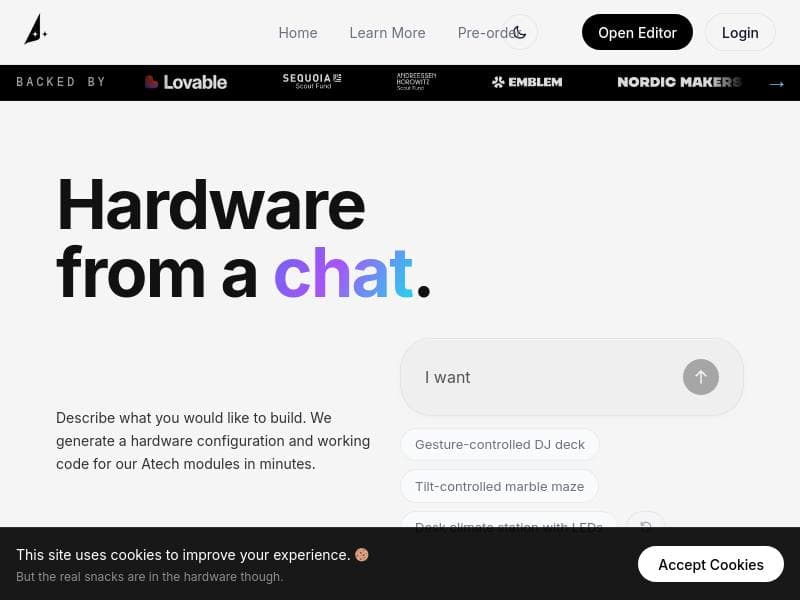
Atech transforms hardware development by letting users snap electronic modules together and describe their desired device in natural language, with AI generating the firmware automatically. Ideal for engineers, startups, and hobbyists, it enables rapid prototyping without soldering or deep technical expertise, making hardware creation as accessible as building with Lego.
Atech is an innovative AI-driven platform designed to revolutionize the hardware development process by introducing modern abstraction layers to electronics design, similar to what software development experienced decades ago. Traditionally, hardware creation has relied on processes and methodologies that are often decades old, requiring deep technical knowledge, manual soldering, and extensive datasheet consultations. Atech disrupts this paradigm by offering a modular, Lego-like system for real electronics, where users can simply snap hardware modules together and describe their desired functionality in natural language. The platform then automatically generates the necessary firmware, enabling users to go from concept to a working device within minutes. This approach dramatically simplifies hardware prototyping and development, making it accessible to a broader range of creators, engineers, and innovators. At its core, Atech leverages advanced AI to translate user descriptions into precise hardware configurations and corresponding firmware code. Key features include the ability to generate hardware device configurations directly from chat-based descriptions, eliminating the need for manual coding or hardware design expertise. The platform also automatically produces working firmware tailored to the assembled modules, ensuring seamless integration and functionality without requiring users to dive into complex datasheets or debug low-level code. This rapid hardware development process accelerates innovation cycles, allowing teams to iterate quickly and bring products to market faster. Additionally, Atech is backed by leading investors and has secured $800K in pre-seed funding, underscoring its strong market potential and credibility. Atech is best suited for hardware engineers, product designers, startups, educators, and hobbyists who want to streamline the prototyping and development of electronic devices. Use cases range from building IoT devices, custom sensors, and robotics components to educational projects and rapid proof-of-concept demonstrations. By abstracting away the traditional complexities of hardware design and firmware programming, Atech empowers users with varying levels of expertise to create functional devices without soldering or deep technical knowledge. This makes it particularly valuable for teams looking to reduce development time and cost while maintaining flexibility and control over their hardware projects. Regarding pricing, Atech operates on a paid model, though specific pricing tiers or subscription plans are not detailed publicly. Interested users should visit the official website to inquire about pricing options and enterprise plans. The platform's value proposition lies in its ability to significantly cut down development time and reduce the need for specialized hardware engineering resources, which can translate into cost savings and faster time-to-market. When compared to traditional hardware development tools and platforms, Atech stands out by offering a highly abstracted, AI-powered approach that integrates hardware configuration and firmware generation into a single seamless workflow. Unlike conventional methods that require manual schematic design, PCB layout, and firmware coding, Atech's chat-driven interface and modular hardware system simplify these steps into an intuitive process. This positions Atech as a unique solution in the hardware development ecosystem, bridging the gap between software-like abstraction and physical electronics creation. However, potential users should consider that, as a relatively new platform, Atech may have limitations in terms of the range of supported hardware modules or the complexity of devices it can currently handle. Additionally, since it is a paid service, budget-conscious users should evaluate the cost-benefit ratio based on their project scale and frequency of use. Integration capabilities with existing development environments or hardware tools are not explicitly mentioned, which could be a consideration for teams with established workflows. Despite these factors, Atech represents a significant step forward in democratizing hardware design and accelerating innovation cycles through AI-driven automation.

Description
Atech transforms hardware development by letting users snap electronic modules together and describe their desired device in natural language, with AI generating the firmware automatically. Ideal for engineers, startups, and hobbyists, it enables rapid prototyping without soldering or deep technical expertise, making hardware creation as accessible as building with Lego.
Atech is an innovative AI-driven platform designed to revolutionize the hardware development process by introducing modern abstraction layers to electronics design, similar to what software development experienced decades ago. Traditionally, hardware creation has relied on processes and methodologies that are often decades old, requiring deep technical knowledge, manual soldering, and extensive datasheet consultations. Atech disrupts this paradigm by offering a modular, Lego-like system for real electronics, where users can simply snap hardware modules together and describe their desired functionality in natural language. The platform then automatically generates the necessary firmware, enabling users to go from concept to a working device within minutes. This approach dramatically simplifies hardware prototyping and development, making it accessible to a broader range of creators, engineers, and innovators. At its core, Atech leverages advanced AI to translate user descriptions into precise hardware configurations and corresponding firmware code. Key features include the ability to generate hardware device configurations directly from chat-based descriptions, eliminating the need for manual coding or hardware design expertise. The platform also automatically produces working firmware tailored to the assembled modules, ensuring seamless integration and functionality without requiring users to dive into complex datasheets or debug low-level code. This rapid hardware development process accelerates innovation cycles, allowing teams to iterate quickly and bring products to market faster. Additionally, Atech is backed by leading investors and has secured $800K in pre-seed funding, underscoring its strong market potential and credibility. Atech is best suited for hardware engineers, product designers, startups, educators, and hobbyists who want to streamline the prototyping and development of electronic devices. Use cases range from building IoT devices, custom sensors, and robotics components to educational projects and rapid proof-of-concept demonstrations. By abstracting away the traditional complexities of hardware design and firmware programming, Atech empowers users with varying levels of expertise to create functional devices without soldering or deep technical knowledge. This makes it particularly valuable for teams looking to reduce development time and cost while maintaining flexibility and control over their hardware projects. Regarding pricing, Atech operates on a paid model, though specific pricing tiers or subscription plans are not detailed publicly. Interested users should visit the official website to inquire about pricing options and enterprise plans. The platform's value proposition lies in its ability to significantly cut down development time and reduce the need for specialized hardware engineering resources, which can translate into cost savings and faster time-to-market. When compared to traditional hardware development tools and platforms, Atech stands out by offering a highly abstracted, AI-powered approach that integrates hardware configuration and firmware generation into a single seamless workflow. Unlike conventional methods that require manual schematic design, PCB layout, and firmware coding, Atech's chat-driven interface and modular hardware system simplify these steps into an intuitive process. This positions Atech as a unique solution in the hardware development ecosystem, bridging the gap between software-like abstraction and physical electronics creation. However, potential users should consider that, as a relatively new platform, Atech may have limitations in terms of the range of supported hardware modules or the complexity of devices it can currently handle. Additionally, since it is a paid service, budget-conscious users should evaluate the cost-benefit ratio based on their project scale and frequency of use. Integration capabilities with existing development environments or hardware tools are not explicitly mentioned, which could be a consideration for teams with established workflows. Despite these factors, Atech represents a significant step forward in democratizing hardware design and accelerating innovation cycles through AI-driven automation.
Tool Features
- Generate hardware device configuration from chat description
- Automatic generation of working firmware
- Rapid hardware development process
- Backed by leading investors
- Pre-seed funding of $800K
Frequently Asked Questions
What is Atech?
Atech is an AI-powered platform that simplifies hardware development by allowing users to assemble modular electronics and describe their desired device functionality in natural language, after which it automatically generates the necessary firmware to create a working device quickly.
How much does Atech cost?
Atech operates on a paid pricing model, though specific pricing details are not publicly available. Interested users should visit the official website to request pricing information and learn about available plans.
Who is Atech best for?
Atech is ideal for hardware engineers, product designers, startups, educators, and hobbyists who want to accelerate hardware prototyping and development without deep technical knowledge or manual soldering.
What are the main features of Atech?
Key features include generating hardware device configurations from chat descriptions, automatic firmware generation, a rapid hardware development process, backing by leading investors, and $800K in pre-seed funding.
Does Atech offer a free trial?
There is no publicly available information about a free trial for Atech. Prospective users should check the official website or contact the team directly for trial or demo options.
What integrations does Atech support?
Specific integrations with other development tools or platforms are not detailed publicly. Users interested in integration capabilities should inquire directly with Atech for more information.
How does Atech work?
Users snap together modular electronic components and describe the device's intended function via chat. Atech's AI then generates the hardware configuration and automatically produces the working firmware, enabling rapid creation of functional hardware devices without manual coding or soldering.
Sponsored Tools






























Reviews
No reviews yet. Be the first to share your experience.