Description
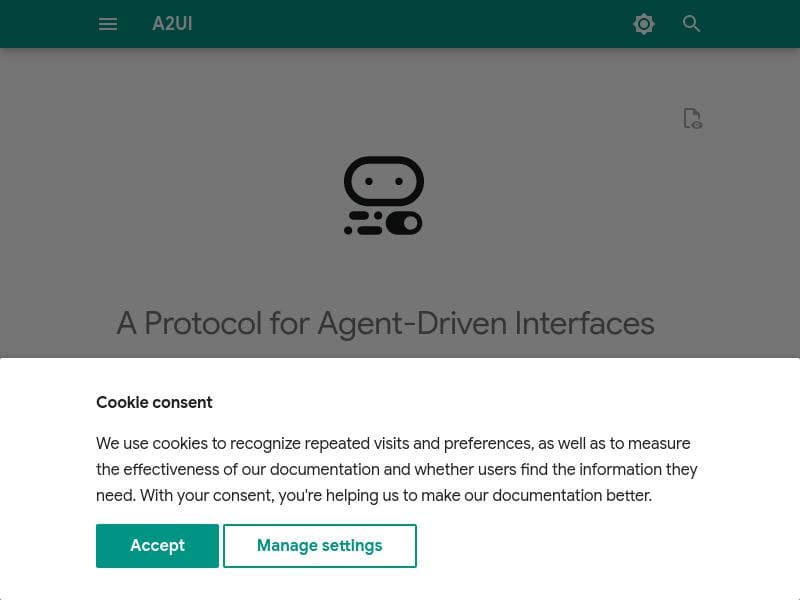
A2UI is a secure, open protocol by Google that enables AI agents to generate rich, interactive user interfaces through declarative JSON rather than risky code execution. Ideal for developers and organizations integrating intelligent agents, it supports dynamic, streaming UI experiences across Flutter, web, and mobile platforms.
A2UI is an innovative open protocol developed by Google that empowers intelligent agents to generate rich, interactive user interfaces without the risks associated with executing arbitrary code. At its core, A2UI replaces traditional code execution with a declarative JSON-based communication model, allowing agents to send UI descriptions that clients can render natively across multiple platforms including Flutter, web browsers, and mobile devices. This approach ensures a secure, framework-agnostic environment optimized for large language models (LLMs) and other AI agents, facilitating dynamic and responsive user experiences that adapt in real-time to user inputs and agent decisions. The protocol’s design centers around streaming capabilities, enabling continuous, agent-driven UI updates that reflect ongoing interactions and data changes. This streaming protocol supports the creation of highly interactive interfaces that can evolve fluidly as the agent processes new information or user commands. By leveraging declarative JSON, A2UI abstracts away the complexities and security concerns of executing code on the client side, instead focusing on describing UI elements and behaviors in a standardized, interpretable format. This makes it easier for developers to integrate AI-driven interfaces into existing applications without compromising security or requiring extensive platform-specific development. A2UI’s key features include its streaming protocol for seamless UI updates, support for dynamic and responsive interface elements, and a design philosophy tailored to intelligent agent interactions. These features collectively enable developers and organizations to build AI assistants and tools that can present complex information, gather user input, and guide workflows interactively and intuitively. The framework-agnostic nature of A2UI means it can be adopted across diverse technology stacks, making it highly versatile for various development environments. This tool is particularly well-suited for developers, AI researchers, and companies looking to integrate advanced conversational AI or agent-driven interfaces into their products. Use cases range from customer support chatbots that require rich interaction capabilities to complex data visualization tools powered by AI agents that adjust displays based on user queries. Additionally, educational platforms, healthcare applications, and enterprise software can leverage A2UI to create safer, more engaging AI-driven user experiences without the overhead of managing code execution security. A2UI is available for free, making it accessible to a broad audience from individual developers to large organizations. Its open protocol status encourages community contributions and widespread adoption, fostering an ecosystem where improvements and integrations can evolve collaboratively. Compared to alternatives that rely on executing scripts or embedding proprietary UI frameworks, A2UI’s declarative and streaming approach offers enhanced security and flexibility. It mitigates common risks such as code injection attacks and reduces platform lock-in by supporting multiple client environments natively. However, as an emerging protocol, A2UI may have limitations related to ecosystem maturity and tooling support. Developers might encounter a learning curve when adapting existing applications to this new paradigm or when building custom clients that render the JSON-based UI descriptions. Additionally, while the protocol is designed for LLMs and intelligent agents, its effectiveness depends on the sophistication of the agents generating the UI JSON and the client implementations rendering it. Future enhancements and broader adoption will likely address these considerations, expanding its capabilities and ease of use. In summary, A2UI represents a forward-thinking approach to AI-driven user interfaces, combining security, flexibility, and interactivity in a protocol designed specifically for modern intelligent agents. Its free availability and open nature make it a compelling choice for developers aiming to build next-generation AI applications with rich, dynamic interfaces.

Description
A2UI is a secure, open protocol by Google that enables AI agents to generate rich, interactive user interfaces through declarative JSON rather than risky code execution. Ideal for developers and organizations integrating intelligent agents, it supports dynamic, streaming UI experiences across Flutter, web, and mobile platforms.
A2UI is an innovative open protocol developed by Google that empowers intelligent agents to generate rich, interactive user interfaces without the risks associated with executing arbitrary code. At its core, A2UI replaces traditional code execution with a declarative JSON-based communication model, allowing agents to send UI descriptions that clients can render natively across multiple platforms including Flutter, web browsers, and mobile devices. This approach ensures a secure, framework-agnostic environment optimized for large language models (LLMs) and other AI agents, facilitating dynamic and responsive user experiences that adapt in real-time to user inputs and agent decisions. The protocol’s design centers around streaming capabilities, enabling continuous, agent-driven UI updates that reflect ongoing interactions and data changes. This streaming protocol supports the creation of highly interactive interfaces that can evolve fluidly as the agent processes new information or user commands. By leveraging declarative JSON, A2UI abstracts away the complexities and security concerns of executing code on the client side, instead focusing on describing UI elements and behaviors in a standardized, interpretable format. This makes it easier for developers to integrate AI-driven interfaces into existing applications without compromising security or requiring extensive platform-specific development. A2UI’s key features include its streaming protocol for seamless UI updates, support for dynamic and responsive interface elements, and a design philosophy tailored to intelligent agent interactions. These features collectively enable developers and organizations to build AI assistants and tools that can present complex information, gather user input, and guide workflows interactively and intuitively. The framework-agnostic nature of A2UI means it can be adopted across diverse technology stacks, making it highly versatile for various development environments. This tool is particularly well-suited for developers, AI researchers, and companies looking to integrate advanced conversational AI or agent-driven interfaces into their products. Use cases range from customer support chatbots that require rich interaction capabilities to complex data visualization tools powered by AI agents that adjust displays based on user queries. Additionally, educational platforms, healthcare applications, and enterprise software can leverage A2UI to create safer, more engaging AI-driven user experiences without the overhead of managing code execution security. A2UI is available for free, making it accessible to a broad audience from individual developers to large organizations. Its open protocol status encourages community contributions and widespread adoption, fostering an ecosystem where improvements and integrations can evolve collaboratively. Compared to alternatives that rely on executing scripts or embedding proprietary UI frameworks, A2UI’s declarative and streaming approach offers enhanced security and flexibility. It mitigates common risks such as code injection attacks and reduces platform lock-in by supporting multiple client environments natively. However, as an emerging protocol, A2UI may have limitations related to ecosystem maturity and tooling support. Developers might encounter a learning curve when adapting existing applications to this new paradigm or when building custom clients that render the JSON-based UI descriptions. Additionally, while the protocol is designed for LLMs and intelligent agents, its effectiveness depends on the sophistication of the agents generating the UI JSON and the client implementations rendering it. Future enhancements and broader adoption will likely address these considerations, expanding its capabilities and ease of use. In summary, A2UI represents a forward-thinking approach to AI-driven user interfaces, combining security, flexibility, and interactivity in a protocol designed specifically for modern intelligent agents. Its free availability and open nature make it a compelling choice for developers aiming to build next-generation AI applications with rich, dynamic interfaces.
Tool Features
- Streaming protocol for agent-driven user interfaces
- Enables dynamic and responsive UI experiences
- Designed to support intelligent agent interactions
Frequently Asked Questions
What is A2UI?
A2UI is an open protocol developed by Google that allows AI agents to generate rich, interactive user interfaces by sending declarative JSON to clients, which then render the UI natively across platforms like Flutter, web, and mobile. It avoids executing code directly, enhancing security and flexibility.
How much does A2UI cost?
A2UI is completely free to use, as it is an open protocol designed to be accessible to developers and organizations without any licensing fees.
Who is A2UI best for?
A2UI is best suited for developers, AI researchers, and companies looking to build intelligent agent-driven applications with rich, interactive user interfaces. It is ideal for those wanting secure, framework-agnostic solutions for AI-powered UI across multiple platforms.
What are the main features of A2UI?
The main features of A2UI include a streaming protocol for continuous agent-driven UI updates, support for dynamic and responsive user interface experiences, and a declarative JSON format that enhances security by avoiding direct code execution.
Does A2UI offer a free trial?
Since A2UI is an open and free protocol, there is no need for a free trial; it is available for immediate use without cost.
What integrations does A2UI support?
A2UI supports native rendering on multiple client platforms including Flutter, web browsers, and mobile devices, making it framework-agnostic and highly versatile for various development environments.
How does A2UI work?
A2UI works by having AI agents send declarative JSON descriptions of user interfaces to clients, which then render these UIs natively. This streaming protocol allows for dynamic, real-time UI updates driven by agent interactions, all without executing code on the client side.
Sponsored Tools





























Reviews
No reviews yet. Be the first to share your experience.