
Latest AI News

Indian IT Braces for Soft Start to FY27 as AI Margins Remain a Mirage
Analysts expect a muted start to FY27 as Indian IT’s enterprise spending remains cautious, while AI is yet to generate meaningful high-margin revenues.
View

Ex. GitHub CEO’s Startup Launches ‘Fastest’ Git Hosting Network
Entire says its distributed Git network sustained 570,000 repository clones per hour and 2.1 million Git pushes per hour in early testing, targeting AI coding agents that generate heavy concurrent Git traffic.
View

AI chip maker SambaNova raises $1B at $11B valuation, 5 months after last mega round
AI chip companySambaNova Systemshas raised $1 billion at an $11 billion valuation led by General Atlantic, in a first close of its Series F round, with more investors expected to join soon. “In the next few weeks, a few more investors will be coming in, and the second close is likely to finish up,” Rodrigo Liang, CEO and co-founder of SambaNova, told TechCrunch. The latest round comes roughly five months after the Palo Alto, California-based startup companyunveiled its SN50 chip, alongside a$350 million Series E in February. SambaNova had also been in acquisition talks with Intel, a deal valuing it at roughly $1.6 billion, according toa December reportfromBloomberg News. Asked whether closing its Series E and F rounds meant SambaNova, founded in 2017, had settled on staying independent, Liang was noncommittal. He said the company keeps fielding interest. “We’re always being approached.” The door is open to such an exit in this dynamic AI market, the CEO said, but momentum and growth will most likely drive the company toward “being public at some point.” SambaNova’s ties toIntel, a backer since its Series C and a participant in this latest round, have deepened. Five months ago, the nine-year-old startupannounceda multi-year partnership with Intel to support AI inference development based on Intel’s Xeon chip. The two now co-develop products and take them to market together. “That gives us a great relationship with them that lets us leverage the scale of Intel with the technology we have,” Liang said. Alongside the new funding, SambaNova said it has been selected by JPMorganChase as an “inference-infrastructure partner,” with its SN40L and SN50 systems set to power secure, on-premises AI inference at the bank. “Having JPMorgan Chase decide they’re going to use SambaNova for their inference solution is a big deal,” Liang told TechCrunch. “It sends a message to the banking industry that it’s time not to completely depend on cloud services. These banks want heterogeneous [infrastructure].” Liang said the JPMorgan win was a signal to the broader market. Banks “of the caliber of JP Morgan” are now building their own private, secure infrastructure to run inference on their most sensitive models, he said, a move he expects to resonate beyond banking. Enterprises and governments are “just starting their AI journey,” Liang continued, with most of the growth so far concentrated among tech’s model makers and frontier labs, leaving what he called “a huge amount of revenue” still on the table. SambaNova launched itsSN40Lin September 2023, available in the cloud, and on-premises fromNovember 2023. Its next-generation SN50, unveiled in February 2026, is due to begin shipping to customers in the second half of 2026, with SoftBank as its first deployment partner, Liang noted. Liang said SambaNova’s edge as “premium inference” running the largest models and running them fast. Today’s frontier models span trillions of parameters, and he said SambaNova was built specifically to handle them at that scale. The company fits multi-trillion-parameter models onto a single rack which helps them run quickly. SambaNova sees three types of customers. The first is sovereign clouds, where governments fund local partners to build private clouds, a push Liang expects SambaNova to figure centrally in. The second is neoclouds. The third is enterprises building for their own use. In addition to JPMorgan, it also names Saudi Aramco, Intel, and other Japanese firms as customers. SambaNova will use the proceeds to scale the business and shore up its supply chain against what Liang called an incredible wave of demand. “We’re using that capital to secure the supply chain,” he said, describing it as essential to fulfilling orders and buying the materials the company needs to deliver over the next 12 months. Other investors participating in the round include Seligman Ventures, T. Rowe Price Associates, and Capital Group. New and existing investors also joined, including A&E Investment, Assam Ventures, Battery Ventures, Cambium Capital, BlackRock, Kabila Capital, QFO Capital, Qatar Investment Authority (QIA), Vista Equity Partners, and Volantis.
View

Hot French startup ZML releases free product to speed inference across lots of AI chips
The days of Nvidia’s unparalleled market dominance aren’t over, but challengers and choices are arising from all directions. ZML, a hot French AI startupendorsedby Turing Award winner Yann LeCun, has releasedinference-performance software that allowsa variety of open-source large language modelsto run on avariety of chips— including Nvidia’s, AMD’s, Google’s TPU, Apple Metal and Intel Arc. WithZML/LLMD, the newly launched LLM inference server, the company’s ambition is to break existing silos and make different chips available for AI use cases at their maximum available speed, and sometimes faster, ZML founder Steeve Morin told TechCrunch. As AI becomes integrated into our work and everyday lives, optimizing inference — aka, the processing of prompts — has been outpacingmodel trainingin importance, but often feels patchy behind the scenes, with software and architecture barriers that lead to vendor lock-in, Morin said. The promise of achieving peak performance across a variety of chips is a technological feat, but it could also be a market disruptor, amid mounting fears over AI-related costs. ZML hopes to provide enterprises and clouds with the option to use a mix of chips, some of which might be less costly or consume less energy. “The idea is to give people back the power to create their own system and achieve real efficiency gains that allow [AI] to be disseminated,” Morin said. Such a software assist may help novel AI chipmakers, many of which happen to be from Europe, Morin observed, citingAxelera,Fractile,Kalray,OLIX,Q.ANT,SiPearl,SpiNNcloud, andVSORA. But more than their region of origin, what matters to him is that ZML can work with them on “things that haven’t been done before anywhere in the world.” That doesn’t mean Morin is bearish on Nvidia.He’s not, in part because of its existing supply. He told TechCrunch that ZML has a good relationship with the AI chip giant, which has beengearing upfor the rise of inference. Inference has been an area of such intense investment, that the trend has been hailed the “inference gold rush.” So ZML has competition such asBaseten, recently valued at $13 billion;Inferact, from the creators of open source projectvLLM; as well asRadixArk, thecommercial company behind SGLang. Both vLLM and SGLang partially compete with LLMD, but Morin’s ambitions for ZML cover a broader spectrum. “We have reached the point where we are co-designing silicon,” he said. He further credited ZML’s lean team of 20 people as the reason why the Paris-based startup has been able to move fast, with more releases in the plans. It also helped that this small team is well funded for its size. Thanks to his track record as VP of engineering ofZenly, which Snapchat acquiredfor nine figures in 2017, Morin raised $20 million from venture firms including Harry Stebbings’ 20VC, >commit, AALVC, Drysdale Ventures, Xavier Niel’s Kima Ventures, Kindred Capital, LocalGlobe, and Puzzle Ventures. Unlike ZML’s first public project, the inference-focusedML frameworkreleased in 2024 andupdated in March, ZML/LLMD is not open source. But it is launching as a free product with the goal of learning about usage. “I’d rather measure and [then generate revenue] where it is most effective without hindering my growth stupidly because I have been too greedy from the get-go,” Morin said. It is too early to tell when ZML/LLMD might become a paid product, and what its adoption will look like. But the startup’s cap table confirms that other founders are paying attention, including Dagger and Docker founder Solomon Hykes, Clément Delangue and Julien Chaumond from Hugging Face, as well LeCun, now withAMI Labs. This also builds the case that Europe’s AI startupscan now build from home. “I couldn’t do ZML anywhere but in Paris,” Morin said.
View

OpenAI Set to Release GPT-5.6 After US Govt Finally Lifts Restrictions
The approval follows review of national security and cybersecurity risks associated with the frontier AI model.
View

Google Picks 20 AI Startups for India Accelerator From 2,500 Applications
Google has selected 20 AI-first Indian startups spanning agentic AI, climate tech, healthcare, and developer infrastructure.
View
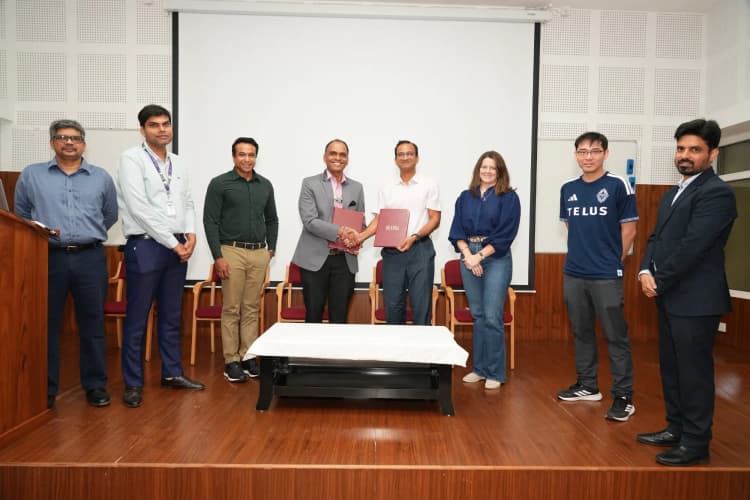
Enterprise AI-Focused TELUS Digital Taps IISc for Research, Talent Development
With the agreement, TELUS and IISc aim to support joint projects, talent development, and exchange of researchers.
View

IT Firm UST to Embed Claude Across Enterprise Platforms, Train 20,000 Employees
The partnership will integrate Claude into UST’s engineering, industry, and enterprise platforms for clients.
View

NVIDIA Rival SambaNova Lands $1 Bn, JPMorgan Chase Deal to Power AI Inference
SambaNova has secured a $1 billion Series F first close at an $11 billion valuation to expand its AI inference platform and global enterprise deployments.
View

India’s Retail GCCs Surpass 5 Global Peer Markets Combined as AI Talent Shortage Looms, Finds Report
AI professionals currently represent fewer than one in 20 employees across India's retail GCC ecosystem.
View

As AI Cannabilises Revenue, Indian IT Looks to Cybersecurity for Margins
As generative AI automates coding, Indian IT firms are racing to build cybersecurity capabilities through acquisitions, partnerships and AI-native platforms.
View

Accenture Wins NATO's Multi-Million-Euro Digital Infrastructure Contract
Accenture will work with Italian firm Leonardo to build a secure, cloud-enabled business network for NATO over seven years.
View