
Latest AI News

Tamil Nadu Doesn't Need a Fab to Dominate India's Chip Future
India Semiconductor Mission CEO Amitesh Kumar Sinha argues that Tamil Nadu already occupies a strategic position in the semiconductor value chain.
View
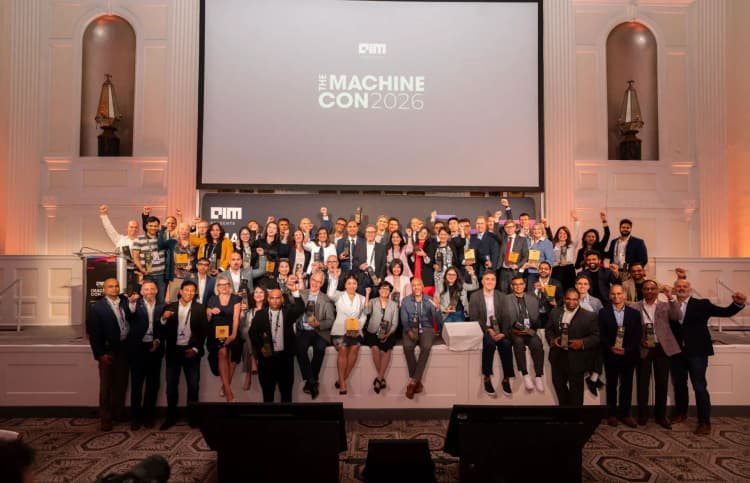
AIM Honours 150 Enterprise AI Leaders at MachineCon New York 2026
The fourth edition of MachineCon New York concluded with the AI150 Awards, recognising enterprise AI leaders from organisations including Wells Fargo, Siemens Healthineers, S&P Global, Bayer and HSBC, alongside discussions on scaling AI in production.
View

OpenAI's First AI Hardware to Reportedly Have Camera, Moving Parts for Lifelike Interactions
OpenAI's long-rumoured AI hardware is finally expected to be on the horizon. While the rumour mill has hinted towards a launch in 2027, a new report has revealed fresh details about what is likely to be the first consumer device from the San Francisco-based AI company. The purported voice-first AI smart speaker is said to feature a compact doughnut-shaped design and integrated cameras and microphones. It will also reportedly feature moving mechanical elements for more lifelike interactions.
View
OpenAI Picks HCLTech as Its Advanced Partner
The designation expands HCLTech’s role in helping enterprises deploy GPT-5.6, ChatGPT Work, and agentic AI solutions.
View

Join Neysa AI & AIM Innovator Series to Learn What Breaks When AI Moves to Production
As AI adoption scales, infrastructure decisions are becoming critical to balancing cost, performance, and operational control.
View

Why Everyone in AI is Suddenly Obsessed with Harnesses
From memory and orchestration to tool use and evaluation, the next AI moat is being built outside the model.
View
China’s ByteDance is Training a 10 Trillion-Parameter AI Model: Report
The model would be around three times larger than Moonshot AI’s Kimi K3 and could approach the scale of Anthropic’s latest Mythos model.
View

OpenAI’s Smart Speaker to Cost Over $300: Report
The Jony Ive-designed hardware will launch in 2027 as a battery-powered, screen-free AI companion, even as Apple's trade secrets lawsuit threatens to complicate its rollout.
View
OpenAI’s new AI smart speaker will reportedly sell for between $300 and $400
More details continue to trickle out about OpenAI’s mysteriousnew hardware device— described previously as an AI-fueled smart speaker that will be the “physical manifestation” of ChatGPT. Bloomberg nowreportsthat the device will be “donut-shaped,” designed thusly to allow users to carry it around their home and place it in different locations, like a bedside table or a kitchen counter. It will be constructed from “high-quality metal,” have a “premium look,” and (in a detail that mystifies) will have distinct “moving parts,” sources told Bloomberg. It also could be slightly more expensive than your average smart speaker, perhaps $300 to $400 per unit, according to this report. For comparison, most of Amazon’s smart home speakers range in price from $40 on the low end to $240 on the high end. So, to sum up: an expensive talking AI donut that has … moving parts? OpenAI releasing a smart home device has a certain logic to it, in that it would further integrate ChatGPT into users’ lives. However, historically speaking, smart speakershave not always been profitableand may prove adifficult market to break into. The potentially high price point also might not help. The device, which is being developed in partnership with LoveFrom, the design studio founded by famous former Apple developer Jony Ive, will likely be released at some point in 2027, Bloomberg writes. The company’s attempt to enter the hardware market has not gone off without a hitch.OpenAI is being sued by the current king of hardware, Apple, which has accused the AI lab of stealing trade secrets. OpenAI has denied wrongdoing.
View
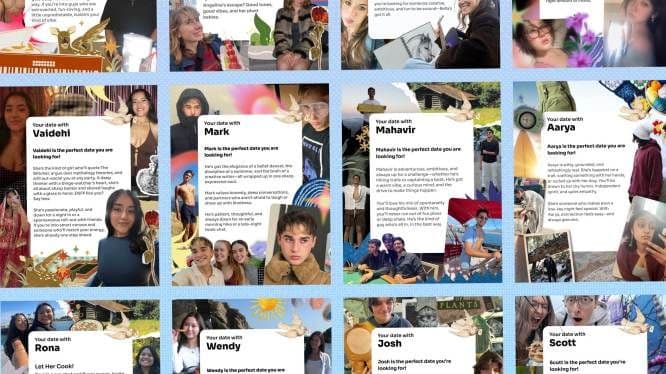
Gen Z dating apps like Ditto ditch swiping in favor of AI matchmaking
This generation of twentysomethings is sodisillusionedwithswipe-baseddating apps that they’ll try literally anything else — even an AI matchmaker. After dropping out of UC Berkeley,Dittoco-founders Allen Wang and Eric Liu set out to build something that would help their peers connect without having to spend hours each week navigating the messiness of apps like Tinder and Hinge. “As Gen Z ourselves, we were firsthand witnessing the behavioral shift in terms of how people are connecting with each other,” Wang told TechCrunch. “We see that people are getting super tired of all the endless swiping and endless small talk, and they’re really looking for something more genuine in real life.” Instead of a typical app, college students can sign up for Ditto by texting a certain iMessage number, along with a code. Then an AI chatbot introduces itself as Ditto, “a dating initiative built by college students who get it … no swiping, no awkward DMs, just real dates every Wednesday at 7 pm.” Users text their way through an onboarding process, starting with basic biographical information like their name, gender, and birth date. Then Ditto gets into more specific questions to understand someone’s personality, interests, and dating preferences. Some users even upload photos of their celebrity crushes to give the AI a sense of their type. The Ditto algorithm tries to match people not based on similar hobbies and interests, but rather what those hobbies and interests say about who someone is. “If there’s this guy, and he’s really into rock climbing, skydiving, and outdoor sports, and this girl, if she’s into hip hop, streetwear, and skateboarding, then even though those hobbies don’t look similar on the surface, I can tell you deeper down, both are very adventurous; maybe they’re very individualistic,” Wang said. “So that’s actually the core reason why people will find chemistry with each other, and so basically our claim is that chemistry is actually predictable with the right signals.” Then, every Wednesday at 7 p.m., Ditto messages users with their match for the week. “It comes with the person, it comes with a time, it comes with a location, and the users simply just need to show up and date each other and come back. We’ll collect more feedback about the date, and then improve our understanding of the user, and send them to a better next date,” Wang said. “Right now people’s goal is really just to go out there and meet each other, so it’s actually removing a lot of friction for our users, so that we are doing the heavy lifting for them, and they just simply go there and then meet whoever.” Ditto has 150,000 signups, and Wang says that out of all the matches that are connected via Ditto, about 20% of those matches end up going out on a date. (If that percentage sounds low to you, then you’ve probably never used Tinder.) Ditto creates a collage-like graphic to introduce users to one another and explain why they might be a good match — it’s a popular aesthetic among Gen Z that other connection apps with young founders likeSonderhave gravitated toward. With any dating app, and especially one that minimizes the time between matching and going out, it can be hard to discern the safety of a situation — is the person you’re meeting really who they say they are? For now, while Ditto is only available at a few dozen colleges, there’s a built-in vetting process in which you know that someone is a student at your university with a .edu email. Ditto is focused on figuring out how to grow to more schools — and eventually beyond just college — while scaling safely. Even for the most established and well-funded dating apps, this is a challenging endeavor. But Ditto does have $9.2 million in seed funding to work with from investors like Gradient, Peak XV, and Scribble. Wang said, “99% of the investors just reached out to us through inbound, because we were pretty big on LinkedIn and Twitter for a bit. Even Duolingo’s co-founder Severin [Hacker] reached out to me saying, ‘Hey, love your mission, I really like what you do, let’s hop on a call.’” Ditto has been able to establish this notoriety through its irreverent marketing, like videos ofrobot stunts. Now based in San Francisco, Ditto has 12 full-time employees, but they’re also hiring a “chief yacht officer” to throw promotional parties (yes, this is a legitimate job listing). “Our users are college students, and they can smell corporate marketing from a mile away,” Wang said. “But the stunts are the top of the funnel, not the product … Viral moments get college kids to look; a good first date is what makes them stay.”
View
Naïve raises $28.5M to automate the grunt work of setting up and running a company
Developers detest drudgery. The entire field of programming is proof of how hard people will work to automate away the boring tasks involved in building things. And, as vibe coding has proved, they’ve even managed to find ways tonotdo most of the work of putting products together. So I wasn’t very surprised to hear thatNaïve, which offers infrastructure that lets AI agents take on the bulk of the work involved in running a business, had signed up over 30,000 developer customers within months of its launch. Taking vibe coding a step further, the startup claims its infra can automate most of the work in setting up and running a business — provided you supply the AI agents and the required token budget, of course. It packages the process of assembling payments, email accounts, phone numbers, cloud infrastructure, storage, and company incorporation behind a single API. Naïve supplies a prompt that developers can provide to tools like Cursor, Claude Code, or Codex, which can connect to the company’s API to provision the infrastructure to set up a business. It lets an agent orchestrate the formation of a U.S. LLC, supplying details such as the state, industry code, business description, and proposed names, though users are still required to be involved to complete KYC/KYB processes and make any required payments. The rest of the set up can be done by your AI agents, including setting up email inboxes, virtual cards, phone numbers, databases, computing resources and connections to services such as Stripe and QuickBooks. A governance layer promises to help users set budgets, restrict their agents’ capabilities, and require human approval before sensitive actions are carried out. The company also provides templates for businesses, such as AI SEO, full-stack SaaS apps, recruiting, accounting, customer support, and even a mobile emulator with which agents can operate smartphone apps on emulated devices. The allure of such automation has clearly resonated, as evidenced by the user figure mentioned above. And Naïve has scaled annual run-rate revenue by 10x to the low double-digit millions over the past six months, CEO and co-founder Sean Dorje said. Based on that traction, the company has now raised $28.5 million in a Series A funding round led by Nexus Venture Partners, TechCrunch has exclusively learned. Dorje told TechCrunch that his customers are using Naïve to run autonomous businesses such as AI automation agencies, “face-less” online content channels on TikTok and YouTube, and even a rental car agency. In one case, he discovered Naïve’s infrastructure supporting a TikTok channel that posted AI-generated videos of cats and dogs dancing and boxing. “I think the one that’s growing the fastest right now is AI automation agencies,” Dorje said. “You know, the first business that a lot of people start is genuinely just selling agents to other small businesses […] We have some customers who run an entire rental-car agency autonomously.” But this toolkit for running businesses may only be part of Naïve’s opportunity. Using AI to automate everything sounds great, but the cost of keeping agents running can grow astronomical as they call expensive AI models, pass large amounts of context between tasks, and consume resources while sitting idle. Naïve is using some of the new capital to develop infrastructure that it says can make those agent loops more efficient. It’s building a model router to send queries to the most efficient model for a task while preserving and replaying already reasoned data; a memory system that stores and surfaces business context as needed by agents to do their tasks; and an orchestrator for dividing work among agents. Notably, Naïve is also building a serverless runtime that runs agents within lightweight JavaScript environments rather than assigning each one a complete virtual machine — an approach that lets customers pay primarily when an agent is active and makes it less expensive to deploy large numbers of agents. While the autonomous company toolkit is in the most demand today, Dorje said optimizing inference costs is one of its fastest-growing sources of demand. “Part of running an autonomous company and running agents, like that’s your biggest cost line now, and so the highest growing demand right now, I would say is [for] inference and serverless agents,” he said. He added that part of the business is getting interest from enterprises, though he did not name any. That could prove to be a more valuable business than helping founders automatically set up phone numbers and corporate cards. Developers may initially use Naïve to deal with the tedium of setting up a company, but as they grow, they may care more about whether it can meaningfully reduce the recurring cost of operating a horde of agents. Enterprises with established businesses may find something to care about on that front, too. Naïve currently has 10 full-time employees. Dorje said proceeds from the Series A will be used to hire researchers and develop the company’s four infrastructure projects: virtualized sandboxes for agents; model routing and inference optimization; a memory layer; and governance and orchestration. Y Combinator, Zetta, Liquid 2 and angel investors including Gokul Rajaram, Apollo.io co-founder Tim Zheng, and former HubSpot COO JD Sherman also participated in the Series A. The funding brings the company’s total capital raised to roughly $32 million.
View
ChatGPT brings unlimited text chats to free users
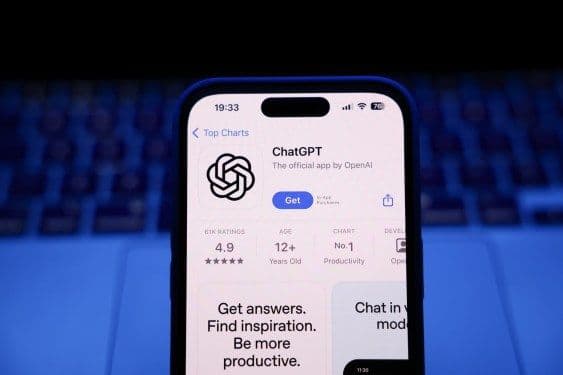
OpenAI is removing limits on text-based chats for all users on ChatGPT, which recently crossed the1 billion weekly user mark, the companyannouncedtoday. The new GPT-5.6 Luna model will power this experience and will be the default model for Free and Go users, replacing GPT-5.5. Both users will also get a new “Think” button that lets them select higher reasoning power for complex questions. OpenAI said that there will still be separate limits for files, images, voice, and image generation. The update brings changes for Plus and Pro users as well. They’ll gain access to an upgraded GPT-5.6 Sol model that’s better for quick tasks such as questions, web research, advice, planning, writing, and making decisions. The company noted that this new model will give more compact and robust answers. (Notably, this is a separate version from GPT-5.6 Sol used for Codex and Work, which is unchanged.) ChatGPT Plus and Pro users are also getting a thinking slider to adjust “how much” thought the model puts into an answer. They can tune the thinking slider based on complexity and steps involved in solving a query. OpenAI said an internal evaluation found that, compared to GPT-5.5-Instant, factual errors were 62% less common for GPT-5.6 Luna and 68% less common for GPT-5.6 Sol. The updated version of GPT-5.6 Sol is available to Plus and Pro users today, while the other changes for Free and Go users are arriving this week. Next week, users will gain access to unlimited text chats and the new Think button for harder questions.
View