AI Styling Studio — Infinite avatar looks from just 1 photo.Try it now.

BestAITools

Submit your Tool

8000+ AI tools already listed
8K+Tools
100K+/moViews
25K+/moVisitors

AI NewsThe Pentagon is developing alternatives to Anthropic, report says

The Pentagon is developing alternatives to Anthropic, report says

1:10 AM IST · March 18, 2026

The Pentagon is developing alternatives to Anthropic, report says

After theirdramatic falling-out, it doesn’t seem as though Anthropic and the Pentagon are getting back together. Instead, the Pentagon is building tools to replace Anthropic’s AI, according toa Bloomberg conversationwith Cameron Stanley, the chief digital and AI officer at the Pentagon. “The Department is actively pursuing multiple LLMs into the appropriate government-owned environments,” he said. “Engineering work has begun on these LLMs, and we expect to have them available for operational use very soon.” Anthropic’s $200 million contract with the Department of Defense (DOD) broke down over the last several weeks after the two parties failed to come to an agreement over the degree to which the military could obtainunrestricted accessto Anthropic’s AI. While Anthropic sought to include a contractual clause that prohibits the Pentagon from using its AI for mass surveillance of Americans or to deploy weapons that can fire without human intervention, the Pentagon didn’t budge. Instead, OpenAI swooped in andmade its own agreementwith the Pentagon. The Department of Defense — known under the Trump administration as the Department of War — also signed an agreement with Elon Musk’s xAIto use Grok in classified systems. It makes sense, then, why the Pentagon would be working on phasing Anthropic’s technology out of its workflows. While some reports said there was a smallpossibilitythat Anthropic would reconcile with the Pentagon, this news suggests that the government is preparing to forge ahead without them. In fact, Defense Secretary Pete Hegseth has declared Anthropic asupply-chain risk, a designation usually reserved for foreign adversaries, which bars companies that work with the Pentagon from working with Anthropic as well. Anthropic ischallengingthis designation in court.

read more

Latest AI News

View All News →
Amazon launches new $1 billion FDE org, following OpenAI and Anthropic

Amazon launches new $1 billion FDE org, following OpenAI and Anthropic

As companies struggle to integrate AI, they’re increasingly ready to bring in outside help — and service providers are launching new purpose-built groups to make sure they get it. On Tuesday, Amazon Web Services (AWS)launcheda new internal organization for AI-focused forward-deployed engineers. Engineers on the new team will embed within companies to deploy purpose-built agents, focusing on fast engagements and customer self-sufficiency. In a post announcing the new org, AWS VP of Frontier AI Francessca Vasquez emphasized that the org would do more than build and maintain requested systems. “Customers leave AWS FDE deployments with both new solutions and new engineering capabilities,” the announcement reads. “Along with agentic systems running in their own AWS environment, they gain lasting AI skills, workflows, and patterns they can use to innovate independently.” Amazon says $1 billion will be committed to the new org, although the figure represents internal Amazon resources rather than a joint venture or conventional investment. Pioneered by Palantir, the forward-deployed engineer (FDE) model has become increasingly popular as a way to manage AI deployments. In a typical FDE system, an engineer from the contracting company (in this case, AWS) works for the client temporarily while the system is being established, allowing them to respond directly as internal opportunities or challenges emerge. In the FDE model, much of the relevant technology can be reused between deployments, while still being tailored to the specifics of each company’s needs and workflows. It also gives the client company an influx of expertise and puts primary responsibility for the deployment in the hands of the contractor. The biggest downside is the labor involved, since it means maintaining a full corps of FDE engineers to install and maintain the company’s technology. Both OpenAI and Anthropichave launched their own FDE joint ventures in recent months, valued at $4 billion and $1.5 billion, respectively. In those two cases, the AI labs were paired with private equity firms, which provided both the capital to launch and connections with client corporations in their portfolios.

41 minutes ago

View

Podcasting platform Riverside enters the newsletter publishing game

Podcasting platform Riverside enters the newsletter publishing game

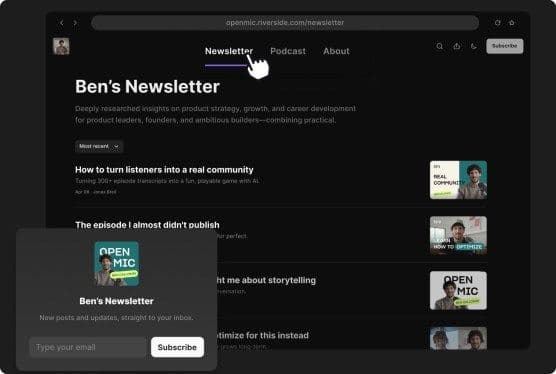
Video and podcast recording tool makerRiversideis giving its users a new way to reach their audiences: newsletters. Riverside isn’t aiming to directly take on established newsletter platforms like Mailchimp, Substack, Beehiiv, or Ghost, however. Instead, recognizing that its userbase already generates a lot of content, the company is giving the users of its recording tools an AI tool to turn their existing videos and podcasts into newsletters, and send them directly from within its app. Users can also create and send newsletters from scratch without using the AI conversion feature. “Substack and Beehiiv start you at a blank page. But our creators and business customers are already producing rich, information-dense spoken content on Riverside. For most people, speaking is easier and more natural than writing from scratch, and the ideas are already there, in the conversation. So instead of asking them to start over in a separate tool, we help them turn a recording they’ve already made into newsletter-ready content with far less effort,” Riverside’s co-founder and CEO Nadav Keyson told TechCrunch. The company is also updating its recording suite to support multi-camera recording setups. It’s also giving users the ability to add remote guests to recordings. The update brings new AI features as well. Users can use AI to draft a first cut of a recording as soon as it’s finished, and the assistant can also create hooks and content for various social media platforms. The company is also adding an AI video enhancement feature, trained on conversational video podcasts, that it says can improve lighting, depth, and sharpness of recordings. Riverside,which has raised over $60 million in funding, joins a host of platforms that have been trying to enter alternative publishing avenues to either diversify or expand their revenue streams. For instance, Substack in March launcheda built-in recording studiothat competes directly with Riverside, and in April, newsletter platformBeehiiv ventured into podcastingas well. In June, social network Mastodon said that it will allow users topublish their posts as newsletters.

41 minutes ago

View

X now offers an MCP server to make its platform easier for AI tools to use

X now offers an MCP server to make its platform easier for AI tools to use

X is making it easier for AI assistants like Claude, Cursor, Grok Build, and other MCP-compatible apps to connect directly to the platform through a new hosted MCP server. On Monday, the Elon Musk-owned social networkunveiledahosted Model Context Protocol (MCP) serverthat lets AI tools communicate with the X API using a user’s own account permissions. MCP, for context, is an open standard that defines a common way for AI models to connect to external tools and services. Previously, if developers wanted an AI assistant like Claude or Cursor to access X, they would have to build their own MCP server, host it, connect to the X API, and handle the authentication. Now, X hosts the MCP, and users authenticate with their own X account’s permissions. This allows developers to save the time spent on integration work to focus on whatever it is they’re actually building. Developers have long been able to search X, read posts, look up users, analyze conversations and trends, and do more using the platform’s API. The hosted MCP doesn’t add new capabilities on that front; it just makes them easier to expose to AI applications. By doing so, X can position itself as an information network filled with real-time data to retrieve and analyze, rather than just a social hangout. The move sees X joining a growing number of companies that now offer their own official MCP servers or endpoints, likeGitHub,Slack,Notion,Stripe, andSalesforce. Of course, there’s always concern that by removing an infrastructure hurdle, X is opening itself up to more automated posting or spam. However, X clarified to TechCrunch that the MCP tool is not compatible with X’s Write API endpoints, so it’s not possible to use it to post autonomously (or at all) on X. It’s also worth noting that the hosted MCP isn’t bypassing X’s API rules, whichcontinue to restrict its useif the company detects spammy behavior. X also updated itsAPI v2 earlier this yearto address the issue of AI-generated spam, particularly programmatic replies to conversations. Plus, it recently updated its API pricing,increasing the cost for publishing poststo $0.015, and posting linksto $0.20. The price increases were designed to “curb vectors of misuse,” X said at the time — meaning it’s at least getting more expensive to spam X. Updated after publication to include information that the MCP tool will not provide“Write” access, after confirmation from X.

41 minutes ago

View

Anthropic’s Claude Science bets on workflow, not a new model, to win over scientists

Anthropic’s Claude Science bets on workflow, not a new model, to win over scientists

Anthropic introduced Claude Science on Tuesday, an AI workbench that gives scientists one environment to do computational research, sparing them the hassle of bouncing between databases, pipelines, and tools. To be clear, Anthropic says Claude Science is “not a new AI model and not a more capable model for biology. It runs the same Claude models already available to everyone today (including Claude Opus 4.8), with no special access and no gating.” The workbench builds on Anthropic’s October 2025 launch ofClaude for Life Sciences, which essentially augmented the Claude chatbot by making it better at life sciences tasks. Claude Science is a dedicated place to do that work. The launch, announced Tuesday at an AI for Science briefing, fits into Anthropic’s broader push to be more than a model provider and to further own the operating layer for specific industries, the way Claude Code has become the operating layer for software development. Anthropic is increasingly betting its growth on vertical, workflow-level products rather than just raw model capability (which could shape how it competes, and prices, against rivals). Here’s how it works: One main AI assistant acts as a kind of project manager for scientists. It connects to more than 60 scientific databases and comes with prebuilt toolkits for specific fields, like genomics, protein structure, and chemistry. That assistant can then create sub-assistants to help split up the work, like a project lead delegating tasks to specialists, or hand work off to a custom “expert” assistant that the user has built for their own research. A separate fact-checker AI then double-checks the citations and calculations before anything goes to publication. That fact-check step matters, as more AI-assisted writing leads to fabricated citations and unverifiable stats slipping into papers. That said, it’s still the same underlying model checking itself, not an independent source of truth. Claude Science has other ways of ensuring reproducibility, Anthropic says. For example, the workbench can generate figures like 3D protein structures and chemistry drawers alongside the code that made them. Each figure includes the “exact code and environment that produced it, a plain-language description of how it was created, and the full message history,” according to the company. The process also saves scientists time by allowing them to edit figures in plain language, prompting the agent to edit its own underlying code. Another way Claude Science can save scientists time is by running on the lab’s own infrastructure setup rather than sending data off to Anthropic’s servers. Early users say they’re already putting this to work. Allen Institute neuroscientist Jérôme Lecoq used the tool to build a multi-agent computational review pipeline. Stephen Francis’s group at the UCSF Brain Tumor Center relied on Claude Science to speed up comprehensive germline analysis of glioma to a sliver of the time it previously required, with results independently validated. The Claude Science launch comes a couple of months after OpenAI approached the same problem from a different side. In April,OpenAI released GPT-Rosalind, a specialized model that is fine-tuned for biological reasoning. The difference between the two approaches isn’t only about whether a specialized model is necessary — it also comes down to who gets access, and how fast. Rosalind launched as a research preview limited to qualified enterprise customers in the U.S., gated behind a qualification and safety review. Partners like Amgen, Allen Institute, Moderna, Thermo Fisher, and Novo Nordisk got early access. And then there’s Google DeepMind, which is playing a different game entirely. DeepMind actually owns foundational science models like AlphaFold and AlphaGenome, which the other two can only call into as tools. Its Gemini for Science platform also bundles those plus more than 30 life science databases into one skill set. The net effect is that three very different distribution strategies are now competing for the same scientific research market: Anthropic is going wide with broad subscription access, OpenAI is going narrow and enterprise-gated, and Google is leaning on owned, proprietary models nobody else has. How that plays out could be an early signal for how AI vendors compete in other specialized verticals like law, finance, and engineering, down the line. Claude Science is available in beta to anyone on Pro, Max, Team, and Enterprise subscriptions. Anthropic also named Novo Nordisk and Allen Institute as customer case studies, suggesting pharma organizations are already working with multiple AI vendors. Anthropic will also support up to 50 Claude Science projects, providing up to $30,000 in credits: “We are looking for postdoctoral and graduate projects that span domains and explore the boundaries of science, with an early focus on fields across biomedical research. Applications are open through July 15, 2026, with award notifications sent out by July 31. Projects will run from September 1 to December 1, 2026.”

41 minutes ago

View