AI Styling Studio — Infinite avatar looks from just 1 photo.Try it now.

BestAITools

Submit your Tool

8000+ AI tools already listed
8K+Tools
100K+/moViews
25K+/moVisitors

AI NewsTalat’s AI meeting notes stay on your machine, not in the cloud

Talat’s AI meeting notes stay on your machine, not in the cloud

1:21 AM IST · March 25, 2026
Talat’s AI meeting notes stay on your machine, not in the cloud

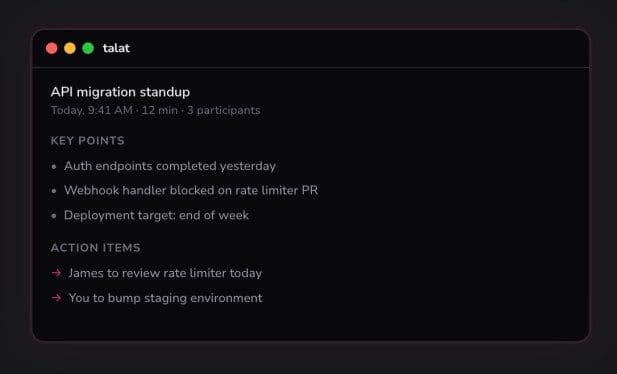
The AI-powered notetaking app Granola, valued at$250 million, has become a popular tool among tech industry foundersand VCs. But one developer believes there’s demand for a more private, local-only alternative that’s available for a one-time fee and without a subscription. That’s led to the creation of a new Mac app calledTalat. Yorkshire, England-based developerNick Payne, a self-described computer nerd, says the idea to build a local AI notetaker came about mostly because of a series of happy accidents. “I think Granola is awesome; it’s a shining example of what you can do with an Electron app [a framework for building desktop applications] given enough love and care,” he told TechCrunch. “When I first tried it, I was fascinated that it managed to record system audio on my Mac without recording video, which was the standard workaround at the time. That led to a ton of research, discovering a relatively new and poorly documented Apple API.” To make it easier to work with that API (Core Audio Taps, which lets developers tap into a Mac’s audio streams), Payne decided to create an open source audio library,AudioTee. “During that time, I was slowly piecing together a toolkit, but I never found anything that felt like it could stand on its own as a product rather than just a cool tech demo,” Payne said. “The state-of-the-art hosted transcription models — the same providers folks like Granola use — are incredible, and it’s viscerally cool to see your speech unfurled onscreen in near real time. But it always nagged me that the trade-off required providing not just my data, but my audio data; my actual voice,” he added. He then stumbled upon a software toolkit calledFluidAudio, a Swift framework that enables fully local, low-latency audio AI on Apple devices. It lets you run small, fast transcription models directly on the Mac’s Neural Engine — Apple’s dedicated hardware for AI processing. That was the piece that made Payne realize he could turn his research into an actual product — one where your audio never leaves your Mac and your transcripts aren’t stored on another company’s servers. Talat, which wasbuilt alongsidePayne’s longtime friend and former colleague Mike Franklin, is the result of Payne’s interest in the audio space. The result is a 20MB, one-time purchase that doesn’t require you to create an account or even share analytics data back with the developers. There are no ongoing fees, either. While some AI notetakers may have more bells and whistles, Talat offers a streamlined set of features. It captures audio from your computer’s microphone when you’re in meeting apps like Zoom, Teams, Meet, and others, and transcribes it in real time. The app tries to assign speakers in real time, but you can reassign them as needed. You can also take notes, plus edit, delete, or split transcript segments. When the meeting finishes, a local LLM generates a summary with key points, decisions, and action items. The notes, transcripts, and summaries are all searchable in Talat, too. In addition to the privacy angle, Payne said the goal is to give users more options. “We’re leaning into configurability and letting users control where their data goes: pick your own LLM, auto-export to [notetaking app] Obsidian, webhooks that push data out when a meeting finishes, anMCPserver,” which is a standardized way for AI tools to connect to outside data sources, “to pull it on demand,” he explained. Under the hood, the AI is a mixture — “mostly stitched together and abstracted behind FluidAudio,” Payne noted, which he credits with doing a lot of the heavy lifting. For the summarization piece, the app defaults to an Al model called Qwen3-4B-4bit, which can run on even fairly modest hardware. However, users can opt to switch that out to any cloud LLM provider of their choice, or they can choose between two Parakeet variants — speech-recognition models developed by Nvidia — or point it at Ollama (a tool for running AI models locally), giving them more control over the experience. In time, Talat will add support for more built-in choices and will have integrations for other apps, like Google Calendar and Notion. At launch, users with M-series Mac computers (those running Apple’s own processors, starting with the M1) can download the app and try it out for free with 10 hours of recordings before deciding to purchase. Talatisavailable for $49while in this pre-release version, which is still under active development. When the app hits a 1.0 release, the price will increase to $99. Payne and Franklin are bootstrapping Talat and plan to keep the core product a one-time purchase going forward.

read more

Latest AI News

View All News →
Vibe coding platform Base44 launches own model as AI startups seek defensibility

Vibe coding platform Base44 launches own model as AI startups seek defensibility

Base44, the vibe coding platform thatWix acquired for $80 millionjust one year ago — when the company was barely six moths old and had a team of eight — has started rolling out its own AI model to support its users in creating apps with natural language. The move comes as the discussion in AI circles has intensified over whether frontier models are best suited for all use cases. A related question is whether businesses built on top of someone else’s models are truly defensible long-term. The latest move of Base44, based in the Bay Area, speaks to both. While its custom LLM is only just rolling out, Base44 hopes that it will eventually outperform frontier models. According to its founder, Maor Shlomo, “training and owning the model as part of [our] entire stack allows us a lot more optimizations on latency, cost, and efficiency.” At first glance, this could be a way to stay ahead of competitors such asSwedish startup Lovable, which reachedunicorn statusin its Series A round last summer and thatrelies on external LLMs. However, Shlomo expects that others will train their own models — “at least the players that have gotten enough scale and velocity to have enough data.” According to Jonathan Userovici, a general partner at VC firm Headline — whose portfolio includes AI companies like Mistral AI, but not Base44 — data is one of three key ingredients of defensibility for AI startups, alongside distribution and tech stack. The upshot is that players with strong brands are now leaning into their data and infrastructure to increase their defensibility, and Base44 fits that pattern. The company says the first iteration of its LLM, Base1, was developed and trained on a dataset generated from “tens of millions of real user interactions on the platform.” This dataset will keep on growing with the company; but so will its rivals’. The bigger competition may not be vibe-coding startups at all but instead come from frontier AI labs that are getting closer to Base44’s home turf — Cursor and Grok’s parent company xAI now bothbelong to SpaceX, and Claude Code has become a vibe coding player in its own right. This gives Anthropic and other foundational AI providers access to data and feedback loops they can use to improve models for app creation, but Shlomo thinks specialization gives Base44 a leg up. “Models are progressing, but they’ll stay very general in what they can do,” he predicted. Userovici, for his part, cautioned against underestimating frontier models, citing the example of the legal tech startup Harvey, which abandoned plans to train its own model. He doesn’t expect applied AI companies to become frontier labs en masse but frames Base44’s move in a broader context — one in which inference costs have become a meaningful part of the equation. That cost pressure, Userovici says, has driven change that enterprise customers are now demanding. “They don’t necessarily see a [return on investment] when using the latest models for all use cases, so an entire infrastructure is being set up to do orchestration and optimization to select the right models for them so that costs don’t skyrocket while maintaining the same or similar performance across the majority of use cases.” Enterprise companies still are a minority among the audience of the vibe coding platforms, but they represent a growing share of platform revenue, and users of all sizes are starting to express concerns over the cost of using AI. Base44’s decision to develop its own LLM stemmed from multiple factors, but cost reduction is likely among the benefits. “We want to get a model that is going to be more aligned to what we think is the right thing, is going to be more optimized to what we see users like in terms of the results we’re getting, and is going to be faster and cheaper for customers eventually than using the frontier models like Opus,” Shlomo said. As for Base44 itself, cost reduction isn’t as clear cut. In a press release, the company explained that “ownership of the model gives Base44 direct control over compute and inference spend, expected to result in a structurally stronger margin profile over time.” Even with a delayed payoff, improved margins would be good news for Base44’s parent company, which recently announced it wouldlay off 20% of its workforce. In contrast, Base44 has been growing in headcount since the acquisition — and announced it hadpassed $100 million in annual recurring revenuea few months ago. That’s still less than Lovable, which said ithit $500 million in ARR earlier this month. But Shlomo is betting that the “huge engineering effort” to develop Base1 will cement Base44’s positioning as the “only vertically integrated vibe-coding application — meaning, in Userovici’s terms, a player that owns its distribution, data, and infrastructure all at once.

2 hours ago

View

Gemini’s personalized AI image generation is now free for US users

Gemini’s personalized AI image generation is now free for US users

Googleannouncedon Monday that the Gemini app is now offering its personalized Nano Banana-powered image generation feature to a broader audience. Starting today, all eligible users in the U.S. can access the feature for free, a service that waspreviously only availableto Plus, Pro, and Ultra subscribers. Google initially announced that Gemini’s Personal Intelligence feature would get Nano Banana-powered image generation back in April, allowing users to create images that reflect their unique interests. This means that images can be generated based on Gemini’s understanding of your likes and preferences without you having to specify them in your prompt. Gemini utilizes data from your Google account connections — such as Gmail, Google Photos, YouTube, and Search — to achieve this. For example, instead of saying, “Create an illustration of me and my favorite things, such as coffee and baking,” you can simply request, “Create an illustration of me and my favorite things.” Gemini can also pull actual images of you from Google Photos, so you don’t need to manually upload photos. Google initially rolled out the Personal Intelligence feature earlier this year, making itwidely availableto all U.S. users in March. The company recentlyexpandedthis functionality to users in India and Japan. Personal Intelligence is an opt-in feature, allowing you to decide which apps Gemini can access. Once enabled, it is set as the default for every prompt, but you can disable it using a new toggle in the Tools menu. Additionally, last month, Googleannouncedseveral upcoming updates for the Gemini app, including a new “Daily Brief” feature, a revamped interface, access to AI video model Gemini Omni, and a personal AI agent named Gemini Spark. Notably, Google’s AI chatbot Gemini surpassed 750 million monthly active users (MAUs) earlier this year, reinforcing its position as a major player in the AI space.

6 hours ago

View

TIDAL cracks down on AI music by cutting off monetization

TIDAL cracks down on AI music by cutting off monetization

Music streaming serviceTIDALis the latest to take aim at AI-generated music with the introduction ofa new policythat will prevent fully AI-generated music from making money on its platform. In addition, TIDAL will use automated tools to remove AI-generated music that attempts to impersonate an artist or a group, the company said. “We are committed to protecting and rewarding organic creativity to avoid compromising an artist’s ability to connect with and build their fandom from TIDAL subscribers. Many have told us they do not want to be exposed to — or prompted to listen to — wholly AI-generated music,” wroteTonyGervino, TIDAL EVP and editor-in-chief, in anannouncement. He clarified that TIDAL’s new policy was not meant to “bash technological advancement,” but rather focuses on protecting and rewarding “organic creativity” from artists. With the changes, fully AI-generated music on TIDAL will be identified and tagged as such, allowing listeners to see an “AI” badge next to any tracks deemed to be 100% AI. These tunes will not be able to be monetized or collect royalties, and will not be eligible for direct-to-fan sales, the company noted. TIDAL’s policy joins others in the streaming music space, where services like Spotify, Apple Music, Deezer, andQobuzhave developed their own policies to address the growing number of AI-generated tracks filling their services. Spotify last yearrevamped its policies to label AI musicand better filter spam, while still acknowledging that AI tools would be used in the music-creation process to varying degrees. Apple Music alsotook the tagging approach. Deezer, which said that44% of all new musicuploaded to its platform daily is AI-generated, has taken a tougher position. It actively removes AI tracks from recommendations and excludes them from editorial playlists. It alsooffers its AI-detection technology to rivalsandprovides a consumer-facing toolthat lets you see if AI music has slipped into your playlists on competing services. TIDAL’s policy could be an interesting test to see if demonetization could be the thing to slow the deluge of AI music, which many listeners aren’t interested in. “Regardless of what you are reading elsewhere, AI’s takeover of the music industry (and your recommendations) isn’t inevitable if we take even greater steps now to monitor and control it,” noted Gervino. The company said the new policy is a “living document,” meaning it’s open to changes as the space evolves. It goes into effect on July 15, 2026.

10 hours ago

View

Cursor now has a mobile app for guiding your coding agent on the go

Cursor now has a mobile app for guiding your coding agent on the go

Cursor isn’t lettingthe $60 billion SpaceX acquisitionslow it down. On Monday, the companyannounceda new mobile appfor iOSdevices designed for users who want to prompt coding agents directly from their phone. The app ties into the Cursor 2.0 changesunveiled in October, which shifted the service towards independent coding agents. With the mobile app, users can spin up new coding agents or interact with agents that were initiated from the desktop client. Cursor’s move to mobile follows similar apps from Anthropic and OpenAI, both of which offer ways to interact with their coding tools on mobile. It’s part of a broader shift in AI-based coding tools, which are increasingly abstracting away from written code and towards oversight of code-writing agents. With no need to access large code bases, many developers are switching away from multi-monitor desktop setups in favor of phones, which allow continuous conversations with remote agents. In a recent talk, Anthropic’s head of Claude Code, Boris Cherny, said he had almost entirely switched to mobile AI coding as a result. “Most of my coding now is on my phone,” Cherny said in the talk. “I would have said ‘you’re crazy’ if you told me that six months ago, but yeah, here we are.”

10 hours ago

View