AI Styling Studio — Infinite avatar looks from just 1 photo.Try it now.

BestAITools

Submit your Tool

8000+ AI tools already listed
8K+Tools
100K+/moViews
25K+/moVisitors

AI NewsOpenAI announces new advanced security for ChatGPT accounts, including a partnership with Yubico

OpenAI announces new advanced security for ChatGPT accounts, including a partnership with Yubico

2:21 AM IST · May 1, 2026
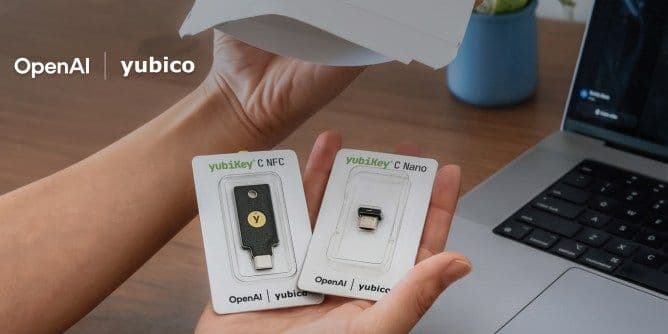
OpenAI announces new advanced security for ChatGPT accounts, including a partnership with Yubico

OpenAI is getting serious about account security. The company on Thursday launchedAdvanced Account Security(AAS), a set of opt-in protections for ChatGPT users designed for high-value individuals — but available to anyone who wants them. As part of that new program, digital security provider Yubicoannouncedit has partnered with OpenAI to link two new security key products to ChatGPT accounts. The company said the partnership was designed to protect users from the threat of phishing, which is considered to be a growing threat for chatbot users. The two companies are releasing a pair of “co-branded” YubiKeys — dubbed the YubiKey C NFC and the YubiKey C Nano. OpenAI has suggested that AAS is a good fit for political dissidents, journalists, researchers, and elected officials — people who engage in politically charged and risky work. One would assume that it might make sense for enterprise users, whose corporate secrets are squirreled away in ChatGPT sessions. “Ultimately, our intent is to drastically reduce the threat of unauthorized access to sensitive data in OpenAI accounts worldwide,” Yubico CEO Jerrod Chong said in press release announcing the deal. Security keys are small pieces of hardware that can be tied to digital accounts and enacted through a computer’s USB ports. A unique cryptographic identifier lives on the key, which allows only the person in possession of it to log into a connected account. If the threat of phished ChatGPT accounts may seem somewhat abstract, there is agrowing body of literatureshowing that bad actors are increasingly targeting chatbot users. Cybercriminals are always on the lookout for extortion-worthy information and, given the intimate nature of most chatbot conversations, there is plenty of fodder when it comes to both enterprise and personal-level users. Digital security is also becoming a bigger focus of the AI industry. Several weeks ago, Anthropic announced a newcybersecurity modelcalled Mythos. Perhaps seeking to steal some of its competitor’s thunder, OpenAI has also made a number of announcements related to digital security. Thursday’s news of the Yubico partnership followed OpenAI’sannouncementthat it’s launching a new framework for digital defense. Of course, a security-key-enabled account does offer stronger protection, but it comes with a tradeoff: If the key is lost, OpenAI won’t be able to help recover access. In practice, that means conversations could be lost for good.

read more
Latest AI News

View All News →
India's Compliance Maze: How TeamLease RegTech Is Using AI to Tame a 13,000-Change Beast

India's Compliance Maze: How TeamLease RegTech Is Using AI to Tame a 13,000-Change Beast

Enterprises in India face up to 11,000 compliance instances annually from over 3.2 million regulatory websites. TeamLease RegTech is deploying AI to shift compliance from reactive record-keeping to predictive, intelligence-driven risk management for businesses nationwide.

1 hour ago

View

Meta Strikes Fresh Data Centre Agreements With Crusoe: Report

Meta Strikes Fresh Data Centre Agreements With Crusoe: Report

The latest deal reflects Meta’s ongoing efforts to expand its AI infrastructure as demand for large-scale computing resources continues to grow.

1 hour ago

View

Source: Elastic agrees to buy CRV-backed DeductiveAI for up to $85M

Source: Elastic agrees to buy CRV-backed DeductiveAI for up to $85M

DeductiveAI, a startup that uses AI to catch and resolve bugs in software, has agreed to be sold to enterprise software company Elastic for up to $85 million, according to a person with knowledge of the deal. Deductive, which was founded in 2023, came out stealth last November when it announced a$7.5 million seedround led by CRV with participation from Databricks Ventures, Thomvest Ventures, and PrimeSet.  The investment valued the startup at $33 million, according to PitchBook. Elastic and Deductive did not respond to multiple requests for comment. TechCrunch will update this article if either company responds. The sale marks a speedy exit for Deductive, which is operating in a fast-growing sector known as AI site reliability engineering (AI SRE). Building AI-powered SRE tools has become an important area, driven by the massive influx of AI-written code. Replacing manual debugging with AI enables human SREs to shift focus from constantly fixing outages and other problems, to spending more time on helping with product development. The acquisition reflects a broader trend in which established tech incumbents are looking to buy AI-native startups to integrate agentic technologies into their existing product suites, the source told TechCrunch. Elastic, which went public in 2018, is best known for Elasticsearch, the search and analytics engine that helps organizations store, search, analyze, and monitor large amounts of data in near real time. The company’s observability software — essentially tools that let engineers monitor software systems and detect security threats — could benefit from Deductive’s tech. According to the source, integrating Deductive’s AI technology into Elastic will enhance its observability platform by giving customers tools to automatically monitor performance and resolve system failures in real-time. Deductive was co-founded by Rakesh Kothari, who was previously VP of engineering at Lightspeed-backed business analytics startup ThoughtSpot, and Sameer Agarwal, who formerly worked at Apache Software Foundation and Meta. Agrawal was one of the founding engineers at Databricks. While Deductive reached roughly $1 million in annual recurring revenue (ARR,) according to the source, the startup’s growth lagged behind Resolve AI, one of the sectors’ perceived early winners. The two-year-old Resolve was co-founded by former Splunk executive Spiros Xanthos and Mayank Agarwal. Greylock and Lightspeed-backed startup was last valued at$1.5 billionwhen it raised a $40 million Series A extension in April.

5 hours ago

View

Almost half of U.S. singles feel negatively about AI in dating, Match says

Almost half of U.S. singles feel negatively about AI in dating, Match says

Dating app giant Match Group — which owns apps like Tinder, Hinge, and OkCupid — conducted astudyto determine how U.S. singles really feel about the relationship between AI and dating. Turns out, people don’t want AI messing with every aspect of human life. Across the industry, dating apps are experimenting with AI. Bumble introduced adating assistant named Bee, and Tinder isspendingso much on AI tools that it’s slowed its hiring process. Meanwhile, Hinge’s CEOstepped downlast year to launch a more AI-focused dating app altogether. But according to Match’s survey of 1,000 people aged 18 to 39, 47% of singles have a negative view of AI’s use in romantic contexts. This perspective varies depending on what the AI is being used for. About 40% of singles say they would refuse to date someone who uses an AI companion app, and that figure rises to 51% among women ages 18 to 24. However, only 12% of 18- to 24-year-olds said that they had used a companion app over the last three months, and only about a third of those users said they were seeking genuine connections with those chatbots. While Match says that people harbor a “near-universal” disapproval of actually dating an AI, like in the movie “Her,” that doesn’t mean that respondents are wholly opposed to AI features within apps. Some 64% of respondents said they could see how AI might help them in their dating journey. If we’re being pedantic,technically, every major dating app has already used some form of matching algorithm since before we knew what a GPT was. This survey refers to the new crop of AI features that basically every app is introducing, which help users punch up their profiles, choose photos, and keep conversations flowing. What dating app developers should take away from this survey is that people are not entirely closed off to AI; they just don’t want to be in a relationship with a robot, nor do they want to feel as though their dating experiences are overly inundated with technology that feels inauthentic. “Ask singles what they want from AI in dating, and the answer is pretty consistent: help with the hard parts, but hands off for the human parts,” Match wrote in a blog post. “Yes, they’ll use it to help them punch up a profile or for help figuring out what to say when a conversation goes quiet, but the actual connection is still theirs to create.” Hopefully, this message reaches dating entrepreneurs like Bumble founder Whitney Wolfe Herd, who suggested that dating app users could havepersonal bots that date other users’ bots. It’s pretty normal nowadays to say you met your partner online, but “his bot asked my bot out, and our bots hit it off” will never be a socially acceptable meet-cute.

9 hours ago

View