AI Styling Studio — Infinite avatar looks from just 1 photo.Try it now.

BestAITools

Submit your Tool

8000+ AI tools already listed
8K+Tools
100K+/moViews
25K+/moVisitors

AI NewsNomadic raises $8.4 million to wrangle the data pouring off autonomous vehicles

Nomadic raises $8.4 million to wrangle the data pouring off autonomous vehicles

9:33 PM IST · March 31, 2026
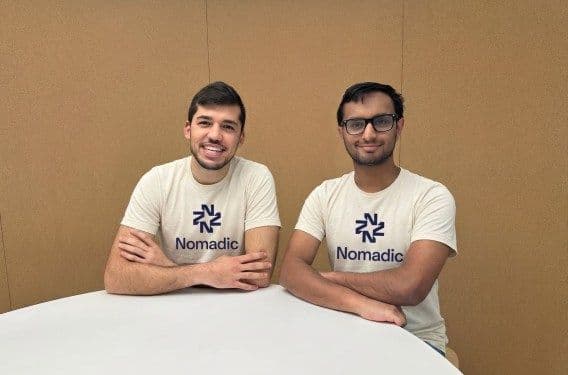
Nomadic raises $8.4 million to wrangle the data pouring off autonomous vehicles

To build the autonomous machines of the future, sometimes your model needs a model. Companies developing self-driving cars, robots manipulating the physical environment, or autonomous construction equipment collect thousands, if not millions, of hours of video data for evaluation and training. Organizing and cataloging that video is now a job for humans, who have to watch all of it. Even fast-forwarding, that doesn’t scale.NomadicML, a startup founded by CEO Mustafa Bal and CTO Varun Krishnan, wants to solve problems for customers who have 95% of their fleet data sitting in archives. The challenge becomes harder when looking for edge cases — the most valuable data depicts events that rarely occur and can befuddle inexperienced physical AI models. Nomadic is working to solve that problem with a platform that turns footage into a structured, searchable dataset through a collection of vision language models. That, in turn, allows for better fleet monitoring and the creation of unique datasets for reinforcement learning and faster iteration. The company announced an $8.4 million seed round Tuesday at a post-money valuation of $50 million. The round was led by TQ Ventures, with participation from Pear VC and Jeff Dean, and will allow the company to onboard more customers and continue refining its platform. Nomadic alsowon first prizeat Nvidia GTC’s pitch contest last month. The two founders, who met as Harvard computer science undergrads, “kept running into the same technical challenges again and again at our jobs” at companies like Lyft and Snowflake, Bal told TechCrunch. “We are providing folks insight on their own footage, whatever drives their own AVs [and] robots,” he said. ”That is what moves these autonomous systems builders forward, not random data.” Imagine, for example, trying to fine-tune an AV’s understanding that it can run a red light if a police officer is directing it to do so, or isolating every time that vehicles drive under a specific type of bridge. Nomadic’s platform allows these incidents to be identified both for compliance purposes, and to be fed directly into training pipelines. Customers like Zoox, Mitsubishi Electric, Natix Network, and Zendar are already using the platform to develop intelligent machines. Antonio Puglielli, the VP of Engineering at Zendar, said that Nomadic’s tool allowed the company to scale up its work much faster than the alternative of outsourcing, and that its domain expertise set it apart from other competitors. This kind of model-based, auto-annotation tool is emerging as a key workflow for physical AI. Established data labeling firms like Scale, Kognic, and Encord are developing AI tools to do this work, while Nvidia has released a family of open source models,Alpamayo, that can be adapted to tackle the problem. Varun argues that his company’s tool is more than a labeler; it is an “agentic reasoning system: you describe what it needs and it figures out how to find it,” using multiple models to understand action taking place and put it in context. Nomadic’s backers expect the startup’s focus on this specific infrastructure to win out. “It’s the same reason Salesforce doesn’t build its own cloud and Netflix doesn’t build its own [content distribution facilities],” Schuster Tanger, a partner at TQ Ventures who led the round, told TechCrunch. “The second an autonomous vehicle company tries to build Nomadic internally, they’re distracted from what makes them win, which is the robot itself.” Tanger praises Nomadic’s talent, noting that Krishnan is an international chess master ranked as the world’s 1,549th-best player. Krishnan, meanwhile, brags that all of the company’s dozen or so engineers have published scientific papers. Now, they’re hard at work developing specific tools, like one that understands the physics of lane changes from camera footage, or another that derives more precise locations for a robot’s grippers in a video. The next challenge, from the point of view of Nomadic and its customers, is to develop similar tools for non-visual data like lidar sensor readings, or to integrate sensor data across multiple modes. “Juggling around terabytes of video, slamming that against hundreds of 100 billion-plus parameter models, and then extracting their accurate insights, is really insanely difficult,” Bal said.

read more

Latest AI News

View All News →
Omen AI’s plan to optimize data centers is all wet

Omen AI’s plan to optimize data centers is all wet

The AI-driven demand for compute power has data centers looking to squeeze more from every rack of GPUs. One consequence? Bacterial outbreaks. The liquid for liquid-cooled chips is a mixture of water and a substance that inhibits bacteria growth. To run the chips hotter, data center managers can change the mix to include more water, which absorbs heat better, but leads to nasty contamination that clogs the flow. To solve that, they flush the system, which can mean shutting down a rack for five or six hours at a potential cost of millions of dollars. Omen AIhas a solution: A tiny spectrometer that can monitor that fluid health in real time, spotting bacterial growth before it becomes a massive problem. “You’re not risking huge amounts of downtime because you have no insight into what’s going on chemically,” explains CEO and founder Zach Laberge. Today, Omen AI said it raised a $31 million Series A round, led by Nava Ventures and including participation from CRV, Vanderbilt University, Mann+Hummel, Starhill Holdings, and Hard Launch Capital, as well as personal investments from executives at Bridgestone, GM, Johnson Controls, and TensorWave. Laberge founded his first company in 2020 when he was 14, raising $3 million to install sensors on construction equipment and ultimately dropping out of high school. (His father and mother, a former Minister of Education for Ontario, were supportive of his plan to carve his own path.) After that startup shut down, Laberge started Omen in 2024, with the idea of focusing on fluid systems as the key to enabling construction machinery to be smart enough to know when it needed to be fixed. The idea was to replace the time-consuming process of extracting samples and sending them to a lab with real-time awareness. Besides bacterial growth, the device can spot pumps and pumps wearing out if it sees copper or chromium, or seals if it sees silicon. Caterpillar dealerships were a key early customer for Omen’s heavy vehicles business, but Cat is also a major supplier of gas-powered turbines and generators to provide on-premises power for data centers. It didn’t take long for Omen to see where the wind was blowing. “That was kind of the transition,” Laberge told TechCrunch. About six months ago, “a lot of the dealerships were saying, ‘Hey, we’re starting to put sensors on our turbines, can you guys do anything on the building side of things?’” Omen discovered that those buildings are full of fluid, from their HVAC systems to their chip cooling. Spotting a new, fast-growing group of potential customers, Omen began to focus on data centers. “It’s rare to see such a young founder who has the respect of established, large corporations in a space that moves a bit more slowly,” said Cory Rellas, a partner at Nava Ventures who sits on Omen’s board. “For Omen in particular, much of our diligence came through our introductions with large customers which quickly validated their approach.” Omen, which has raised $40 million since its founding in 2024, is working with a dozen data center customers as they build out their offering, including TensorWave, a company building an AI compute cloud on AMD chips. “The fluid running through these massive systems is a critical variable that most of the industry is flying blind on,” Piotr Tomasik, TensorWave’s president, said in a statement. “Omen [sees] the future of infrastructure exactly the way we do, better monitoring to optimally support compute customers.” While many organizations rely on mailing fluid samples to labs for insight, Omen isn’t alone in developing on-premises analytics — Pyxis, an established water-monitoring firm, rolled out its data center coolantmonitoring productearlier this month. The key tech advances that unlocked this approach are recent improvements in both optical technologies and signal processing software. “Hardware is just cheap enough that it makes sense to play at scale, and then signal processing lets us make more sense out of the noise,” Laberge said.

just now

View

Robot hand company settles Tesla trade secret suit and announces $11M raise

Robot hand company settles Tesla trade secret suit and announces $11M raise

Jay Li doesn’t recommend getting sued by Tesla if you’re trying to get a startup off the ground. But he does think his company, Proception, might be better off for having endured the experience. “I think it’s kind of like a resilience test, or pressure test,” he told TechCrunch in an exclusive interview. “People say that what doesn’t kill you makes you stronger, right?” Li, who was a technical lead on Tesla’s Optimus humanoid robot program, wasaccused by his former employer last yearof absconding with trade secrets to start Proception. But after months oftradinglegal blows, he finally reached a settlement with Tesla, which dismissed the lawsuit earlier this month. (Tesla did not respond to a request for comment.) Now Li is free to tackle what he thinks is an even harder problem: making robot hands work like a human’s. To help do that, Proception announced Monday that it has raised an $11 million seed round led by First Round Capital, with contributions from Y Combinator and early stage fund BoxGroup. Proception also announced Monday that it is shipping the first batch of its “high-dexterity robotic hand” to “researchers and robotics companies,” while opening up to wider orders. The goal, Li said, is to become the top hand supplier to other companies that don’t want to spend the time or resources developing what’s known in the industry as “dextrous manipulation.” While there’s been an avalanche of money and attention rushing into the world of robotics, Li believes not enough of that has gone to making robotic hands truly mimic a human’s hands. One of the loudest voices talking about this challenge has actually been his old boss, Tesla CEO Elon Musk, who has said robot hands are one of the biggest engineering problems yet to be solved. While Musk has maintained that Optimus robots could start working in factories in a matter of years, the consensus view is that making robotic hands equivalent to a human’s is still many years away. Kevin Lynch, the director of Northwestern University’s Center for Robotics and Biosystems, told the Wall Sreet Journal last year that his team believes it will be a decade until they are “functional and useful and able to do some of the things that humans do.” Li thinks Proception can do it much faster, in large part because of how they’re collecting data. Most companies training humanoid robots right now are using teleoperators to train their systems. A human wearing a virtual reality headset is able to see what a robot sees and manipulate what’s in front of that robot, then the robot can learn from the commands given by the human. A big drawback to this approach, according to Li, is that the teleoperator is not receiving feedback from the objects the robot is touching. This approach is also limited to the number of robots a company has available at any given moment, Li said. Proception’s solution is a glove laden with sensors. With human testers wearing the gloves (and a headset), Proception and its customers can capture “human hand interaction data without requiring a robot in the loop,” according to Proception’s press release. This same glove also goes on the hand Proception is developing, acting as its sensor-packed “skin.” The hand has 22 degrees of freedom and multiple joints per finger to enable a “wide range of dexterous motions,” according to Proception. Li said this approach will also let Proception and its customers gather finer, more task-specific data that can allow its robotic hands to more accurately resemble a human’s. He also thinks it is better suited to scale up. “You need both hardware and data, and those need to come hand-in-hand to get [dextrous manipulation] to work. A lot of companies solely focus on hardware, or like hardware plus non-scalable data [collection],” he said. “We’re working on this highly dexterous hardware plus highly scalable data. We believe that’s a key combination to solve this problem.” First Round partner Bill Trenchard, who led the investment in Proception, said this was a big reason why he backed Li. “We think they will have the best hand in the market, maybe the most sophisticated hand today, and the underlying data and models to support that,” he told TechCrunch. “Dexterous manipulation is a very, very, very important part of the whole humanoid story going forward, and as many people have said, it’s sort of the last mile of getting these robots to be truly performant.” Trenchard also praised Li’s ability to keep a cool head while being sued by his former employer. “He was very upfront with us when this came out, and I think the team did an amazing job of keeping their heads down,” Trenchard said. “Jay’s a very strong leader.” Li is also confident. After facing down Tesla’s “hardcore litigation department,” he told TechCrunch that he wouldn’t be surprised if the company comes calling for help as Proception grows. “I think it will happen,” he said.

just now

View

Mphasis Joins Microsoft Security Partner Ecosystem Amid Rising Cyber Threats

Mphasis Joins Microsoft Security Partner Ecosystem Amid Rising Cyber Threats

Mphasis said the membership builds on its existing collaboration with Microsoft across managed security services, cyber fusion centres and advisory offerings, as enterprises step up investments in AI-driven cyber defence.

just now

View

Capgemini to Lead Bentley Motors' Digital Transformation With AI, Intelligent Manufacturing

Capgemini to Lead Bentley Motors' Digital Transformation With AI, Intelligent Manufacturing

The facility is being developed as a hub for hyper-personalised, digital, and sustainable luxury vehicle production.

just now

View