AI Styling Studio — Infinite avatar looks from just 1 photo.Try it now.

BestAITools

Submit your Tool

8000+ AI tools already listed
8K+Tools
100K+/moViews
25K+/moVisitors

AI NewsKhosla-backed robotics startup Genesis AI has gone full-stack, demo shows

Khosla-backed robotics startup Genesis AI has gone full-stack, demo shows

10:30 PM IST · May 6, 2026
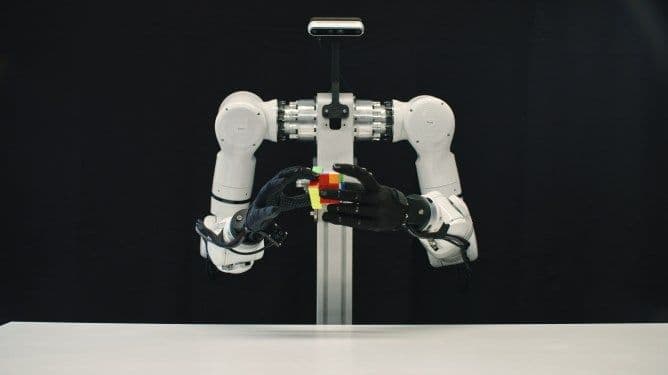
Khosla-backed robotics startup Genesis AI has gone full-stack, demo shows

Genesis AI, a startup that raised a $105 million seed round to build foundational AI for robotics, has unveiled its first model, GENE-26.5, and it comes with surprise hands. In a demo video, the company showcased various advanced tasks performed by a set of robotic hands it has designed in-house. “The model has always been the goal, because a better model means better intelligence,” Genesis cofounder and CEO Zhou Xian told TechCrunch. But the company soon realized that it needed control over the hardware. “So we decided to go full stack,” he said. Other well-funded companies operate at the intersection of AI and robotics — such asPhysical IntelligenceandSkild AI. Zhian also acknowledged that “there’s probably 50 or 100 robotic hand companies out there.” But he and his cofounder Théophile Gervet hope that building their own will give them the upper hand. The key difference is that Genesis’ hand has the same size and shape as a human hand — rather than the two-finger grippers many robotics companies have been using — reducing the gap with real-world conditions. “That lets us collect a lot more data than was previously possible, to train a model that can do many more tasks,” said Gervet, a former research scientist at Mistral AI who is now Genesis’ president. Of all the physical manipulation tasks showcased in the video below, Gervet’s personal favorite is cooking, because it proves that the robot has been able to complete a long series of difficult tasks, such as cracking an egg and slicing a tomato. But Genesis has also tasked its robots with preparing smoothies, playing the piano, and solving Rubik’s cube — a roboticsgimmick. Other tasks, such as lab work, are closer to what could be the commercial applications of Genesis’ technology. But what happens behind the scenes is just as important: the startup has also developed a sensor-loaded glove that works as a real-life double of its robotic hand, collecting data that can more readily be used. “Our idea was that if we could design a robotic hand that tries to mimic a human hand as much as possible, we can instantly unlock huge amounts of human data without having to worry about what people call the ‘embodiment gap’ in robotics research,” Xian said. Others havetried their handat that problem; the main novelty is how Genesis combines this with its model. The current version is named GENE-26.5  for May 2026, but Xian expects there will be many iterations, thanks to the simulation it has developed. “The real bottleneck for the iteration speed of the model is evaluation. So this helps us speed up model training a lot,” he said. Beyond simulation, though, data will be key to training models that can help robots perform more tasks. That’s also where Genesis’ glove could come in handy. Gervet said that, unlike clunky data collection devices that get in the way, it is just as light and easy to wear as the security gloves already used in many industries, while relatively cheap to make. “We’re in talks with a lot of customers right now, and a lot of the value of a glove would be that, for the first time, you can wear the data collection device when you’re doing your daily job, whether it’s a lab technician for pharma or for manufacturing,” Gervet said. This would also be complemented by ‘egocentric video data’ — people filming themselves doing the task. Still, it remains to be seen whether workers would be happy to wear the very gloves and cameras that could train robots to replace them, and whether they will get extra pay for that training. That will be between Genesis’ customers and their employees, Gervet suggested. “We haven’t nailed the details yet,” he said. Either way, they may decide not to share that data with the startup, the founders acknowledged. But the startup also has avenues of its own to build its ‘human skill library’ — it could also pay third-party partners to collect data. Its model is already trained on “massive amounts of human-based internet videos,” according to a press release that didn’t mention compensation. Combined with its simulation system, this could help Genesis lower the costs of its technology for real-world applications like the one it has demonstrated. “This marks an important milestone for their team and the robotics industry more broadly,” said Google’s former CEO, Eric Schmidt, who invested in the startup. In July 2025, just a few months after its creation, the startup had emerged from stealth with a$105 million seed roundco-led by Eclipse and Khosla Ventures, with additional backers including Bpifrance, HSG, and individuals like Schmidt, but also Xavier Niel, Daniela Rus, and Vladlen Koltun. This funding helped Genesis increase its headcount. With offices in Paris and California, it has also expanded to London. “One big reason we decided to be in Europe is there is a huge talent density across the whole continent,” Gervet said. Its team of 60 people is split around “40-45% in Europe and 50-55% in the U.S,” and the startup is currently hiring in all three locations. Aside from hiring, the company also plans to reveal its first general-purpose robot shortly, which Xian told TechCrunch will be a full-body robot, not just hands. But he insisted that the roadmap is still the same. “Our goal is to build the most capable robotic system,” he said.

read more


Latest AI News

View All News →
Google Rolls Out Gemini Thinking Levels Across Platforms With 'Extended' Thinking Mode for All Users

Google Rolls Out Gemini Thinking Levels Across Platforms With 'Extended' Thinking Mode for All Users

Google has started rolling out thinking levels for multiple Gemini AI models across platforms, including the Android and iOS apps, a company executive has announced. The new modes are available to all paid and free users in select global markets, including India. The Gemini app now features up to three thinking levels, depending on the Gemini 3.5 and 3.1 series models. The list of levels also includes a new “Extended Thinking” mode, which lets Gemini take more time before providing an AI-generated answer to users. According to reports, this is expected to improve the quality of responses the Gemini app provides.

1 hour ago

View

Coralogix raises $200M on bet that someone needs to watch the AI agents

Coralogix raises $200M on bet that someone needs to watch the AI agents

Coralogix, a Boston-headquartered software monitoring startup founded in Israel, has raised $200 million in a new funding round, betting that the rise of AI agents will drive demand for a new generation of tools to monitor, troubleshoot, and manage increasingly autonomous software systems. The Series F financing comes just 11 months after Coralogixraised $115 million in a Series E round, a pace that reflects just how quickly investor appetite for AI infrastructure companies has accelerated. The new round values the startup at $1.6 billion post-money and was led by Advent and the Canada Pension Plan Investment Board (CPPIB), with participation from Greenfield Partners and Brighton Park Capital. The company has now raised a total of $550 million to date. The investment comes as software companiesrace to adapt to the rise of AI agents, software systems that can autonomously write code, investigate problems, and complete tasks that would previously have required a human engineer. Coralogix is among a growing number of infrastructure firms betting that as AI systems move into production, demand will rise for tools that can monitor their behavior, troubleshoot failures, and provide the operational data needed to keep them running reliably. (The more autonomous software you deploy, the more you need to know when something goes wrong and why.) Founded in 2014, Coralogix helps companies monitor the health and performance of software systems by collecting and analyzing operational data such as logs, metrics, and traces — essentially a continuous record of what a software system is doing and how it’s behaving. The platform is used by more than 5,000 customers worldwide, including IBM, Tradeweb, and JFrog, to detect outages, investigate incidents, and optimize applications. The observability industry, where Coralogix competes with the likes of Datadog, New Relic, and Splunk, is being reshaped by the rise of AI. Vendors are increasingly embedding AI into monitoring and incident-response workflows as enterprises deploy more AI-powered applications and agents. The shift is already changing how customers interact with Coralogix’s platform, co-founder and CEO Ariel Assaraf (pictured above, right) said in an interview. More than half of the startup’s enterprise customers now use either its AI agent, Olly, or their own AI models through command-line and agentic interfaces to investigate incidents and query operational data, he said. “The interface layer is slowly getting eroded,” Assaraf told TechCrunch, observing that engineers are increasingly interacting with software through AI assistants and command-line tools rather than traditional dashboards. “Most of the usage is going to be around, ‘How do I connect my LLM to this? How do I operate this through my CLI?’” In plain terms, his customers are less interested in logging into a dashboard and more interested in asking an AI assistant what’s wrong. The shift has coincided with strong growth for Coralogix. The startup grew revenue by more than 60% over the past year and now counts about 30 customers spending more than $1 million annually, Assaraf said, as it expands further into the enterprise market. The company surpassed $100 million in annualized revenue more than a year ago, Assaraf added, though he declined to disclose current figures The startup employs more than 600 people globally, with about 100 based in India, home to its third-largest office after the U.S. and Israel. The India operation, Assaraf said, has evolved into a regional hub supporting customers across Asia while helping Coralogix expand into large domestic enterprises, including financial institutions. Coralogix did not raise because it needed additional runway, Assaraf said, adding that the funding would be used to accelerate investment in AI-focused products, security offerings and global expansion. “In the AI era, execution and speed matter more than any point-in-time valuation,” he said. “We wanted to accelerate, expand, and take a further step into this AI game that we believe we’re leading in our space.” Coralogix does not currently expect to raise additional capital and is working toward profitability over the next few years, Assaraf said. The company is also preparing to operate with the financial discipline of a public company, he said, though he stopped short of committing to a timeline for an initial public offering.

1 hour ago

View

Meta’s AI agent for WhatsApp Business is now available globally

Meta’s AI agent for WhatsApp Business is now available globally

For years, WhatsApp has been a communication layer for businesses of all sizes around the world. Meta is now infusing AI into that layer in a bid to turn WhatsApp into a viable piece of workflow software for small and medium businesses. The company on Wednesday said it is making its customer support AI bot, now known as Meta Business Agent, available globally within WhatsApp. The launch comes as Meta has spent nearly two years testing AI agents in WhatsApp Business for customer support in countries like India and Mexico. Meta said the AI agent can answer customer questions, recommend products, book appointments, qualify sales leads, and reroute queries to a person if needed. The company is also making the bot available within Instagram DMs. Meta said it is testing a way for the Business Agent to provide daily briefings of chats that occurred overnight, and provide insights. The company is testing this feature with select accounts on WhatsApp Business, Instagram Pro, Messenger and Meta Business Suite. The company said it’s working to add capabilities like doing market research, highlighting product features, managing users’ calendars, and connecting with tools to extract competitive insights. Meta said it’s also working to enable the Agent to surface businesses when you search for one or share contact details in chat. And, it is building a platform to let larger enterprises create custom agents that can connect to systems like Shopify, Zendesk and Shopee. Meta is planing to charge businesses for using this AI agent by including it in some tiers of its WhatsApp Business Premium subscription. The company noted that large businesses will pay for the agent based on how many tokens they use. This is critical for WhatsApp, which has relied on businesses paying for messaging and click-to-WhatsApp ads.

1 hour ago

View

Neo4j to Launch ‘Alternative to Palantir Gotham’ By Acquiring Graph Aware

Neo4j to Launch ‘Alternative to Palantir Gotham’ By Acquiring Graph Aware

The graph database company plans to combine GraphAware’s intelligence analysis software with its own graph platform to target government, defence and law-enforcement customers seeking sovereign AI deployments.

1 hour ago

View