AI NewsI tried Amazon’s Bee wearable and am both intrigued and slightly creeped out
I tried Amazon’s Bee wearable and am both intrigued and slightly creeped out
4:31 AM IST · May 25, 2026
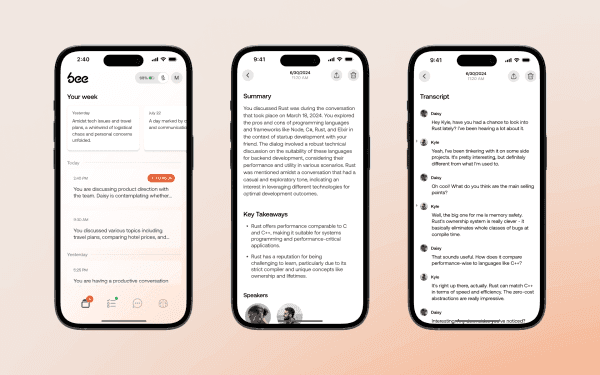
I recently had the opportunity to test out a wearable fromBee, the AI wrist gadget that Amazonacquiredlast year and has sinceupdatedwith a number of new features. Like other AI wearables, Bee is designed as a kind personal assistant: it records, transcribes, and summarizes the user’s conversations throughout the day, providing an ongoing note-taking capability that’s useful if you’re forgetful or just want to be more organized about your life. If you sync it with your calendar, it can also send you alerts and reminders about things you’re supposed to do throughout the day. TechCrunch haswritten about Beebefore, and the way it works is pretty simple: the user powers it up, puts it on, syncs it with the Bee mobile app, and enters some basic personal information. Bee has a built-in recorder that can be turned on and off by clicking the wearable’s button. When Bee is recording, a green light flashes. When it’s not, that green light goes off. After a conversation has been recorded, the app will create an automated summary that is easy to read, as well as an entire transcription of the conversation. Your mileage may vary on how exciting (or not) this whole conceit is. The problem for me is that I am something of a privacy enthusiast. In a world where the average person is beset from all sides by constant digital surveillance, I appreciate any opportunity I can get to not be recorded. Therefore, the idea of walking around with an eavesdropping gizmo strapped to my wrist 24/7 was not particularly appealing. Yet, even I have to admit that — in the right context — Bee could have a lot of potential to help organize your life. Bee really comes through in the context of professional engagements. If your day is full of meetings and you have trouble keeping it all straight, Bee could be a moderately competent assistant. During a business-related phone call this week, I activated Bee after getting confirmation that I could record our meeting. Afterward, the app faithfully regurgitated a summary of the conversation, helpfully breaking down each segment of our talk so that I could review it later without having to re-listen to our entire conversation. This was undeniably helpful, although it should be noted that this isn’t something that’s markedly different than those offered by other transcription services,like OtterorGranolaand others, which also offer transcriptions and auto-generated summaries. That said, you could envision a situation in which a professional who has to navigate between various meetings throughout the day would be well-served by this device. You could just keep Bee running throughout the day and, later, review the conversation summaries for anything you’re not clear about. Bee does a relatively good job at summarizing conversations, but the actual transcripts offered by the wearable can be a bit of a mess. Previous critics have noted that you usually have to manually enter the names of other speakers, as Bee doesn’t always know who is talking. During my conversation, I noticed that it had also omitted certain sections of our chat — nothing huge, but it wasn’t a complete account of everything that had been said. I also took Bee to my semi-weekly movie night with my friends and left it running throughout the night. Given the fact that we watchedReservoir Dogs, I was mildly afraid that the wearable would mistake all of the vulgar carnage for real-life bloodshed and potentially trigger some sort of internal alarm. However, Bee knew — basically — what was happening. The wearable figured out that we were watching a movie and, in the summary of events afterward, the wearable labeled the conversation “Tarantino Film Scene Analysis.” While Bee shows early promise as a professional tool, I would not want this thing recording me in my personal life. Weirdly enough, Bee has largely been marketed as a product for personal use. To be comfortable with that, you have to be comfortable with Bee having access to a majority of both your offline and digital life. Indeed, to work well, Bee needs expansive mobile permissions — including access to your location, photos, phone contacts, calendar, and mobile notifications. You can also share your health data with it — should you, for whatever reason, want it to know about your sleep patterns or your resting heart rate. The large accumulation of data Bee collects is stored in the cloud, which — again, for the digital privacy enthusiast — presents its own concerns. In a message to tech YouTuber Becca Farsace, Bee apparentlyunveiled a demoof the device running entirely locally. Were the company able to produce such a device, I would be thoroughly impressed — and might even consider buying one. That said, Amazon hasn’t offered any update on those plans. As for Bee’sdigital privacy protections, the company says that it offers encryption to protect user data — both at rest and in-transit. In its privacy policy, the company states that it has “implemented technical and organizational security measures designed to protect the security of any personal information” that the company processes. Bee also claims that it undergoes “rigorous third-party security audits” and employs continuous security monitoring. That all sounds quite good, although it’s worth noting that Amazon — like many large tech companies — has been subject to the occasionaldata security issue or two(not exactly surprising for a company that governs as much of the global cloud environment as it does, but still). In short, Bee is a curious piece of hardware that, given some time and some tweaking, could have some promising professional applications further down the road. As a digital assistant for your personal life, however, it might prove to be a little too invasive for some users.
read more