AI Styling Studio — Infinite avatar looks from just 1 photo.Try it now.

BestAITools

Submit your Tool

8000+ AI tools already listed
8K+Tools
100K+/moViews
25K+/moVisitors

AI NewsGoogle’s Dreambeans, its weirdest-named AI tool to date, will turn your life into a cartoon

Google’s Dreambeans, its weirdest-named AI tool to date, will turn your life into a cartoon

3:19 AM IST · June 4, 2026

Google’s Dreambeans, its weirdest-named AI tool to date, will turn your life into a cartoon

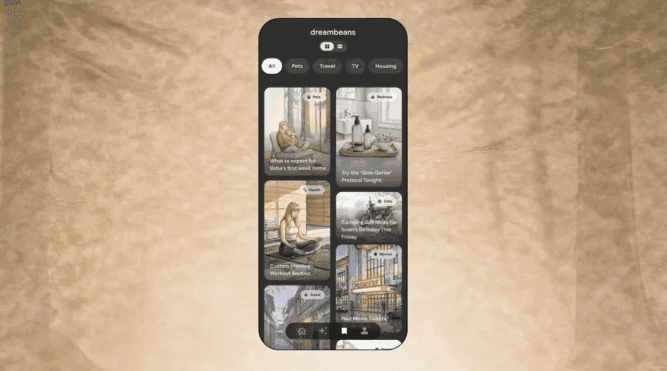
Google Labs, the tech giant’s team devoted to experimental product design, has launched a new AI-fueled app for iOS and Android that will quite literally animate your life. Behold,Dreambeans. Why is it called that? We’ll get to that later. First, what is it? Gozde Oznur, the product lead behind the new app, told TechCrunch that the idea is to use data culled from across your various Google services to generate a curated list of AI-illustrated “stories.” These stories come in a variety of different shapes and forms, although — in general — they seem to be lifestyle suggestions. Oznur describes them as “places to visit, topics to explore, things to try, upcoming trips, events that you should be aware of.” Dreambeans generates these ideas based on a user’s Google data. “With your permission, Dreambeans uses Personal Intelligence to connect information from Google apps like Gmail, Calendar, Photos, YouTube and Search History, to curate a finite collection of daily stories designed to spark new ideas,” the company says. So for instance, some stories may be geographical recommendations — like suggesting a new coffee shop near where the user lives that they might be interested in. Or, as is the case in thismarketing video, if you’re getting a new dog and that event has been marked in your Google Calendar, Dreambeans might deliver some insights about what it’s like to live with a new puppy. Still other stories may simply be news articles curated from the web, based on a user’s past interests. Oznur said the app has also been built as a doomscrolling antidote, in that it only provides users with a limited number of stories per day — typically 10 to 14. The idea is to get a few inspirational ideas and then go out and live your life, she said. A lot of companies are currently trying to court the user that is sick of phone addiction. I recentlyreviewed a startup, Bond,which also uses AI to auto-generate lifestyle suggestions for the user. What about privacy protections? According to Oznur, they are pretty solid. The only person with access to the app’s stories is the user, she said. Users can also delete their data whenever they want, and can choose which Google services they want to connect to the tool. Finally, where did the name “Dreambeans” come from? The idea for the name was generated, in part, by the way the system works while you are asleep, she said. “The dream part is literal, because while you sleep, the app is working through everything across your connected apps, because, as you can imagine, it’s a lot of data that it is distilling,” Oznur said. “The beans part is about how you kind of start your day with a freshly brewed cup of coffee. It has processed everything overnight and hands you a concentrated drop of inspiration in the morning.” Dreambeans is currently only available for eligible U.S.-based Google AI Ultra subscribers on Android and iOS. However, there is also awaitlistthat is available to users with a personal Google account.

read more


Latest AI News

View All News →
SpaceX Acquires Cursor, the AI Coding Startup Competing With Claude Code and OpenAI Codex

SpaceX Acquires Cursor, the AI Coding Startup Competing With Claude Code and OpenAI Codex

SpaceX has acquired AI coding startup Cursor in a $60 billion (roughly Rs. 5,66,500 crore) all-stock deal, bringing a prominent competitor to Anthropic's Claude Code and OpenAI's Codex under its growing artificial intelligence business. The acquisition follows months of collaboration between the two companies on AI model training and infrastructure, and comes days after SpaceX's public market debut. The deal also marks the latest step in SpaceX's efforts to expand its presence in the AI sector by combining software development capabilities with large-scale computing resources.

2 hours ago

View

Enterprise AI’s Real Problem Isn’t the Technology, It’s the Execution

Enterprise AI’s Real Problem Isn’t the Technology, It’s the Execution

Enterprise AI’s real frontier isn’t more workflows, it’s execution. With 78% of organisations stuck in pilot mode and only 14% reaching production scale, the gap between AI ambition and operational reality is 2026’s defining leadership challenge.

2 hours ago

View

Madhya Pradesh Explores AI-Driven Governance Solutions With Gnani.ai

Madhya Pradesh Explores AI-Driven Governance Solutions With Gnani.ai

The discussions focused on how emerging technologies can help improve accessibility, efficiency, and responsiveness in public service delivery

2 hours ago

View

Anthropic’s latest feud with the Trump admin may actually help it, sales data suggests

Anthropic’s latest feud with the Trump admin may actually help it, sales data suggests

Anthropic is having a month. The AI lab finished May by surpassing OpenAI in market share of business spending for the first time, Ramp justrevealed. It raised $65 billion at a $965 billion valuation (also besting OpenAI) at the end of May, then waltzed into June by filingconfidential paperwork for an IPO, reportedly on the strength of itsfirst-ever profitable quarter. Then on Friday, the Trump administration renewed its war on the model maker by sending a letter demanding it ban non-Americans, including Anthropic’s employees, from accessing its state-of-the-art models: the limited-release Mythos 5 and the more guarded version of Mythosreleased to the public three days earlier, called Fable 5. This essentially forced Anthropic to pull its latest all-powerful model from the market altogether. Although the White House invoked an obscure export control directive when ordering the ban, the exact cause remains unclear. Thechatter was that hackers easily bypassed Fable 5’s guardrails, which were intended to prevent access to Mythos’ capabilities. That model is so good at finding security flaws in software code that Anthropic itself marketed it as dangerousand restricted its public release. This new drama comes after Anthropic famously refused to allow the government to use its models for mass surveillance of Americans and fully autonomous weapons. As a result, in March, the Trump administration declared the companya supply-chain risk. That didn’t deter Anthropic’s sales to businesses. Quite the opposite, Ramp’s data shows. Ironically, this latest feud with the Trump administration, which also appears to validate the hubbub over Mythos’ mythological power, may help rather than hurt Anthropic, according to Ramp’s lead economist, Ara Kharazian. Kharazian is the person who compiled the business-spending AI data. “If anything, it’ll probably boost them,” Kharazian told TechCrunch. “Anthropic’s best month on record, as far as business adoption, was the month that the Department of Defense labeled them a supply-chain risk. There’s a lot of aura that comes with your model specifically being named too dangerous to use.” Ramp’s data isn’t granular enough for us to see how much of a financial hit the company will take by pulling Mythos and Fable 5 off the market. Still the data, from more than 70,000 businesses that use its platform, shows that customers heavily use Anthropic’s Opus models and that business use has been growing. For instance, Ramp reported that Anthropic’s share of AI subscriptions paid for by businesses rose 2.5 percentage points in May to 41%. This compares to OpenAI, which commanded 39.5% of AI subscriptions by its customers, essentially flat from the prior month. (OpenAI still greatly leads Anthropic in overall consumer usage, according tonew data from Sensor Tower.) Beyond subscriptions, the vast majority of what companies spend money on is API calls to the model, which cover token use for activities like coding. Anthropic’s Claude Code has a strong reputation as a powerful AI coding tool. Ramp can’t always see from the spending data which models most businesses are using. When it can see the model details — in about one-third of transactions — businesses are mostly spending on various flavors of Claude Opus, particularly the later versions. Opus is the model that preceded Mythos and is still openly available. In fact, in late May, Anthropicreleased a new version, Opus 4.8. Mythos had not been on the market for that long, having been released to limited users as of April. And Fable 5 was shut down after a few days. While we can’t predict how this latest drama with the White House will impact Anthropic’s ability to go public as it hoped to (public-market investors tend to be wary of companies embroiled in controversies with the government), the numbers indicate that Anthropic’s available models are more popular with businesses than ever before.

6 hours ago

View