AI Styling Studio — Infinite avatar looks from just 1 photo.Try it now.

BestAITools

Submit your Tool

8000+ AI tools already listed
8K+Tools
100K+/moViews
25K+/moVisitors

AI NewsDuckDuckGo makes its ‘no-AI’ search engine easier to access as its traffic booms

DuckDuckGo makes its ‘no-AI’ search engine easier to access as its traffic booms

11:14 PM IST · June 1, 2026

DuckDuckGo makes its ‘no-AI’ search engine easier to access as its traffic booms

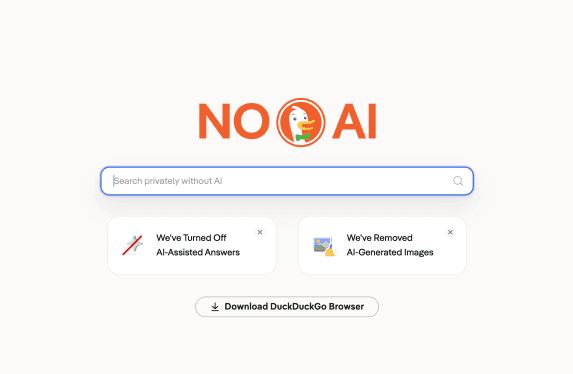
As its traffic continues to climb, alternative search engineDuckDuckGois leaning into anti-AI sentiment with the launch of new browser extensions that allow users to set its no-AI search experience,noai.duckduckgo.com, as their default search engine. Once enabled, users will be directed to DuckDuckGo’s AI-free search page, where there are no AI-assisted answers, no chat prompts, and fewer AI images in the search results, the company claims. The extensions are currently available forChromeandFirefoxusers. Meanwhile, people who have switched to the DuckDuckGo web browser already have their AI settings preserved, even if they clear their browser history. The company says the extensions are meant to help people have a consistent AI-free search experience — something that’s harder to come by these days, especially after Googleannouncedits AI-first revamp of its search engine at its developer conference earlier in May. Since then, traffic to DuckDuckGohas been booming. Last week, the company noted that web visits to its no-AI search page were up nearly 30% week-over-week, and its U.S. app installs were also up 18.1% week-over-week, with U.S. iOS app installs peaking at 69.9% week-over-week growth. Those trends followed news that Google wasoverhaulingits search box in the biggest change to its search engine in more than 25 years. Now, instead of returning links at the top of the page, Google will favor sending users into AI-generated search overviews, which are becoming more interactive experiences capable of creating visualizations, charts, graphs, or even mini apps, as needed. Follow-up questions from AI Overviews will push users into an AI Mode chat experience. The traditional “10 blue links” that defined Google in its earlier days are more of an afterthought, appearing below all this AI-fueled productivity. But not everyone is on board with having AI made the default, which is why some are making the move toalternative search engines like DuckDuckGo, Kagi, and others. DuckDuckGo says traffic to itsno-AI search pagewas up threefold on Thursday, May 28, 2026 — a new high-water mark since Google’s search announcement — and the numbers are still climbing. The growth is not coming in spurts either, the company points out. Instead, visits are averaging roughly 84% above the baseline, suggesting a more sustained shift. In addition to the new “no AI” search Chrome and Firefox extensions, DuckDuckGo will soon update its original DuckDuckGo Privacy Essentials extensions for Chrome, Firefox, Edge, and Opera to offer controls for AI search settings, as well. It’s worth noting that DuckDuckGo isn’t an anti-AI company. The company still offers its own AI chatbot with access to many popular models,and a subscription planthat provides access to the latest models and other tools, like a VPN service, identity theft restoration, and personal information removal services.

read more

Latest AI News

View All News →
Alphabet plans to raise $80B to pay for AI buildout

Alphabet plans to raise $80B to pay for AI buildout

Google parent company Alphabet said Monday that it plans to raise $80 billion to help pay for the massive AI infrastructure buildout it has planned. Alphabet will sell off that amount in stock and will then use the funds to pay for “general corporate purposes, including capital expenditures to scale AI infrastructure and global compute,” the company saidin a statement. Part of the plan involves selling $10 billion in stock to Berkshire Hathaway, the massive global holding company formerly led by Warren Buffett. “The company is experiencing strong demand for its AI solutions and services from enterprises and consumers, at levels that are exceeding the company’s available supply,” Alphabet said in its statement. “By scaling its investments, the company seeks to expand its foundational infrastructure to support the significant growth opportunity ahead.” The company added that the stock plan represented a way to “fund its investments in a balanced way while retaining a healthy balance sheet.” Like other tech giants, Google has announced plans for a massive investment in compute this year, the likes of which will be used to support a flurry ofnew AI services. At Google I/O last month, CEO Sundar Pichaisaid thatthe company expects to spend between $180 billion and $190 billion on capex before the year is out. Google and other tech giants areexpected to spendas much as $700 billion this year on AI capex.

45 minutes ago

View

Water access is now a risk factor in SpaceX’s IPO

Water access is now a risk factor in SpaceX’s IPO

SpaceX has added new language to its IPO filing that warns prospective investors about the company’s access to a potentially scarce resource: water. The company, which now includes Elon Musk’s AI play, xAI, wrote in anamended version of the filingon Monday that access to water — required to cool its data centers — is just as important as SpaceX’s ability to secure power, processors, and other critical resources. The addition comes amid an ever-evolving debate about how much water data centers use, and whether that usage is contributing to localized droughts that are being made worse by climate change. Deep in the “risk factors” section of SpaceX’s IPO filing, the company added language about water to a section about the challenges of scaling AI infrastructure. Previously, SpaceX focused on telling investors that its data centers were primarily constrained by access to “power at economically feasible prices,” along with long construction timelines and material shortages. The amended filing adds multiple lines about water access. SpaceX now tells prospective investors in the IPO that data center buildouts are constrained by the “availability of power and water at economically feasible prices.” The company goes on to say that “significant water resources may be required for cooling large-scale data center operations.” Water availability is such a concern that SpaceX says it has become a “critical consideration in data center site selection, development and operations.” SpaceX also says that “water scarcity, drought conditions, competition for local water resources, or regulatory restrictions on water use could limit our ability to obtain sufficient water for cooling, constrain data center cooling capacity, increase our costs, delay or limit expansion of our data center infrastructure, or require us to implement alternative cooling techniques that may be more costly or less available.” It’s not clear what inspired SpaceX to add this language about water to its filing, or why it was left out of the initial version. The company is in the pre-IPO period, during which the Securities and Exchange Commission (SEC) has been sending SpaceX “comment letters”seeking clarification or additional details about the filing. It’s possible that questions from the SEC led to this particular change, though we won’t know until those comment letters are made public in the weeks following the IPO. Adding more detail about SpaceX’s access to water was not the only change the company made in this first amended filing. SpaceX also revealed that it is setting aside up to 5% of the stock being sold in the IPO foremployees and friends of executives. SpaceX also added language that warns investors that the company mayissue a “significant” numberof shares in future transactions following the IPO — a hint at a potential merger with Tesla — which could create dilution for existing shareholders.

4 hours ago

View

Florida sues OpenAI, Sam Altman, in first-of-its-kind lawsuit over violent incidents

Florida sues OpenAI, Sam Altman, in first-of-its-kind lawsuit over violent incidents

OpenAI and its CEO, Sam Altman, were sued by the Florida Attorney General on Monday, in a first-of-its-kind state litigation effort over ChatGPT’s alleged links to a number of violent incidents. The lawsuit accuses OpenAI of looking the other way on safety concerns as it has sought to prioritize winning “the AI arms race and amass large fortunes.” “Today, we announced the first-in-the-nation state-led lawsuit against OpenAI and its CEO, Sam Altman,” said Florida Attorney General James Uthmeier. “OpenAI and Altman ignored internal and external safety warnings, put children at great risk, and allowed a dangerous product to reach millions of Floridians.” “Because of Defendants’ misrepresentations about ChatGPT and their careless introduction of ChatGPT to Florida and the world, mass shooters have been aided and abetted in deadly rampages, vulnerable people have been encouraged into suicide, professionals have suffered public humiliation, users have lost critical thinking skills, and minors have become addicted to a tool that feigns human compassion to collect their data with no parental oversight,” the83-page lawsuitclaims. The Florida Attorney General’s office launcheda criminal investigationinto the company in April. That probe sought to determine what role ChatGPT may have played in a mass shooting that took place last year at Florida State University. Prior to the attack, the shooter is alleged to have consulted the chatbot. OpenAI has also beensued in a civil suitby the family of one of the victims of that shooting. OpenAI has previously denied responsibility for the Florida shooting. “Last year’s mass shooting at Florida State University was a tragedy, but ChatGPT is not responsible for this terrible crime,” an OpenAI spokespersonpreviously told NBC News. TechCrunch reached out to OpenAI for comment. OpenAI justconcluded a different legal caseinvolving former co-founder Elon Musk, who sued the company in 2024, accusing it of having betrayed its original mission to help humanity by converting the organization into a for-profit business. The case concluded after the jury swiftly decided that Musk had waited to long to file the case and that thestatute of limitations had passed. This is only the latest legal case that has attempted to link ChatGPT to violent deaths. Last year, OpenAIwas suedby the parents of Adam Raine, a California teen who took his own life after discussing suicide with the chatbot. In that case, ChatGPT allegedly offered “technical specifications” for various suicide methods, despite also referring him to mental health resources. Other lawsuits — including ones alleging the chatbot’sculpability in suicides,stalking, andmurder— are ongoing.

4 hours ago

View

Nvidia chases $200B CPU market with AI agent PCs from Microsoft, Dell, and HP

Nvidia chases $200B CPU market with AI agent PCs from Microsoft, Dell, and HP

Nvidia opened Taipei’s enormous Computex trade show on Sunday with a spark, literally. The chipmaker unveiled a new PC CPU called the RTX Spark, which it dubbed a “superchip,” and named a who’s who list of PC makers that will soon deliver AI PCs powered by it. The super-fast, 1-petaflop chip is designed to run AI agents like OpenClaw or Hermes Agent securely, according to Nvidia. Such RTX Spark Windows PCs will be available this fall from ASUS, Dell, HP, Lenovo, Microsoft Surface and MSI, with models from Acer and Gigabyte to follow. In addition to being equipped with secure sandboxes (jointly developed with Microsoft) to run agents securely, the PCs will also have enough CPU, GPU, RAM and underlying Nvidia CUDA software to run local versions of large language models. Nvidia said that its RTX technology will deliver faster performance for AI, better image quality, and support for AI features in more than 1,000 games and applications. The chipmaker is marketing this as an alternative for creators making AI content, as well as providing a significant upgrade to its traditional market of gamers. Nvidia said more than 100 Windows software makers have signed on to support the new chip, including Adobe, Blender, ComfyUI, Riot Games and Xbox. But Nvidia founder and CEO Jensen Huang’s vision for these new PCs is far larger. He wants to end the days of launching apps, pointing, clicking and typing. “With RTX Spark and Microsoft Windows, you ask — and the PC does the work,” he said in the press release. “Frontier models. Creative workflows. RTX games. All on a laptop.” Last month, after delivering another record quarter, Huang promised investors he had found a new$200 billion market for Nvidia in selling CPUsfor AI, not just GPUs. He made specific mention of the high-end server CPU released earlier this year called Vera — of which Nvidia says it has already sold $20 billion worth. He also hinted at his bigger ambitions. “We’ll have billions of agents, and those billions of agents will all use tools. And those tools are going to be like PCs, just like us humans using using PCs today,” he said on the earnings call in May. “We’re going to need a lot more CPUs.” Nvidia ARM-based Windows devices have been tried before — and failed. Back in 2013,Microsoft famously had to write off $900 millionon its Nvidia ARM-based Surface RT, with partners like Dell also bailing on the product. But at this point, after delivering record after record of quarterly revenue, it’s hard to bet against Huang as he pursues his PC dreams once again. And this chip is an entirely different beast. It’s more powerful, not less. Microsoft is positioning its own RTX Spark PC as so mighty that it named it the Surface Laptop Ultra, and iscalling it“the most powerful Surface Laptop ever built.” Still, PC manufacturers have not released a lot of specifics about each of their offerings, including pricing. These systems appear to be full-fledged Windows versions of theDGX Spark mini-computerthat Nvidia already sells to developers for about $4,800. We’ll have to wait and see if these PCs will compete on price with the affordable Mac Mini that has becomea popular choice for running OpenClaw. Or perhaps they will sit at the high end of the PC market, like Nvidia’s own agent-running mini computer. Either way, if Nvidia has cracked the code on bringing AI agents easily, safely, and usefully to the masses, it could — and should — be big.

4 hours ago

View