AI Styling Studio — Infinite avatar looks from just 1 photo.Try it now.

BestAITools

Submit your Tool

8000+ AI tools already listed
8K+Tools
100K+/moViews
25K+/moVisitors

AI NewsCopilotKit raises $27M to help devs deploy app-native AI agents

CopilotKit raises $27M to help devs deploy app-native AI agents

10:28 PM IST · May 5, 2026
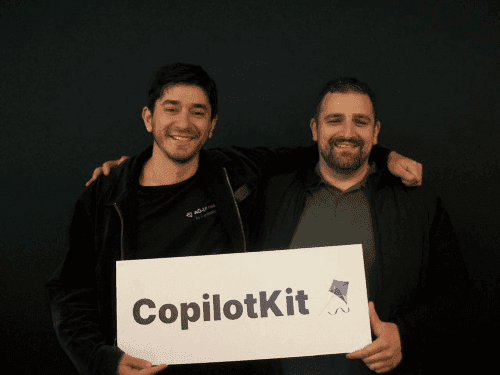
CopilotKit raises $27M to help devs deploy app-native AI agents

Many companies today provide AI simply as a chatbot inside their apps: You type in (or dictate) what you want it to do, and the AI bot goes and tries to do it. Still, the experience tends to feel clunky. A text-based UI doesn’t always translate to a smooth experience; for example, if you want to use a travel app to book an entire itinerary but have to scan through reams of text. According to the founders ofCopilotKit, that approach doesn’t make the most of what AI agents and LLMs can do. The company’s co-founders, Atai Barkai (pictured above, right) and Uli Barkai (pictured above, left), believe the way forward is to enable agents to live inside applications, understand what users are doing, take actions, and show useful interfaces instead of just returning long blocks of text. The company’s popularAG-UIprotocol is aimed at the first part of that solution. The widely adopted, open source protocol standardizes how AI agents connect to and communicate with user interfaces (like a web browser or an app), providing features such as streaming chat, front-end tool calls, and state sharing to enable human-in-the-loop functionality. Essentially, AG-UI gives devs the framework and tools needed to deploy AI agents within their apps. CopilotKit is also building an enterprise toolkit on top of AG-UI, adding support, self-hosted deployment features, and other must-have offerings for businesses thinking of building agents into their product. To bring that toolkit to market, the Seattle-based startup has raised $27 million in a Series A round led by Glilot Capital, NFX, and SignalFire, TechCrunch has exclusively learned. The flexible user interface is a particular selling point. CEO Atai Barkai told TechCrunch developers can use the startup’s framework to provide the specifications and building blocks for dynamic user interfaces, which an AI agent can then use to generate UIs to fit the context. “The agent can reply to you, not just with blocks of text, but with interactive UIs that are defined by your own company,” Atai explained. “If, for example, a user asks for breakdown of revenue by category, instead of getting this kind of big, impenetrable paragraph, you get a pie chart, and it’s your own design of the pie chart that the user can interact with […] So all of your agents can, very trivially, speak to a UI and use these catalog of components and show that to users.” Atai also noted that CopilotKit’s toolkit gives developers full control over how much their AI agent can change the UI, to the point where they can choose to have the interface be “pixel-perfect” or just provide broad building blocks that the AI can put together as required. The funding follows a period of strong adoption both for AG-UI and CopilotKit. The protocol, which works alongside the widely adoptedModel Context Protocol (MCP)andAgent2Agent (A2A) protocol, is today supported by major AI infrastructure providers likeGoogle,Microsoft,Amazon, andOracle, as well as popular frameworks likeLangChain,Mastra,PydanticAI, andAgno. Atai said CopilotKit and AG-UI (the company’s strongest claim to ecosystem relevance) see millions of installs per week, and that a large portion of Fortune 500 companies are using the protocol and the startup’s tools in production. Meanwhile, CopilotKit counts enterprise bigwigs like Deutsche Telekom, Docusign, Cisco, and S&P Global as enterprise customers. To tap that growing interest, the company is also launching CopilotKit Enterprise Intelligence, a self-hostable offering that bundles a number of infrastructure features to fully deploy agents within apps. CopilotKit faces heated competition in the market for enterprise agents tools. Cloud platform Vercel’s open sourceAI SDKhelps developers build AI applications with similar capabilities, andassistant-uioffers components for building AI chat interfaces. Meanwhile, OpenAI’s Apps SDK is also an option for building richer interfaces, though only inside ChatGPT. Atai argues that CopilotKit is different from those offerings because it takes a horizontal, enterprise-friendly approach rather than a vertically integrated one. Instead of offering a full-stack AI platform, CopilotKit aims to support whatever agent framework, cloud provider, or back end an enterprise already uses. “If there are two things we hear in almost every single enterprise conversation, enterprises want optionality and they want self-hosting,” he said. “Maybe they’re already using the Google, Amazon, Oracle, Microsoft, LangChain, Mastra stacks. They want optionality, and they want self-hosting, and these are two things that they don’t really get in the Vercel stack.” That open positioning will be important to maintain. Companies that build on top of their own open source infrastructure often face a tension, which is that they want their technology to stay a neutral standard, but they also need to build a business on top of it. But Atai said that AG-UI is a fully open protocol, and that CopilotKit’s commercial product is meant to harden the open source stack for enterprises, not replace it. “They’re very much complementary. Our strategy is to be the default choice in the ecosystem, and then to monetize the top enterprises,” Uli, the startup’s head of growth, added. “So it’s very much in our interest that the open source is the best out there, and the 95% of users can just go build and get started without paying anyone or talking to anyone.” The company currently has about 25 employees and plans to use the new funding to grow its team.

read more


Latest AI News

View All News →
Publishers will be able to opt out of AI Search, thanks to new regulation

Publishers will be able to opt out of AI Search, thanks to new regulation

The U.K. has just imposed legal guardrails on Google’s AI search onslaught. On Wednesday, Googleannouncedcompliance with the U.K.’s regulatory requirements, which state that the tech giant must offer publishers a way to opt out of being aggregated into AI search. To opt out, publishers will be able to use a new toggle in Google’sSearch Console, a free service that allows website owners to manage their web presence in Google’s search results. Once opted out, the publisher’s site will not be shown in Google’s generative AI Search features, like AI Overviews, AI Mode, or AI Overviews in Discover. (Google, of course, makes a point to note in the same announcement that its AI Overviews now have over 2.5 billion monthly active users, and its AI Mode has surpassed one billion monthly users.) The tech giant says it will initially test the opt-out option with a subset of U.K. publishers before rolling it out globally. The U.K.’s Competition and Markets Authority (CMA)calls the moveto put publishers back in control of how their content is used a “world first,” and points out that it will put publishers, including news organizations, into a stronger position to negotiate content deals with Google for use of their content in AI features. The CMA had first designated Google as having “strategic market status” last October, laying the groundwork for future regulations. InJanuary, it pushed Google to give website publishers a choice as to whether their content is aggregated into AI search features or used to train stand-alone AI models. Alongside the opt-out toggle, Google will also now be required to make sure publisher content in AI features is properly attributed, using clear links. Google suggested that it’s complying with this as well, noting that it had recentlyincreasedthe number of inline links directly within its AI responses, and added website previews to encourage users to click through. Google notes that a website’s decision to opt out of generative AI search features will not be used as a ranking signal for traditional Google search. The company, however, will present new metrics in its Search Console to hopefully sway publishers who could be considering opting out, including impression metrics and other information about which of their pages appear in AI responses, and in which countries. More metrics will be added over time, Google said.

33 minutes ago

View

These two founders left Goldman and Meta to build voice AI for markets everyone else overlooked

These two founders left Goldman and Meta to build voice AI for markets everyone else overlooked

Customer support and service are among the hottest sectors in voice AI right now. But building a product that sounds human and responds without noticeable delay turns out to be much harder in some markets than others — and most of the major players weren’t built with Africa and the Middle East in mind. AethexAI, a startup founded last year to close that gap, has raised $3 million in pre-seed funding led by 4DX Ventures, with participation from Enza Capital, Dorm Room Fund, Mojo Ventures, and Stanford GSB 26 Fund. Individual investors include Stanford faculty, telecom executives, and AI researchers from Anthropic. Rather than using existing orchestration tools likeVapiandLiveKit, the company built its own small model and orchestration layer from scratch to handle the localized dialects of English, French, and Arabic spoken across its target markets — a decision driven, as we’ll get to, by the particular demands of operating in the region. The company is also launching its platform for enterprises to try out its tech and sign up for its services, along with APIs and SDKs for developers to experiment with its models. The startup was founded by Mariama Diallo and Ayooluwa Odemuyiwa. CEO Diallo worked at Goldman Sachs and later joined YC-backed ModelML as a product and growth hire. CTO Odemuyiwa graduated from Caltech, worked at Meta, and enrolled at Stanford Business School before co-founding the company. The pair wanted to build something for emerging markets and started looking for opportunities. Businesses around the world are racing to adopt AI tools to automate parts of their operations. But that doesn’t always work out. In Egypt, a call center automated a significant share of its calls, but rolled the system back because of poor results, the founders found. Several support centers in Africa told them that finding and hiring engineers to automate calls at the right cost was a persistent headache. “The latency and jitter that we saw on automated calls in this region were outrageous. If we had become orchestrators, we might have had to use large models that were hosted outside the region, resulting in higher latency. We realized that in order for this to work, we have to use very small models and cut latency at every step,” Odemuyiwa told TechCrunch about the decision to build the company’s own models and orchestration layer. AI labs that deploy their latest models usually spend millions training them and acquiring data. AethexAI found a solution for both. Rather than chasing the largest possible models, it decided that small models are enough to tackle the latency problem while maintaining accuracy and developed its own Kora series, with parameters ranging from 300 million to 1.7 billion. That’s a fraction of the size of the LLMs, which is precisely the point. To train these models, the startup used anonymized recordings from a call center partner. It also shipped hard drives to radio stations across Africa to collect more audio data. To keep costs down, it built a contributor network of university students to annotate data and pronounce local names. As a result, the startup says, it’s now handling more than 17,000 calls per day. On the business side, the company is taking care to walk clients who are new to voice AI through the process, offering onsite demos and workshops to help them identify the best use cases for automation. “We always tell customers that we cannot be everything for everybody right now. We’re small. When we start talking to a company, we ask them to pick one use case that is the most important to them to start [with],” Diallo said. The startup is open to working across all industries, but at the moment, a big part of its use cases involves calls for debt collection, customer activation, or KYC — Know Your Customer verification, the standard identity-checking process used by banks and telecoms. The company is hiring forward-deployed engineers on a contract basis to serve local markets and building channel partnerships with telecoms providers to handle telephony for voice AI calls. Plug-and-play solutions, it says, simply won’t work here. Walter Baddoo, co-founder and managing partner of 4DX Ventures, argues that the Africa and Middle East market is fundamentally different from the markets most voice AI companies were built to serve. “Enterprises in Africa and the Middle East process roughly three times the call volume of their Western counterparts, as voice is still the dominant channel for customer interaction,” he said. “Incumbent systems were built for Western markets characterized by high-end GPU infrastructure, standard English and European speech environments, and enterprise workflows common in the U.S. and Europe. That creates real gaps when enterprises need systems that handle dialects, code-switching, and informal speech patterns, and that work within their existing telephony infrastructure and their actual price points.” Put another way, while companies like ElevenLabs, Deepgram, Sierra, and Cognigy are expanding globally at a fast pace, the markets they were built for and the markets they are entering aren’t always the same thing. Startups like AethexAI are betting that the gaps — models specialized in local dialects, on-the-ground partnerships, infrastructure built for the region — represent a market opening that the giants have neither the incentive nor the architecture to close.

33 minutes ago

View

Amazon will show AI product images when you search for some reason

Amazon will show AI product images when you search for some reason

In what may be one of the more questionable uses of AI to date, Amazon announced on Wednesday that it will display AI-generated images of products within its shopping app based on users’ search queries. That’s right — a retailer where people shop for real-world products thinks that displaying fake photos will “help” consumers better find what they’re looking for. Enough already. Here’s how Amazonsays in a blog postthat the feature will work. Customers may have something in mind but don’t know the right term to describe it in a way that returns useful results. (The examples Amazon gives are things like “cowl neck” for a style of shirts or “rattan” for furniture.) When someone enters a search query, they’ll be shown a variety of AI-generated product images below their autocomplete suggestions. (See above photo.) For instance, if you search for a blue gingham dress, you might see a few dress styles — short or long sleeves, varying lengths, and other differences — appear as visual options. The idea is that clicking one would direct you to search results that better match that style, powered by Amazon’s visual search capabilities. In reality, it’s somewhat bananas for a retailer to make up fake products as a way of guiding users to search results. For starters, it’s potentially misleading — customers who don’t read carefully may think they’re being directed to a page where they could find that exact dress, then be disappointed when it isn’t available. And there’s the fairly obvious question of why you’d make up product images when you have a website full of real photographs of real products — which is presumably what an online shopper actually wants to see. The feature follows a number of other attempts by Amazon to integrate AI into its retail site and shopping app, with mixed results. On the more useful end, Amazon alreadysummarizes customer reviewsvia AI, so you don’t have to read them all to get a sense of the key pros and cons of a product. More bizarrely, it last year rolled out ashort audio product summaryfeature in which AI experts describe a product’s highlights, podcast-style. Other recent AI features include AI-generated “shoppable collages” to direct people to curated pages devoted to a particular fashion style;Amazon Lens Live, which scans products in a camera’s view to find visual matches; the ability to add text to visual searches; and a Lock Screen visual search widget for iOS. Earlier this month, Amazon alsoreplaced its Rufus AI chatbot with Alexa for Shoppingto enable natural language shopping queries via voice and text.

33 minutes ago

View

Everything Microsoft Announced at Build 2026

Everything Microsoft Announced at Build 2026

From Scout and Project Solara to new MAI models and GitHub Copilot upgrades, here are the biggest announcements from Build 2026.

33 minutes ago

View