AI NewsAs AI companies race to go public, who else is along for the ride?
As AI companies race to go public, who else is along for the ride?
5:16 AM IST · June 15, 2026
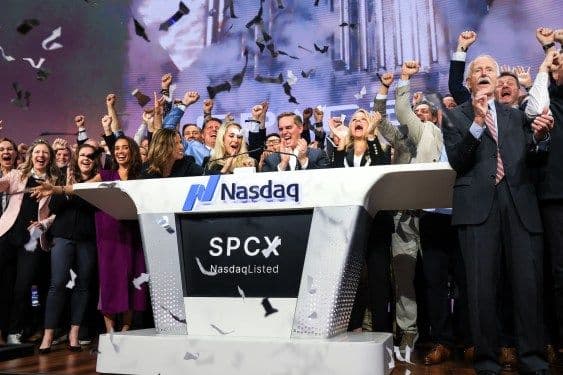
SpaceX went public this week inthe largest IPO ever, making CEO Elon Muskthe world’s first trillionaire. Despite its name, SpaceX has been emphasizing the potential ofits costly AI business, and competitorsOpenAIandAnthropicmay soon follow with their own public market debuts. So on the latest episode ofTechCrunch’s Equity podcast, Kirsten Korosec, Sean O’Kane, and I discussed what’s looking like a hot IPO summer. “We have SpaceX not only sucking up just a huge chunk of the money that’s available on public markets, but also really stress testing the limits of what a public company can be and how much it can be controlled by one single person,” Sean said. “My eye is really on these other tech companies that will go public and how much they will try to emulate.” Kirsten also noted that there are other startups trying to “ride that SpaceX IPO wave,” for example by raising money for orbital data centers after SpaceX helped to popularize the concept. “So there’s a ripple effect that’s happening throughout the market that I think is probably even more interesting than just the headline, ‘SpaceX makes Elon a trillionaire,’” she said. Keep reading for a preview of our conversation, edited for length and clarity. Anthony Ha:I want to zoom out a little bit from just the SpaceX IPO, because beyond the Elon Musk of it all, it’s the beginning of what could be a [series] of different IPOs for different AI companies. We’ve talked about Anthropic confidentially filing to go public, and now OpenAI has done the same. How excited are either of you about this? Kirsten Korosec:I want to start off by saying that I love Julie Bort’s story, which I think sums it up pretty nicely. It’s a great headline, so I’m gonna read it here: “It’s not FAANG anymore, it’s MANGOS.” FAANG being Facebook, which is now Meta; Amazon; Apple; Netflix; Google, now Alphabet. Now it’s shifted, and we’ve got Meta, Anthropic, NVIDIA, Google, OpenAI, SpaceX. [We’ve still got] massive tech companies, surely, but there is a shift here, right? First of all, we’ve got a bunch of AI labs in there, and that’s very different. Netflix gets booted out of there, a giant streaming service. And so to me, it’s an interesting shift in terms of public markets and the vast amount of money and capital available in the public markets shifting away from consumer [and] social networks and towards, specifically, AI labs and other, more innovative deeptech, such as SpaceX. So I think that’s the most interesting thing — aside from the fact that this summer is going to keep us all very busy as reporters, more than probably any other summer in a while. Sean O’Kane:You know, once upon a time I wanted to be a lawyer, and one of the reasons I didn’t was because I hated the paperwork that was going to be involved. And here I am looking forward to reading hundreds more pages of SEC filings this summer — talk about a beach read. It’s a moment we’ve been anticipating for a while. We’ve spent the last few years really wondering if the IPO market was going to quote-unquote “open back up” after a lot of consternation about private markets, and mockery about people reaching their like Series [whatever] fundraising round. This is a good stress test — I mean, “good,” take that word however you want — a good stress test of public markets in general. We have SpaceX not only sucking up just a huge chunk of the money that’s available on public markets, but also really stress testing the limits of what a public company can be and how much it can be controlled by one single person. My eye is really on these other tech companies that will go public and how much they will try to emulate. A thing that I keep saying and thinking about with SpaceX is, they’re really trying to take some of the most extreme aspects of Google and Meta’s original IPOs back in the early 2000s and mashing it up with that “We’ll lose money forever” with Amazon. And I’m curious how much Anthropic and OpenAI will try to do the same. Will they remake themselves in the image of SpaceX? Or will they try to put themselves in a different light? Anthony:One aspect that really got driven home as I was reading about the OpenAI IPO is also the extent to which some of this is also a bit of a race in terms of timing. I think we can confidently say at this point, SpaceX is first out the gate, which probably has some advantages and disadvantages. It’s also a bit of a different company because it’s billing itself as an AI company, but obviously has a bunch of other stuff going on, too. But there is a sense in which, at least according to some analysts, OpenAI and Anthropic may both want to go before the other one, because there’s only a finite amount of capital, a finite amount of interest. At some point some of these valuations have to start coming back down to Earth, and so they may both be scrambling to be first. Kirsten:I mean, there’s very much a race between Anthropic and OpenAI. You’re even seeing OpenAI talk about slashing prices, and they’re certainly going to be competing on the IPO calendar. But that is very short-term thinking. If they’re smart, they should be much more concerned about the long-term play here. To me, what’s really interesting is while Anthropic, OpenAI, and SpaceX all prepare for these moments, there are a host of other companies out there that are raising money on the backs of the success of companies like SpaceX, or going into SPACs. Just today, for instance, or as we’re recording this, a company calledQuantum Space is doing a SPACand absolutely trying to ride that SpaceX IPO wave. We’ve got a host of other startups that our reporter Tim Ferholz has reported on that are clearly — they’re not going to go public, right? But if SpaceX is successful with space data centers, they’re raising money off of that potential and they’re building businesses on that potential. So there’s a ripple effect that’s happening throughout the market that I think is probably even more interesting than just the headline, “SpaceX makes Elon a trillionaire.” Sean:The commonly accepted theory in Silicon Valley is that AI is remaking the economy, but because of itsuse. AI is actuallyalreadyremaking the economy — just because of how people are trying to build it. We have everything that you just described, we have these other companies rushing to public markets. And I think that’s a really good point to think about: Will they ever regret rushing to public markets? But we even have companies like Ford and General Motors who are pivoting their unused battery creation capacity to be energy providers for data centers. And Ford’s stock shot up when it announced what is honestlya pretty modest-looking energy storage business, in comparison to something like Tesla. And Tim De Chant had a really great series of stories this week aboutGM’s pivot, as well. The economy’s already being remade. Whether that’s durable, again, that’s the question, but it’s happening right now. Kirsten:That is actually a really good point, because to me, I want to say five, six, seven, eight years ago, there were all these headlines of “the next Tesla killer” and these automakers and other companies are still chasing trying to recreate all these various businesses, and specifically the strategies of Elon Musk-based businesses. They haven’t learned their lesson. I wish I could communicate this to all the automaker CEOs out there: I get it that you have a lot of unused batteries and you want to pivot to something else, but trying to model your business after Tesla or SpaceX and others, it doesn’t always work. Perhaps look elsewhere. Sean:So Ford shouldn’t get into space data centers. Is what you’re saying? Kirsten:No, they shouldn’t. But just watch. This is going to happen.
read more